
*View accurate shipping rates and availability






272 Items


Up to 70% off across the store, plus free towels and mirrors up for grabs on orders over $800*


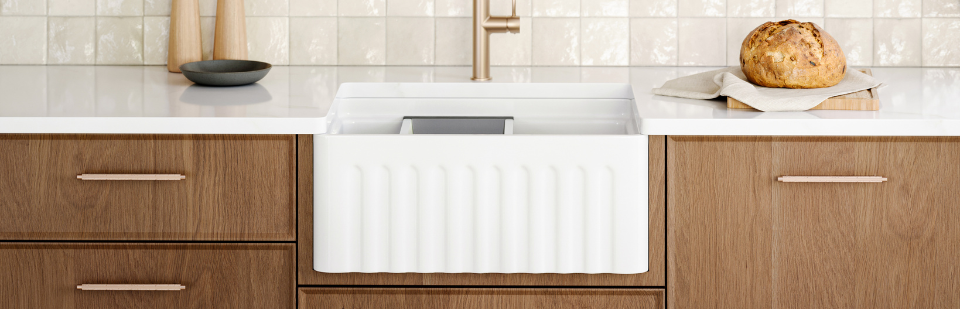


A gooseneck sink mixer is a kitchen tap with a tall, curved spout that arches over the sink like a swan's neck. One lever sets flow and temperature, and the spout swivels across the bowl. This page holds gooseneck mixers, also written goose neck, in chrome, matte black, brushed nickel, brushed brass, gold, gunmetal, bronze, stainless steel and white, including fixed spouts and gooseneck mixers with a pull out spray. The guide below sets out who a gooseneck suits, how to check the height and reach, and how to fit and look after one.
The defining feature is the spout: it rises from the base, curves over and points down into the sink. That arch gives the room under the spout to fill a tall pot, rinse a large tray or wash a big bowl without tilting it. The spout swivels, so you can sweep the water from one bowl to the other or clear it away when you work. Most goosenecks are fixed, with a plain aerated stream, and some add a pull out spray head for rinsing.
A gooseneck suits a deep single bowl, a household that cooks with large pots and trays, and a kitchen with a clear run above the tap. It also suits a farmhouse, Hamptons, industrial or modern kitchen where the tap is a visible feature. If you work with big stockpots, tall jugs or a kettle you fill at the sink, the extra height is a daily convenience. If you have a window sill, a low cabinet or a shallow sink, check the height before you choose, because a tall spout can hit the sill or splash.
A gooseneck has a tall fixed arch. A pull out mixer has a lower spout and a spray head on a hose that draws out toward you. Choose a gooseneck for height and a clean line. Choose a pull out for reach and rinsing, especially with a shallow or double sink. Many goosenecks now combine both, with an arched spout and a pull out spray, so you do not have to choose. For the pull out type, see pull out sink mixers, and for fixed spouts without a spray see sink mixers.
Check three measurements before you order: the height of the spout above the bench, the reach from the base to the spout, and the height under any overhead cabinet or window. Gooseneck spouts on this page stand from about 166mm to about 340mm above the bench, and their reach runs from about 160mm to 244mm. The water should land in the centre of the bowl, and a double bowl sink needs enough reach to cover both bowls with the swivel. Leave room to swing the spout without touching the wall, the window or a cabinet.
A tall spout drops the water from a greater height, which suits a deep bowl and splashes in a shallow one. In a shallow sink, choose the lower end of the height range, or a pull out mixer. An aerator mixes air into the stream and softens the fall, which reduces splashing and makes a lower flow feel fuller. Most of the gooseneck mixers here have an aerator, and you can unscrew it to clean it.
The sink decides the tap. A single deep bowl suits a tall arch that reaches the middle of the bowl. A double bowl sink needs a spout with enough reach and a swivel wide enough to cover both bowls. An undermount sink with a thick stone bench needs a tap with a long enough thread to grip the bench, and a farmhouse or apron sink often has a high back that suits a tall spout well. Measure the distance from the tap hole to the middle of the bowl and the height from the bench to the underside of the cabinet above, then compare them with the reach and height on the product page.
The same tall spout works in a laundry or a butler's pantry. In a laundry, the height lets you fill a bucket in the trough, and a swivel spout reaches across a wide tub. At a bar sink, a shorter gooseneck gives a neat look without crowding a small bowl. Check the spout height against the depth of the tub, because a very tall spout over a shallow trough will splash. If you want a spout without a mixer handle on the same body, ask your plumber about a separate wall mixer.
Most gooseneck mixers use a single lever on the side of the body, which sits in a natural place for your hand. Some use a paddle handle, which is flat and slim, and some use a progressive handle that starts on cold and warms as it lifts. Check the position of the handle against the splashback and the window, because a handle that cannot lift fully will not give full hot. A lever is the easier grip with wet or greasy hands, and for easier operation again, see accessible taps.
Almost all gooseneck mixers are hob mounted, which means the tap sits on the bench or the sink deck through a single hole, usually 35mm. Check the hole in your sink or bench, and the thickness of the bench, because the fixing needs enough thread to grip. A bench mounted tap needs space behind the sink for the handle swing, and a proper seal so water does not seep under the base. A few goosenecks are wall mounted, which keeps the bench clear and needs the plumbing run to the wall before tiling.
We recommend a solid brass or stainless steel body and a ceramic disc cartridge. A ceramic disc cartridge uses two ceramic plates to control the water, resists wear and shuts off cleanly for years. The cartridges here are mostly 25mm or 35mm, depending on the range, and the bodies are brass, lead-free brass, DZR brass or 304 stainless steel. The National Construction Code limits lead in plumbing products that touch drinking water to 0.25 percent from 1 May 2026, and many mixers here are lead-free. Check WaterMark approval on the product page, and use a licensed plumber to fit the tap.
WELS is the Australian water efficiency label, and more stars means the tap uses less water. The gooseneck mixers here carry 4, 5 or 6 stars, so compare the rating on the product page. Mains pressure gives you the most choice. Low pressure and gravity fed systems need a tap rated for it, and a plumber can check your pressure. Some mixers have a cold start position, which sends cold water only when the lever sits in the centre, so a quick rinse does not fire up the hot water system.
A kitchen tap is touched with wet, greasy hands all day, so the finish matters. Brushed finishes hide fingerprints and water spots better than polished chrome or flat black. The finish process differs by colour: chrome and matte black are mostly electroplated, while brushed nickel, brushed gold, brushed brass, gunmetal and bronze are mostly PVD, which bonds the colour to the metal and resists scratching and tarnish.
Keep the tap, the sink and the cabinet handles in one finish, or in a deliberate pair, and limit a room to two finishes with one leading.
Wipe the tap with a soft microfibre cloth and warm water after use, and clean it weekly with a mild detergent. Dry it so water does not set on the surface. Avoid bleach, harsh sprays, abrasive pads and scourers. Pay attention to the curve of the spout, where limescale can build at the aerator, and unscrew and soak the aerator now and then, in hard water areas especially. If the mixer starts to drip at the spout, a new cartridge is the usual fix.
The hole matters more than the style. Keep the existing layout where you can: a mixer replaces a mixer in the same hole. Look under the sink at the supply hoses and the shut-off valves before you order, because old valves can seize, and check that nothing in the cabinet blocks the hoses. A gooseneck is taller than most old taps, so check the clearance above it before you commit. A like-for-like swap is among the quicker kitchen jobs, and a licensed plumber should make the water connections.
The contents depend on the tap. A gooseneck sink mixer comes with the mixer, installation instructions and a fixing kit, and many include flexible hoses. Some come with a spare cartridge, an aerator spanner or a stabiliser. A pull out gooseneck also comes with the hose, the spray head and a counterweight. Read the product page for the exact list before you order.
The gooseneck mixers on this page include Nero taps, Phoenix taps, Meir taps, Greens tapware, Caroma taps, Modern National tapware, Fienza taps and Clark taps. Staying with one brand and range keeps the handle and finish consistent with the rest of the kitchen. For a hands free option see sensor taps, and for easy grip levers see accessible taps.


