
*View accurate shipping rates and availability






2 Items
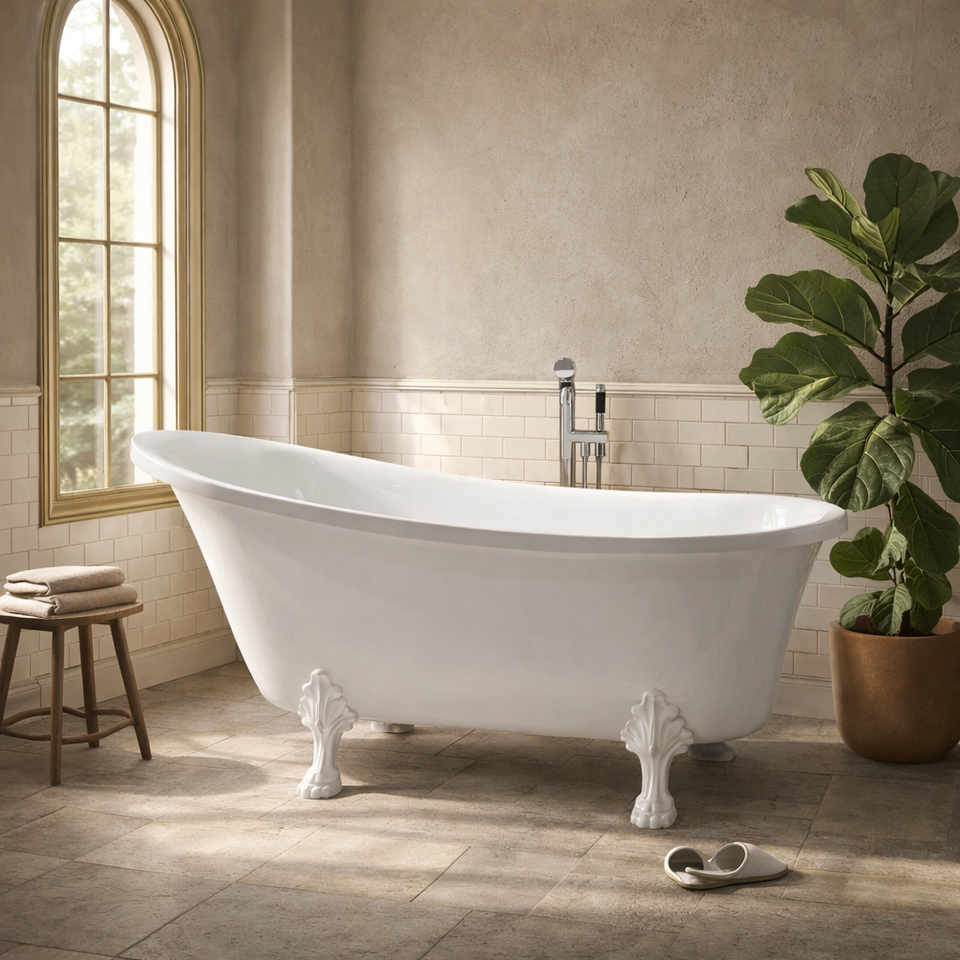

A claw foot bath is a freestanding bath that stands on four feet instead of a plinth or a solid base. The look is traditional: a rolled rim, a long curved body and feet that lift the bath off the floor. The baths on this page are two Fienza claw foot baths in a slipper shape with a roll-top edge, in gloss white acrylic, each in 1500mm and 1700mm lengths. They differ only in the feet, which are semi-gloss white on one and matte black on the other. Claw foot bath, clawfoot bath, claw bath, footed bathtub and bath on feet all describe the same search. This guide covers what a claw foot bath is, what the feet and shape change, how the acrylic compares with cast iron, and what to plan around the bath before you order.
The claw foot is a design that began with carved legs on European furniture and moved to baths in the 1800s, when bathing became fashionable. Built-in baths replaced it through the twentieth century, and it has since come back. In Australia it is closely tied to Victorian, Federation and Edwardian homes, where a bath on feet was the usual fitting, so it suits a period renovation, a cottage bathroom or a modern room that wants one traditional piece. Because the bath stands clear of the walls, the floor stays visible beneath it and the bath reads as furniture and not as a fixture.
Both baths are made from Lucite PMMA acrylic, which is sanitary grade and UV stabilised, so the white does not yellow over time. The shell has an inbuilt steel support frame with adjustable steel legs, which lets the bath be levelled on a floor that is slightly out of true. Each bath includes a chrome overflow and a chrome waste, so the fittings are in the box. The shape is a traditional slipper with a roll-top edge, and the finish is gloss white. The two versions are identical in the shell and the sizes, and the only choice is the colour of the feet.
Semi-gloss white feet keep the bath all white and soft. The bath, the feet and the floor read as one pale shape, which suits a light, traditional or coastal room. Matte black feet draw a line under the bath and give it a graphic edge, which suits a room with black tapware, black window frames or a dark floor. Feet are a visible part of a claw foot bath, so match them to the tapware finish and to the other black or white fittings in the room. The black baths page shows the other ways to bring black into a bathroom, and white baths covers the whites.
Claw feet come in several styles in general. The ball and claw is the common one, and variations include the eagle claw, with talons gripping a ball, and the lion paw, which may grip a ball or stand flat on the floor. On the Fienza baths the choice is the colour of the feet.
Claw foot baths come in a few shapes. A roll-top has a rounded, folded-over rim all round. A flat-rim bath has one rounded end and one flat end that sits against a wall. A double-ended bath has both ends rounded and suits the middle of a room. A slipper has one end raised so the bather reclines, and a double slipper has both ends raised. The Fienza baths are slipper-shape with a roll-top edge, so they combine the raised end with the rolled rim. For the shape in detail, see slipper baths.
The traditional claw foot bath is cast iron with a porcelain lining. Cast iron is heavy and holds heat very well, and it needs a reinforced floor. A modern claw foot bath in acrylic is lighter and much easier to install, and the floor load is far lower. These two are acrylic. The Lucite PMMA used here has a crisp, clean finish, the white stays white, and the baths are easy to move into a room and to level. If you want the look of a claw foot bath without the weight and the floor works of cast iron, acrylic is the practical choice. For the material in general, see acrylic bathtubs.
Each bath comes in two lengths and two foot colours, which makes four versions. The bath itself is the same in every one.
| Length | Feet | Bath finish | Included |
|---|---|---|---|
| 1500mm | Semi-gloss white | Gloss white acrylic | Chrome overflow and chrome waste |
| 1500mm | Matte black | Gloss white acrylic | Chrome overflow and chrome waste |
| 1700mm | Semi-gloss white | Gloss white acrylic | Chrome overflow and chrome waste |
| 1700mm | Matte black | Gloss white acrylic | Chrome overflow and chrome waste |
Because the shell, the frame and the fittings are the same, you can choose the length for the room and the feet for the style without trading one against the other.
A slipper-shape bath has one end raised, so the raised end supports the back and the neck and lets the bather recline for a long soak. The roll-top edge gives a smooth, rounded rim to rest against, and the depth suits a long soak. A bath on feet also sits a little higher than a built-in one, so check the height on the product page if you have a low window or a sloping ceiling near the bath.
The 1500mm bath is the compact size. It works in a room with a wall of about 1650mm or longer, and it suits a smaller bathroom or a bather who prefers a shorter, more upright soak. The 1700mm bath is the larger size and generally needs a wall of at least 1800mm, and it is the safer choice for a taller bather. Both sit in the standard bath range of 1500mm to 1700mm. The length pages group each size across every maker: 1500mm baths and 1700mm baths. Measure the wall, the door swing and the route into the room before you decide.
Freestanding baths generally have no tap holes, so the tapware is a separate and important choice. There are two ways to do it. A floor mounted mixer or spout stands beside the bath and brings its pipes up through the floor. A wall mounted set suits a bath placed fairly close to a wall and brings its pipes through the wall behind. Decide which before the plumber roughs in, because the pipes are inside the floor or the wall once the room is finished. The freestanding bath mixers collection lists the floor mounted options. Match the finish to the feet: chrome suits white feet, and a black or brushed finish suits black feet.
Both baths come with a chrome overflow and a chrome waste, so there is nothing to add to complete the bath. Australian building codes require a fully removable bath waste in some situations, so confirm with your plumber before you order. If you want a waste in another finish to match your tapware, the bath wastes collection has the options.
A claw foot bath looks best where it can be seen from more than one side. In a larger room it can stand in the centre or under a window, with clearance all round for cleaning and for stepping in. In a smaller room it can sit along one wall, and wall mounted tapware keeps the pipework tidy. Leave room around the exposed sides, because the open base lets you clean the floor beneath the bath, and keep the waste position in mind when you set the bath on the floor. For the type across every maker, see freestanding baths.
People often search for a claw foot bath with a shower. A freestanding bath stands away from the walls, so a fixed screen is hard to fit, and the usual answer is a handheld shower on the mixer or a separate shower. If you want a full shower over the bath, a back to wall or inset bath is the better base, because the wall behind the bath holds the screen. Back to wall baths and shower baths cover those options.
Acrylic baths are light, and the adjustable legs and inbuilt frame carry the weight to the floor through four feet. Water adds roughly 1kg per litre, and a bather adds more, so the floor still needs to be sound and level, especially on a timber floor. The adjustable legs correct a slight slope, and they do not replace a floor that is weak. Check the route into the room too, since a bath of 1700mm may not clear a standard 820mm doorway when it is carried upright.
Rinse the bath after each use and wipe it with a soft sponge or microfibre cloth and a pH neutral cleaner. Keep abrasive powders, steel wool and strong solvents away from the acrylic. Wipe the feet and the floor around them as well, since the open base is the part of a claw foot bath that a built-in bath does not have.
Start with the room and the wall, then the length. Choose the feet to match the tapware and the other fittings, and decide whether the bath will stand in the centre of the room or against a wall. Then plan the tapware and confirm the floor. For the other Fienza baths, see Fienza baths, and for the full range of baths from every maker, bathtubs.


