
*View accurate shipping rates and availability






3 Items


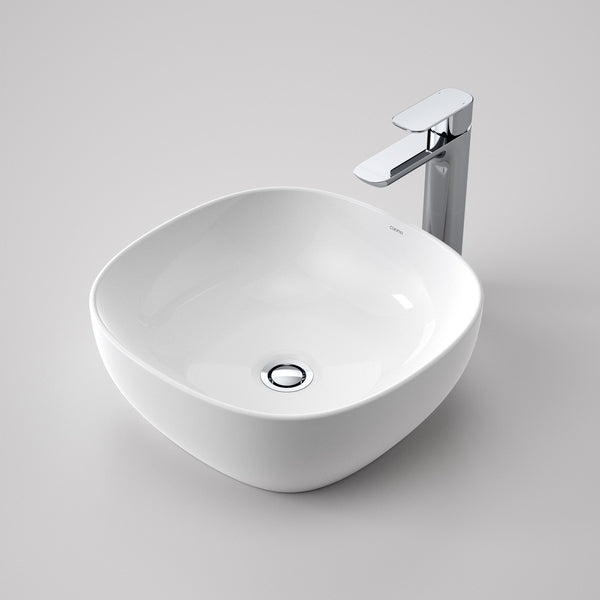
The Caroma Artisan above counter basins are white ceramic basins with a thin rim and softly rounded corners, made to sit on top of the bench. This page holds three shapes: a 600mm rectangle, a 390mm square and a 400mm curved square. All three have no tap hole, no overflow, and a white plug with a chrome flush-fitting waste in the box. The guide below covers the range name and what retailers call it, and what is and is not known about each model. It then explains how the waste and the bench cut-out work, which taps suit a basin with no tap hole, the heights to plan around, and how to clean the basin. Every fact below names its source: a listing, a maker guide or a retailer page, and conflicts between sources are stated.
The listings here call the range Artisan. Retailer pages for Caroma above counter basins use a second name for the same family. A trade supplier lists a round 405mm basin as a Tribute Artisan basin, with the specification style given as Artisan. Caroma's own product page for the oval 510mm uses the Tribute name, as do retailer pages for the curved square 400 and the rectangle 600. A search result for the range also shows Caroma's catalogue path using Artisan and the page title using Tribute. In practice the two names point at one family of above counter basins, so a search for Caroma Tribute basins and a search for Caroma Artisan basins land in the same place. See Caroma Tribute basins for the pages that carry the Tribute name.
The listings describe the range as influenced by European trends, with a thinner rim and a variety of shapes and sizes. A maker's technical guide for the round Tribute basin calls the range fresh and simple in Nordic style design, and says the basins suit general purpose, domestic and commercial applications. For the rest of the brand, see Caroma basins.
The listings give the shape and the finish and do not give sizes, capacities or weights, so the numbers below come from retailer pages and a search result, each named.
The Rectangle 600mm is described in its listing as a rectangle with softly rounded corners that frees the space under the bench. A retailer lists its bowl capacity as 17.5 litres, with no tap hole and no overflow. A search result for a retailer page that would not open gives the size as 600mm wide, 410mm deep and 150mm high. It is the largest basin on the page by a wide margin, and its capacity is more than double that of the other two.
The Square 390mm is described as a square with softly rounded corners that suits small bathrooms or powder rooms. A retailer listing for the square 390mm gives a bowl capacity of 10.3 litres, though the excerpt showed neither the product code nor the depth, so that figure is unconfirmed for this exact model. The Curved Square 400mm is described as a solution for small bathrooms or powder rooms where space is at a premium. A retailer lists it at 8.3 litres, with no tap hole and no overflow, in vitreous china with a thin rim, and does not give its dimensions.
That leaves gaps. No confirmed depth or height exists in the sources for the square or the curved square, and the TBS listings omit them. If a dimension decides the choice, such as the bench depth behind the basin or the tap clearance, ask for the specification sheet before you order and do not assume it from the model name. See rectangular basins, square basins and small basins to compare across makers.
Three other Artisan or Tribute basins help to show the scale of the family, and they are not on this page. The round 405mm is listed by retailers at 405mm by 405mm and 140mm high, with a bowl capacity of 8.3 litres and a weight of 8.6kg. The oval 510mm is listed on Caroma's page at 10.5 litres. A curved rectangle in the range is listed at 10 litres and 11.4kg. These show that the family runs from about 8 litres in the compact shapes to about 17.5 litres in the 600mm rectangle, and that the only two weights on record are 8.6kg and 11.4kg. A trade supplier's page for the round basin also says a two-person lift may be required and the product is fragile.
None of the three basins has a tap hole. The tap goes on the wall or on the bench behind or beside the basin. A maker's installation note for a counter basin gives two rules. If wall-mounted tapware is used, consider the length of the outlet and the position of the basin on the bench top. If tapware is bench-mounted, allow enough top width for fitting it. A stockist guide says an above counter basin pairs best with wall taps or an extended basin mixer because of its height, and says to plan wall tap positions at rough-in to avoid costly plumbing mistakes.
Caroma's page for the oval Tribute basin says it is marketed as paired with Caroma Luna tapware, which is not included. Two tall mixers on the store give figures, which you can check against a basin: the Kaya Tall has a spout height of 216mm and a reach of 170mm, and the Empire Slim Tall has a spout height of 244mm and a reach of 180mm. The reach has to get the water to the drain, and for the square 390mm basin the centre of the bowl is about 195mm from the edge if the drain is central. The listings do not give the drain position, so measure it on the basin you receive. See basin mixers.
All three basins have no overflow, and the listings say each comes with a white plug and a chrome flush-fitting waste. A maker's technical guide for the round Tribute basin says the basin is designed for the Caroma waste outlet, which suits a 40mm trap connection. It says a chrome flush-fitting waste and white plug are supplied, and that other waste options are available, including an anti-vandal flush-fitting chrome waste and a chrome grate waste. That guide covers the round basin, not the three on this page, so treat it as the range's approach and confirm the details on your own basin's sheet.
With no overflow slot, the basin has nowhere to send water if the plug is in and the tap is left running, so turn the tap off before the bowl fills. If you want a waste in a different finish, the range's chrome waste is the supplied one, and a different finish means a different waste, which you should check for fit before you buy it. See basin wastes.
An above counter basin sits on the bench, so the bench needs a hole for the waste and the basin needs to be sealed to the top. The steps below come from maker guides, and the guides differ on sealant.
Another maker's guide for above counter basins says the opposite about how much sealant to use. It says to apply 20mm silicone dots to hold the basin in place, limited to three fixing points so the basin can be removed later. It says not to apply a full bed of silicone to the bench. It names non-acidic silicone for the other basin types in its guide. A third guide names neutral cure, mildew-resistant silicone for its own basin. These are for different basins, so follow the guide that comes with yours. For the Artisan basins, the technical guide for the round basin is the best guide to the range and it says acetic cured silicone, which matches the Caroma guidance.
The installation PDFs linked from the three listings are image files with no readable text, so the steps above are the range's published method and not a quote from those three sheets. The round guide also says all dimensions are subject to normal manufacturing variations. A trade guide for another vitreous china basin says to test-fit on site because the size varies, particularly with stone benchtops, so have the basin in hand before the bench is cut.
The basin adds its own height to the bench. A basin guide from a stockist gives a floor-mounted vanity at 850 to 900mm and a wall-hung vanity at 800 to 900mm, with a vanity depth of 460 to 550mm and an accessible rim at 800 to 830mm. A UK guide gives 800 to 850mm to the rim as a starting point. The rim figure is to the top of the basin, and the vanity figures are to the bench, so subtract the basin height from the rim figure when you choose the bench.
The only height tied to the range is 140mm, for the round 405. On an 850mm bench that would put a 140mm basin rim at 990mm, which is higher than the rim guides give. The listings for these three models give no height, so the sum cannot be done for them. Ask for the height, subtract it from the rim you want, and set the bench from that. For depth, the 600mm rectangle is reported at 410mm deep, which against a vanity depth of 460 to 550mm leaves 50 to 140mm behind a basin set at the front edge, so check that a bench-mounted tap fits there or choose a wall tap.
The listings say the above counter design maximises under bench storage, and that is the practical reason to choose it over a basin set into the bench. The bench below the basin stays clear, so a drawer or shelf can use the full width. For small bathrooms and powder rooms, the listings point to the square 390mm and the curved square 400mm, which are the two small shapes. A stockist guide says compact above counter basins suit powder rooms and ensuites, and a trade page for the round 405 calls the size right for a small bathroom or powder room.
The range is not rated for accessible bathrooms on the pages. The round and the oval pages say it is not suitable for assisted living or not AS1428.1 accessible, but no such line appears for these three, so do not assume. If you need an accessible rim height, the stockist guide gives 800 to 830mm and a circulation space of 900 by 1200mm. See above counter basins for the type.
The Artisan basins are above counter, and it helps to see what that choice gives and costs against the others. Retailer guides say an inset basin is simple to install and easy to clean, though its rim can catch debris. They say a semi-recessed basin gives the full bowl depth without needing a deep vanity, and an under counter basin gives the cleanest bench line but needs a stone or solid surface top. These are retailer-level statements and none gives a source, so treat them as directions to check and not as tested facts.
For an above counter basin, the cut-out is only the waste hole, so the bench can be any material the basin can be sealed to, and the whole bowl stands above it. The cost is the added rim height covered above and a wider gap between the tap and the bowl. If you want to compare against the other types, see inset basins, semi-recessed basins and undermount basins.
A trade supplier's page for the round basin says to clean with a mild household detergent or warm soapy water on a soft cloth. A counter basin installation guide says to use soapy water or approved cleaners and not abrasive materials. A care sheet for vitreous china says that for day-to-day care all you need is water and a damp cloth. It says a proprietary bathroom cleaner removes water marks, grease and soap scum. It says household vinegar removes limescale, with a vinegar-soaked piece of kitchen paper left on stubborn deposits for 30 minutes.
The same sheet warns about substances containing fluoride, such as rust removers and toothpaste, because deposits left on the surface can stain it. It says cream cleaners can dull the surface if overused and should be tested on a hidden area first. It gives bicarbonate of soda with white vinegar as a greener option, rinsed well so the rubber seals in the waste are not damaged. It says not to use harsh chemicals such as Domestos, which can destroy the chrome and the rubber seals in the waste, and never to mix cleaning products. See ceramic basins and white basins for more white ceramic.
Choose the 600mm rectangle if you want a large bowl on a long bench with the storage kept clear beneath. Choose the 390mm square or the 400mm curved square if the bench is short or the room is small. Then confirm the dimensions you need, because the listings do not give them.
After the shape, decide the tap, because there is no hole. A wall tap keeps the bench clear, and a tall mixer needs the bench width behind the basin. Choose the waste only if you want a finish other than the chrome one in the box. Last, test-fit the basin on site before the bench is cut. That order puts the decisions that are easy to change first and the cut last. For a vanity to carry the basin, see bathroom vanities, and for other basin types, bathroom basins.
The sources leave some gaps. The TBS listings for the three basins give no dimensions, capacities or weights, and the three installation PDFs have no readable text. Two Caroma pages and one large retailer page blocked the fetch, so the rectangle's size comes from a search result and not from the page. The capacity of the square 390mm is from an excerpt that did not show its product code. The guides for sealant disagree between makers, and the technical guide is for the round basin and not for these three. No independent review of this range turned up.


