
*View accurate shipping rates and availability






296 Items


Up to 70% off across the store, plus free towels and mirrors up for grabs on orders over $800*


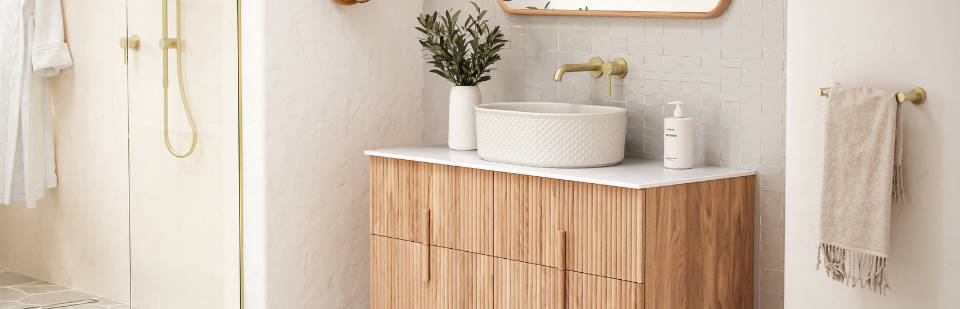


A shower rail is a vertical bar fixed to the shower wall, with a hand shower on a slider that moves up and down it. The hand shower also lifts out of the holder, so one unit does two jobs. It sits at head height for a normal shower, and it comes off the bar for rinsing the recess, washing children or cleaning. Shower rail, rail shower and shower rail set all mean the same thing, and this page covers all three.
A rail takes the place of a fixed head. If you want the fixed head on its own, see shower roses. If you want a hand shower without a bar, see hand held shower heads. The full range sits in showers.
Adjustability is the reason. You change the height and the angle, so one shower suits people of different heights, which is why a rail is popular in family bathrooms. The detachable handset gives more control for cleaning and for children. A rail suits compact bathrooms and ensuites, households with a mix of heights and young children, and it has fewer components to wipe down than a twin shower.
The trade-off is the overhead feel. A rail on its own is not built to give a wide rainfall effect. If you want that, choose a rail set that includes an overhead rose, or add a fixed overhead head beside a plain rail. A plain rail suits you if you want flexibility and a simple look, and a rail with an overhead suits you if you want both.
For Phoenix rails in one place, see Phoenix shower rails. For a gooseneck rail with an overhead head, see Meir twin rail showers.
The two are often confused, and they solve different problems. A rail's main feature is the adjustable hand shower, and the overhead head is generally not the point. A twin shower combines a fixed overhead with a separate handheld, and there the overhead is the main feature. A rail is the better fit for a small bathroom. A twin shower depends on the size and layout of the shower. A rail is simple and streamlined, and a twin shower is more substantial. It also has more components, so there are more surfaces to clean.
A rail suits compact bathrooms and ensuites, people of different heights, regular handheld use and young children. A twin shower suits people who want overhead comfort plus handheld flexibility, and it fits larger family bathrooms, walk-in showers and master ensuites. Both work in family bathrooms. If you want a rail and an overhead and you have the room, a rail set with an overhead rose sits between the two.
A rail does not replace the mixer. A mixer or assembly taps is still needed to run a rail set, so pair the rail with a bath shower mixer and check that it suits your existing tapware. A full rail set with its own diverter does not need a separate diverter, but you still need the mixer. If the rail comes without an overhead rose, the mixer feeds the hand shower directly. See shower mixers for the controls.
The top of the rail is typically set at about 1800 to 1900 mm above the floor, and the hand shower slides down from there to suit each user. The bottom of the rail sits at about 1000 to 1100 mm, and the holder moves up to about 1800 mm.
If an overhead rose is part of the set, treat it as a fixed head. Set it at 2000 to 2100 mm to the centre of the outlet, and 2100 to 2200 mm for households with anyone over 190 cm. The outlet position in the wall sets these heights, so confirm them at rough-in, before tiling.
A rail is fixed to the wall at two points, a top bracket and a bottom bracket, and the distance between those fixing points is part of the specification. It varies by model: 550 mm on one Phoenix twin shower and 650 mm on one Meir rail, for example, and the Nero Mecca Care set carries a 900 mm rail that can be shortened during installation. Check the figure against the wall before you buy, and against the existing holes if you are replacing a rail.
The job follows a set order on most wall rails. Fix the position first. Find the centre of the mixer or valve and make a light pencil mark on the tile. Then use a large spirit level to mark where the top of the rail will sit and the centre of each bracket. Before you drill, scan the area with a detector for hidden pipes and cables.
Screw the bracket to the wall and check it is level. Then slide the rail into the bracket and tighten the bracket screw with an Allen key. Wrap masking tape around nuts before a spanner goes on them so the finish is not marked. Place a washer in each end of the flexible hose, hand-tighten the hand shower to one end and the valve to the other, and run the water for about a minute to flush debris. Then check every joint for drips.
Two cautions apply to any rail. Leave enough slack in the hose for the hand shower to work at both ends of the rail, and make sure the hose is not under tension when the slider is at its highest point. The water connection itself is plumbing work, so a like-for-like swap is a small job, and anything that changes the outlets needs a licensed plumber. Choose a long adjustable rail so different users can reach the hand shower at about 1830 to 1980 mm.
Most rail sets here come with a 1.5 m hose, which gives the hand shower enough reach to rinse the recess. A 1.5 m hose suits most bathrooms, and 2 m suits larger showers, unusually high outlets and bath and shower combinations. Choose a hose that resists kinking and corrosion, and look for stainless steel or reinforced PVC.
Most rails here are rated for an operating pressure of 150 to 500 kPa, a WELS rating from 3 to 5 star, and flow rates from about 6 to 9 litres a minute across the range. The WELS flows are 9 litres a minute at 3 star, 7.5 at 4 star and 6 at 5 star, so a higher star rating means a lower flow. Rail showers come for both high and low pressure supplies, some with pressure-boosting, so check your own supply first. A simple test: if a 10 litre bucket fills from the shower outlet in under 60 seconds, the pressure is good. A hand shower does not reduce pressure by design. A drop after a swap comes from a flow restrictor, a kinked hose or a lower WELS rating than the old head.
Set the slider at the height of whoever is showering, then lift the hand shower out only when you need it. For a child, slide the holder down so the spray lands below their face and they can reach the handset themselves. For an adult, set it so the spray starts above the shoulders. A tall user needs the full height of the bar, so check the rail length against the wall before you buy.
Rails come in chrome, brushed nickel, black, gold, brass, gunmetal, bronze, champagne and white, and in brass, stainless steel and 316 grade stainless steel. The finish rule is short. Chrome suits clean contemporary bathrooms, polished brass suits traditional and transitional styles, and black is a bold focal point. Match the rail to the mixer and the other fittings in the shower, and see the finish pages for a closer look: chrome showers, black showers, brushed nickel showers, gold showers and gunmetal showers.
Wipe the hand shower and the rail after use. Limescale on the hand shower nozzles is the usual cause of weak or uneven spray. Soak the hand shower in warm water with a few drops of mild dishwashing liquid for 30 to 60 minutes, scrub the nozzles with a soft toothbrush, then rinse and dry. Soft silicone nozzles can be rubbed with a finger. Use a wooden toothpick for a single blocked hole, and never a metal needle.
If you only need part of the answer, the neighbouring collections cover it.
Brand ranges that carry rails: Phoenix showers, Nero showers, Meir showers, Caroma showers and Fienza showers.


