
*View accurate shipping rates and availability






46 Items


Up to 70% off across the store, plus free towels and mirrors up for grabs on orders over $800*


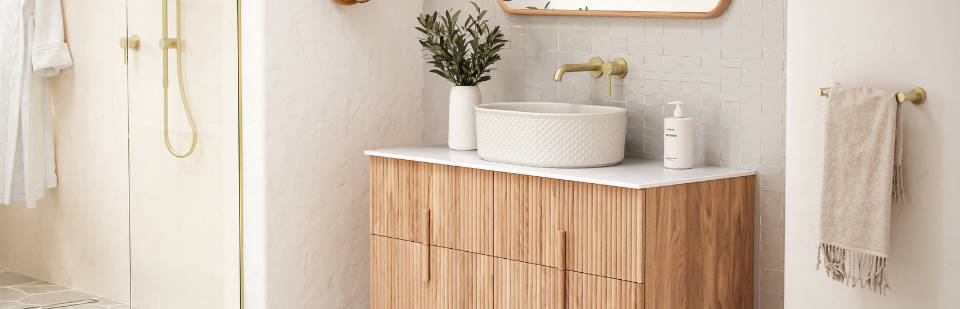


Champagne tapware is a pale, warm metal finish that sits between brushed gold, brushed brass and bronze. This page holds champagne taps and mixers for the basin, the shower, the bath and the kitchen sink, from Meir and Modern National, in hob mounted, wall mounted and floor mounted styles. The guide below explains what the finish looks like, how it compares with gold, brass and bronze, which tap types come in it, how to match it through the room, and how to clean it.
Champagne is a soft, light gold with a faint pink or grey cast, much like the drink it is named after. It is paler and quieter than a bright gold and warmer than nickel. Most champagne tapware is brushed, with fine grain lines in the metal, and the brushing gives the surface a satin look with no mirror shine. That keeps fingerprints and water spots less visible than on a polished surface.
The finish is usually a coating bonded to the brass body, so the colour is a layer on the metal, not the colour of the metal itself. The brush marks are fine and even, and they run in one direction. That direction matters for cleaning, and it is covered below. If you want a bolder warm metal, see gold taps, brushed brass taps and bronze taps.
The four warm finishes are close, and the difference is in the depth of the colour. Brushed gold is the brightest and most yellow. Brushed brass is a little deeper and more golden brown. Champagne is the lightest and the softest, with the least yellow in it. Bronze is the darkest, a brown tone with a coppery warmth. Brass and gold both look more traditional, and champagne looks more modern and calm.
Champagne suits a bathroom or a kitchen where you want warmth without a strong metallic statement. It sits well with white and cream tiles, light timber, warm stone and pale benchtops, and it works with a grey or greige palette where bright gold looks too loud. Against a dark tile or a black vanity, a deeper gold or a bronze will stand out more clearly, so look at the finish against your own surfaces before you decide.
Champagne is offered across the main tap types. The basin mixer is the most common, in standard and tall versions, with the tall mixers made for bowl basins. See basin mixers. Shower and bath mixers come in champagne as wall mixers and as bath sets, with diverters on some models. See shower mixers and bath fillers. A freestanding bath mixer on a floor mounted stand is part of the range, and see freestanding bath mixers.
In the kitchen, champagne is available as a gooseneck sink mixer and as a pull out sink mixer, with a retractable head on some models. See sink mixers, gooseneck sink mixers and pull out sink mixers. There are also spouts for the basin, the bath, the kitchen and the laundry, a hob mixer, a pot filler and a stop tap. See hob mixers and pot filler taps.
Most of the champagne tapware here is Meir. The Meir Round range has a plain, round body, and the Paddle and Pinless ranges use a different lever. Piccola is a compact version, Squareline has a squared outlet and the Star Mini is a small, low basin mixer. See Meir Round, Meir Paddle, Meir Pinless and Meir taps. For the wider Meir champagne group, see Meir champagne.
A small group is from Modern National, who make a traditional range. See Modern National tapware. The shapes differ between the two makers, and so do the exact tones of champagne, so keep the whole room to one maker where you can.
The finish only looks right when the metals in the room agree with each other. Tapware, a shower rail, a basin waste, a towel rail, cabinet handles and a toilet roll holder are all seen together, so choose them as a set. Champagne from one maker is close to champagne from another, but it is not the same, and the difference shows in daylight. If the pieces are from two makers, place them next to each other in daylight before you order, and keep them apart in the room if the tones differ.
Many people choose champagne for the whole bathroom for that reason. See champagne finishes, champagne showers and champagne bathroom accessories for the matching pieces. A tap in a bathroom with brushed brass handles, or a kitchen with nickel handles, will look mixed, so keep the warm metals together.
Most of the champagne taps here have a brass body, and a few are lead free brass. A tap that supplies water for the basin and the kitchen sink is in contact with water you drink and cook with, so lead free brass is the better choice where it is offered. A small number of the products are stainless steel. Check the material and the compliance marks on the model you choose.
Hob mounted taps stand on the basin, the bench or the sink, through a hole in the surface. Wall mounted taps are fixed to the wall, with the pipes inside, and the position has to be settled before the tiles go on. Floor mounted taps stand beside a freestanding bath, with the pipes coming up through the floor. Check the mounting for the model you choose, against the basin, the bath or the sink it will go with.
For a basin, count the tap holes and check that the mixer suits them. For a kitchen sink, check the height of the spout against the window and the cabinet above it. For a bath, check the reach of the spout so it lands the water in the middle of the bath. These checks are the same in every finish, and they are worth doing before the order goes in.
In a bathroom, champagne works best when the taps are the main metal in the room. A basin mixer, a shower mixer and a bath filler in the same tone give the room a clear, calm finish, and the soft colour does not compete with tile pattern. In a small bathroom the pale tone also keeps the fittings from looking heavy against the wall.
In a kitchen, a champagne sink mixer is a visible piece, because the sink is a focal point. A gooseneck or pull out mixer in champagne suits a pale benchtop, a timber island or a white splashback. If the sink is stainless steel, the tap stands out as a warm accent, and if the sink is black or a dark composite, the pale tap shows up clearly. Choose a pull out where the sink is deep, and a gooseneck where you fill tall pots.
Taps sold in Australia carry a WELS rating for water efficiency, and it differs between models. Check the rating for the exact tap, since a higher star rating means less water is used in the same time. A shower mixer and a basin mixer do not need a large flow to feel comfortable, and an aerator in the spout mixes air into the stream, so it feels full and splashes less. A bath filler is the exception, because a bath fills faster from a wide outlet, provided the supply pressure can feed it.
Wipe the tap with a soft microfibre cloth, warm water and a mild detergent, and dry it with a soft cloth. Wipe along the brush marks, in the direction of the grain, to keep the brushed look. Do not use abrasive pads, steel wool, scourers or rough brushes, because they scratch the coating. Do not use multi-purpose or bathroom cleaners, bleach or oven cleaners on a brushed coloured finish, because they can mark or dull it.
Hard water and salt can leave marks if they are left to dry, so wipe the tap down after use in the shower and the basin, particularly in coastal areas. For limescale at the spout, use a cleaner that is made for coloured tapware, and rinse it off straight away. A drop of mild detergent on a soft cloth is enough for daily care, and a regular wipe is better than an occasional strong clean.
Plumbing work has to be done by a licensed plumber, and the installation sheet that comes with the tap is the reference for the connection and the fixings. Handle the tap with clean hands or gloves during fitting, because tools and pipe grease can mark a brushed finish. Ask the plumber not to use pliers on the visible body, and to protect the surface with a cloth where a tool has to grip.
A mixer has a cartridge inside the body, and the cartridge is the part that wears. If the lever becomes stiff, if the tap drips when it is shut, or if the temperature is hard to control, the cartridge is the first thing to check. A plumber can replace it, and will match it to the model, so have the range name and the finish ready.
For the full range of taps in every finish, start at taps. For the other warm metals, see gold taps and bronze taps. For the basin and shower taps from any brand, see bathroom taps and mixers.


