
*View accurate shipping rates and availability






2 Items
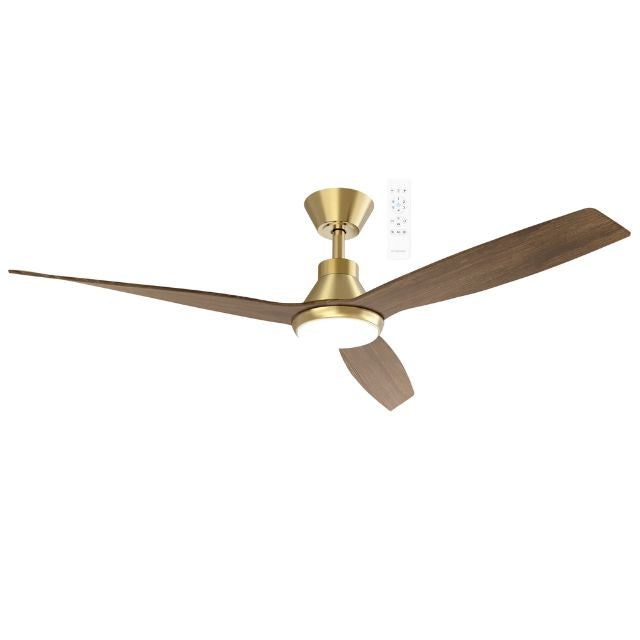

A brass ceiling fan has a warm gold-brown metal finish on the body, and it is chosen as much for how it looks as for how it moves air. People searching for brass fans usually want to know what the finish looks like, whether it comes with a light, and how it suits a period, retro or modern room. This collection holds the Martec Triumph, a 1320mm DC fan. The finish is antique bronze with walnut blades, and the product is filed under the brass and gold colour tags, so this guide explains the finish names, then gives the specification, the size and ceiling advice, and installation and care.
On a fan, brass is a finish on a steel body, not solid brass metal. Finish names vary between makers, so the same name can look different from one fan to the next. Finishing pages written for hardware describe three common versions. Polished brass is bright and reflective, usually sealed with lacquer, and shows fingerprints. Brushed or satin brass has a fine grain that softens reflections and hides marks. Antique brass is a darker brown-gold with an aged look, usually made by a patina or oxidising treatment and then often sealed with lacquer, and it is not always solid brass. These are general finishing guides, not fan guides, so use a photo of the fan itself as the real reference.
Lacquered brass needs little care because the coating slows tarnishing, but if the lacquer is damaged the metal beneath can darken unevenly. Unlacquered brass reacts with air and handling and develops a patina, and it needs polishing to stay bright. A magnet that sticks to a brass-look piece suggests steel with a brass plating. The Triumph has a steel body and canopy with ABS blades, so treat it as a coated finish and avoid abrasive cleaners that could strip it.
The Triumph has its own page at Martec Triumph ceiling fans. For other warm metal finishes see bronze ceiling fans and brushed nickel ceiling fans.
A 52 inch (132cm) fan is the standard size, 48 inch (122cm) suits smaller rooms and over 54 inch (137cm) suits larger square rooms of about 5 by 5 metres or more. By floor area, 6 to 12 square metres pairs with a 48 to 52 inch fan and 12 to 20 square metres with a 52 to 60 inch fan. The 1320mm Triumph is the standard size, so it suits a bedroom or a standard living room, and for a larger room several fans work better than one oversized fan. See medium size ceiling fans.
Blades must hang at least 2.1 metres above the floor, and blade tips should stay at least 50 centimetres from walls. Arithmetic from the overall heights: on a 2.4 metre ceiling the blades hang at about 2.11 metres on the version without a light and about 2.10 metres on the version with a light, so both just clear the minimum. A ceiling of 2.5 metres or more gives more margin. The electrician should confirm the figures. For a low ceiling see low profile fans.
Fans generally handle about 10 degrees of ceiling tilt without a kit, and 20 to 40 degrees usually needs a raked ceiling kit and a longer rod. The Triumph takes up to 15 degrees, so it suits a gently sloped ceiling, and a steeper slope needs the maker's kit and the electrician's advice. See ceiling fans for high ceilings for raked and cathedral ceilings.
The light version has an integrated LED of 2,500 lumens, dimmable, with adjustable colour temperature. Warm white of about 2700K to 3000K suits bedrooms and lounges and neutral white of about 4000K suits task areas, and a warm light flatters a brass finish. A fan light near downlights can cause a strobe effect as the blades pass in front of them, and many models are sold as light or no-light versions only. A light adds 10mm to the overall height. See ceiling fans with lights and ceiling fans without lights.
DC motors are now the most common type and are more efficient than AC. They offer up to seven speeds and run on a normal supply through an internal rectifier. DC fans use less electricity than AC on average. The Triumph is a DC fan with eight settings, including sleep and breeze, and the breeze mode varies the fan speed over time. The remote carries the settings, including reverse, and the Wi-Fi control adds the Smart Life app. See DC motor fans and smart ceiling fans.
A brass finish tends to be noticed, and a fan with a warm metal body reads more like a light fitting than a white fan does. Match the finish to other metalwork in the room, such as tapware, door handles, cabinet pulls and pendant lights, because brass beside chrome can look mismatched, and note that brass finishes vary in tone. A white or light ceiling shows the fan clearly, and a darker ceiling lets it blend in. The walnut blade colour pairs with timber furniture and floors, and many wood-look blades are plastic, as the Triumph's ABS blades are. Colour does not change how much air a fan moves. See woodgrain ceiling fans.
For a bedroom, listen at the lowest speed, because clicking or knocking is more irritating than steady air noise. Humming can come from ripple control signals on the supply and is usually not a fan fault, and a conventional dimmer on a fan light can also cause humming. DC motors are the quieter type. A wobbling fan is louder and less efficient, and a balance kit corrects it.
The Triumph is an indoor fan. Covered does not mean dry, because sideways rain, mist and sea air can reach a fan near the edge of a roof, and damaged lacquer lets the metal beneath darken. For fans rated for outdoor spaces see outdoor ceiling fans.
A hard-wired ceiling fan needs a licensed electrician, and wall-switch fans cannot legally be fitted without one. The electrician checks the ceiling support, the wiring, the switch position and the circuit protection. Dust the blades every few weeks with a soft cloth. If the finish ever looks uneven, ask us before using a polish, because polishing treatments differ for lacquered and unlacquered brass.
Care advice for brass hardware carries over to a coated fan finish in general terms. Lacquered pieces need no more than a gentle wipe, and abrasives can damage the coating. Unlacquered pieces are polished to keep them bright, with a brass polish on polished finishes and very fine wire wool on brushed ones with a patina. A dry soft cloth on a step ladder is the practical routine for a fan, and a coated finish needs nothing more aggressive. Anyone who wants an aged look that deepens should ask whether the finish is lacquered before buying, since a bare finish changes with use and a lacquered one holds its tone.
The Triumph has walnut blades on a steel and ABS construction, so the walnut is a finish and not solid timber. Many wood-look blades are plastic, and timber blades can warp or swell in moisture, which is a reason the Triumph is for indoor use. Walnut is a darker timber tone, and a darker blade sits well with an antique finish on the body. Check the tone against floors, furniture and cabinetry in the room, because mismatched wood tones can clash. See walnut ceiling fans for the wider set.
People often search for brass and bronze together, and the two finishes sit close. Brass leans gold and yellow, and bronze leans brown and red, but makers use the names loosely, and the Triumph is a case in point, with a title that says antique bronze and a tag that says brass. The practical answer is to look at the product photo under the light in your own room. For the darker end of the range see bronze ceiling fans, which carries the finish by its other name.
For every style see ceiling fans. By brand, Martec ceiling fans.


