*View accurate shipping rates and availability






Blackbutt is a pale, honey-coloured Australian hardwood, and a blackbutt handle is the lightest and warmest of the common timber handles. This page holds blackbutt timber cabinet handles, also searched as blackbutt hardware, for kitchens, bathroom vanities, laundries and wardrobes. The range is short and specific: three pull shapes, each cut from timber and offered raw or oiled. A short range suits a short guide. It covers what blackbutt is, how it behaves as a handle, how raw and oiled differ, what each pull measures, how to size and place it, and how to look after it. For timber handles in every species, start at timber cabinet handles.
Blackbutt is a eucalypt, a native hardwood from the eastern coast of Australia. A reference entry places the tree between Eden in southern New South Wales and south-eastern Queensland, while a Queensland government timber guide gives the range as coastal New South Wales to Maryborough. The name comes from the tree and not from the timber. The base of an older trunk is dark and fibrous, often charred by fire, but the wood inside is light. A flooring guide makes the same point: the wood is light-coloured, even though the name suggests black.
The timber is easy to describe. According to a national wood industry guide, the heartwood is golden yellow to pale brown, sometimes with a slight pink tint, with an even texture and generally straight grain. The government guide has pale brown with a faint pink tinge when freshly cut, and a uniform, moderately coarse texture. Both put the density at about 900 to 930 kilograms per cubic metre, which makes it one of the dense hardwoods, and the reference entry calls the timber hard and strong, and tough but not particularly difficult to work.
It is a separate timber from the blackbutt of the south-west. Western Australian blackbutt, Eucalyptus patens, is a different species, which the same industry guide describes as lighter, with interlocked grain and very limited supply. The listings on this page say blackbutt and do not name the species. Read the eastern description as a guide to the look and the feel of the timber, and not as a statement about which tree each handle was cut from.
A handle is a small piece of timber that is touched hundreds of times a week, so hardness and durability matter more than they do on a shelf. The government guide rates blackbutt as Class 1 above ground, with a life expectancy of more than 40 years, and says it resists termites. The wood industry guide adds that it can be stained, painted or polished. One flooring guide notes that blackbutt is laid on floors in kitchens, living rooms and hallways, which are the busiest rooms in a house, and the reference entry mentions the flooring of Parliament House in Canberra. Joinery, furniture and turnery are on the same list of uses, and a turned or shaped handle is closest to turnery.
It is not a flawless material, and three plain points apply to a handle. First, blackbutt has natural tannins. A flooring guide and a composite decking maker both say the tannins can wash out when the timber gets wet, and the government guide says painted surfaces exposed to weather can stain. On a handle that sits indoors, this means wiping up water and not leaving a wet cloth on the grip. Second, the wood industry guide says painting can be problematic because the timber tends to surface check, so a paint finish is the wrong choice here and an oil or a clear finish is the right one. Third, the flooring guide says surface checks, which are small cracks along the grain, may appear where temperatures swing widely, and a handle in a bathroom or beside an oven is the place to watch.
Natural variation is the last point. One flooring maker puts it simply: no two pieces of timber are the same. A blackbutt handle has its own shade and its own grain, and a run of drawers will not match to the last line. That is the reason to choose timber, and it is also the reason a buyer who wants a perfectly uniform finish should choose metal. For a uniform dark option, see black cabinet handles.
Each of the three pulls is offered in a raw or an oiled finish. They are different handles, and the choice is worth making on purpose.
A raw finish leaves the bare timber, which keeps its natural colour and its natural feel under the hand, with no added coating. An oiled finish soaks a natural oil into the grain. The wood industry guide says blackbutt takes oil, polish and stain, and a flooring guide says the timber suits oil finishes and, once sealed, is simple to clean and maintain.
The practical rule is simple. Choose oiled for a kitchen, a laundry or a vanity, where hands and water are constant, and choose raw only where the cabinet is dry and the use is light, and where you want the plainest timber look. Expect to oil a raw handle later. If you are unsure, oiled is the safer choice, and it needs the least looking after.
Every figure below comes from the product listing. Hole centres are the gap between the two screw holes, and overall length is the full length of the timber. The listings say the handles are designed and hand crafted in Australia, in blackbutt, American oak or walnut.
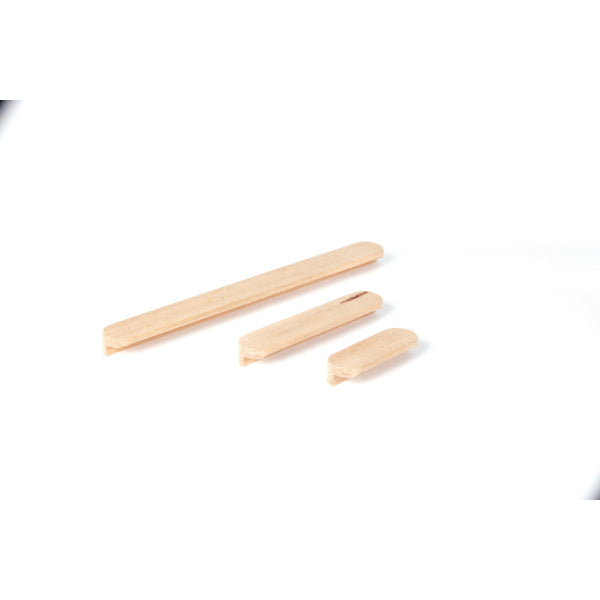
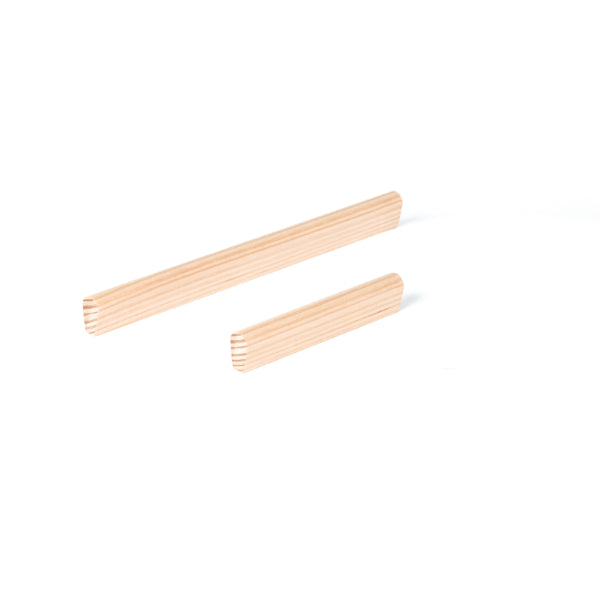
Read the overall figure against the centre figure. The Kimberley at 200mm overall sits on 128mm centres, so the timber stands 36mm beyond each screw. The Airlie at 150mm sits on 96mm centres, which leaves 27mm beyond each, and the Fitzroy at 150mm sits on 64mm centres and leaves 43mm beyond each, so it is mostly handle with two close fixings. That shape suits a small door or a drawer in a vanity. The listings give no projection or screw length, so check the specification sheet before you order if the space in front of the handle is tight.
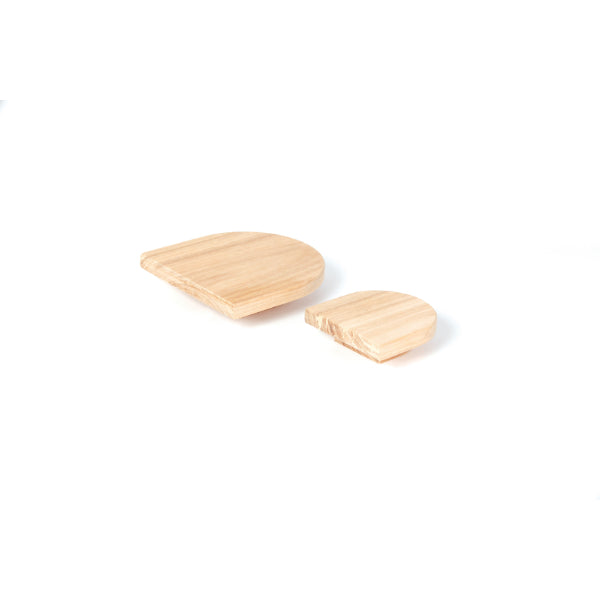
The Kimberley has the widest range of sizes, and the 400mm size is a pull for a wide drawer, a pantry door or a fridge panel. The Airlie has a teardrop profile and not a straight bar, and the Fitzroy arch is a shorter, more sculptural pull. For other curved shapes, see arc shaped cabinet handles and half moon and eclipse cabinet handles.
A retailer describes timber as warm, tactile and quiet against painted joinery. It says timber softens a kitchen in a way metal cannot, and recommends it for Japandi, coastal and Scandinavian rooms. That fits blackbutt, whose pale honey tone reads as a deliberate material against white or pale painted doors, against a stone top, and against a dark carcase, where the light timber stands out.
A hardware retailer groups handles by style. Shaker and traditional doors take round knobs and classic bar pulls, flat-panel doors take slim bars or round knobs, Hamptons and coastal rooms take round or D-shaped pulls, and industrial or rustic rooms take matte black, gunmetal or antique bronze. Blackbutt is not on that list, but it sits easily in the modern flat-panel and the coastal groups, because the timber carries the warmth that a metal finish supplies elsewhere. In a bathroom, a blackbutt pull on a vanity drawer gives a hard room of ceramic and tile one natural material. See bathroom vanities for the cabinets.
Timber handles for a room door are a different job. They sit on the door and not on a cabinet, and they are at interior door handles.
The same hardware retailer advises using the same finish through the home, sticking to one or two handle styles, and limiting each room to two metal finishes. For timber, that translates into a simple rule: let the timber be one of the materials in the room, and let one metal finish carry the taps, the hinges and any knobs. A blackbutt pull on drawers with a small metal knob on the doors keeps the interest on the drawers used most. For a warm second metal, see brushed brass cabinet handles. For a pale partner, see white cabinet handles.
That retailer also notes that you can match handles to other fixtures or contrast them on purpose. Timber is the contrast. The honey tone is not a metal and does not try to match one, so there is no need to match the taps to the handle, and keeping the room calm is enough.
For other timbers beside blackbutt, the siblings of this page are American oak timber handles and walnut timber handles. The listings above show the same three pulls offered in all three species, so the shape you choose here is the shape you can compare there.
It helps to know the market, because it shows what to expect. Timber ranges sold in Australia use oak, walnut, beech, jarrah, mahogany and maple. One timber range lists matt black and unfinished oak, and two-tone handles with metal feet. A second lists Tasmanian oak, reclaimed oak and charred oak, and pairs timber with matt black, polished chrome or satin brass, and a third offers handles handmade in Australia from American oak saved from the bin. Lengths run from small 50mm pulls to 1200mm pulls, knob diameters from 26mm to 74mm, and section widths from 12mm to 28mm.
Timber handles are a small, crafted category, sold by species and by finish. The three blackbutt pulls on this page are one part of it.
Hole centres, the gap between the two screw holes, describe handle length, and overall length does not. A sizing guide says a pull is commonly about one third of the drawer or door width, as a guide and not a strict rule, so a 600mm drawer suits a pull of roughly 160 to 224mm. Another retailer gives the same one-third rule and says pot drawers and pantry doors take longer handles of 250mm or more.
The sizing guide goes further. For drawers up to about 400mm wide, a knob, a short pull or a compact bar usually looks balanced, and for fronts of about 450 to 700mm, 128, 160 or 224mm centres are frequently right. Wider fronts take 256 or 320mm centres, or two pulls placed symmetrically. Knob diameter follows the same logic, with 25 to 38mm suiting standard doors and 40 to 50mm or more suiting pantry doors and deep drawer fronts. A typical starting point for placement is 40 to 60mm from the door edge to the centre of the fixing.
Read against the three pulls here, the Airlie on 96mm centres and the Kimberley on 128mm centres suit a drawer front from about 300mm to 450mm wide. The Kimberley on 256mm centres suits a wider drawer or a pot drawer, and the Fitzroy on 32 or 64mm centres is for a small door or a narrow front. The Airlie on 192mm centres suits a drawer of around 600mm. If your front is wider than 700mm, either choose the 256mm Kimberley or fit two pulls.
If you are replacing handles, measure the centres of the holes you have. The placement guide on this site says a 128mm handle will not fit 160mm holes without drilling new holes, which can leave marks on a painted or veneered front. A retailer says to match the existing hole centres unless you plan to fill the old holes, and the same guide notes that many handles include screws for 16 to 18mm cabinet boards, so check your door thickness.
Centre the handle on a drawer front. On a base door, place it near the top corner on the side opposite the hinges, and on a wall door near the bottom corner. A long vertical pull on a pantry door sits at hand height and not at the exact middle. One retailer gives the general rule as horizontal handles on pull-out drawers and vertical handles on doors, and notes that horizontal handles on doors give a streamlined look but may not open as naturally. It also says to make sure handles do not hit each other when cabinets open.
Test before you drill. One retailer suggests putting painter's tape where the handle will go to compare sizes, and checking that fingers have room to grip. Another suggests holding a handle against your cabinet to check the grip, and choosing one that suits everyone who will use the kitchen, including larger hands or arthritic fingers. For a handle used every day, that is the check that matters. See also cabinet pull handles for the full range of bar pulls and cabinet knobs if a single-hole handle suits a small door better.
Timber asks for gentler care than metal. A cabinet maker's care guide says to dust with a microfibre cloth and to wash high-touch areas with mild dish soap in warm water, while bleach, ammonia, steel wool and scouring pads are out. It says never to spray cleaner directly onto cabinets and to spray the cloth instead. Spills get wiped up at once, wet towels do not hang on cabinet doors, and steam is ventilated so that humidity stays steady through the year, since water is the main enemy of wood.
For an oiled finish, the same guide says to polish every few months with a natural oil-based product, applied lightly and along the grain. It warns against silicone sprays that leave a residue, and says to use the maker's recommended product for the finish. It also says to limit strong sunlight to reduce fading. Check the product's own care note, since the right oil depends on what the maker used.
Two blackbutt points follow. Because the timber has tannins, dry a handle that has been splashed and do not leave the water to sit. Because it can surface check where temperatures swing, keep a handle away from the edge of an oven and out of direct afternoon sun. A raw handle needs this care more than an oiled one does.
For the full range of handle styles, return to cabinet handles, or see the Momo Handles range at Momo Handles premium cabinet handles.