
*View accurate shipping rates and availability




6 Items



Up to 70% off across the store, plus free towels and mirrors up for grabs on orders over $800*

A deadbolt is a lock with a solid bolt that moves only when you turn a key or a thumb turn. Pressing a handle does not move it, which is why it is the lock to choose for a front door. This collection holds Lane single and double cylinder deadbolts in stainless steel, chrome, black and brass. This guide sets out how a deadbolt differs from a deadlatch and a deadlock, when to choose a single or a double cylinder, what the standard grades mean, and which numbers decide fit. For the whole range of entrance locks, see entry door lock sets and exterior door levers.
A deadlock bolt moves only with a key or thumb turn and does not retract when the handle is pressed. Because the bolt is solid and square-ended, it resists card and shimming attacks, and with a quality cylinder and a properly fitted strike plate it also resists bump keys, picking and forced push or pull. A basic knob or lever lock should not be a home's main door lock, because a thief can break off the knob and twist the latch. Fit a deadbolt or deadlock on the front door. A deadbolt adds the bolt that a handle's latch does not have.
The names overlap, so check what a product page means. A deadbolt is operated by hand with a key or thumb turn. It is not a deadlatch, which locks automatically when the door closes. A deadlock is a lock on an external door that needs a key or a digital codepad to operate from both sides, and deadbolts and deadlatches are the two types. A deadlock is fitted with an extra mechanism that resists forcing, and deadlocks and deadbolts overlap in meaning. In this collection every product is a deadbolt, with a bolt you throw by key or thumb turn. For the lock that sits with a handle, see exterior door handles and hardware.
A single cylinder deadbolt is keyed outside and has a thumb turn inside, so anyone inside can leave without a key. A double cylinder deadbolt needs a key on both sides. The single cylinder balances security and convenience, and its weakness is that someone who breaks a nearby window could reach the thumb turn. A double cylinder suits doors with glass panels or windows close by, because a broken window cannot be used to reach a thumb turn. Double cylinders can create emergency risks, since occupants need a key to leave quickly. Keep a spare key near the door in a spot an intruder cannot reach through glass, and remember that some areas limit double cylinders for fire safety, so check local rules. A single cylinder is the most common type in homes because it allows a quick exit without a key.
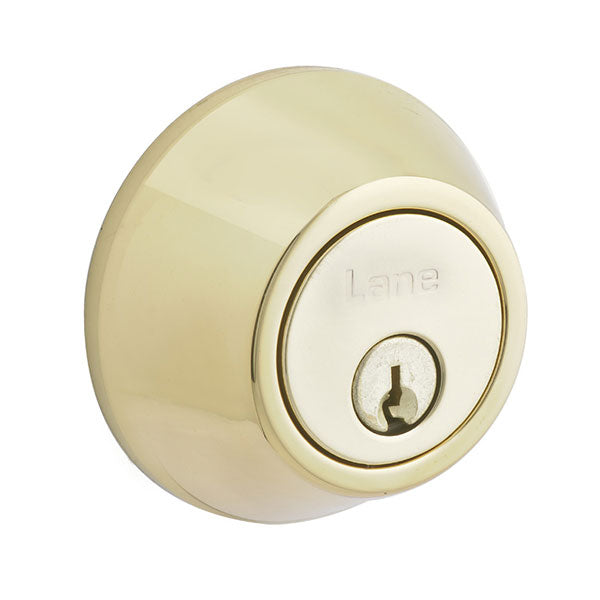
The Lane single cylinder deadbolt lists a C4 five-pin cylinder that can be keyed to suit your requirements, three keys as standard, and a thumb turn inside. The Lane double cylinder deadbolt uses the same cylinder and needs a key to lock and unlock from both the exterior and interior. Both list doors 32 to 45mm thick, a 60 to 70mm adjustable bolt and a 54mm cross bore hole. They are non-handed, so they suit both left and right hand doors, and they suit inward and outward opening doors. The finishes are polished stainless steel, satin stainless steel, brushed satin chrome on a slimline round zinc alloy single cylinder, matte black and polished brass. See Lane deadbolts and Lane door levers.
Australian Standard AS 4145 tests cylinder security, bolt strength, lock body strength and key control, with grades running from 1, the minimum, to 4 and above, which is typically commercial or high-risk. Grade 2 or 3 suits most homes, depending on the property, location and insurance requirements. Unrated locks have not been independently tested, and some insurance policies specify minimum lock standards. That is the locksmith's view, so check your policy and the product page for a stated grade. AS 4145 is the standard for mechanical locksets and hardware for doors and windows in buildings.
The cylinder is the most critical and most targeted component of a lock. It advises choosing a cylinder that meets the required AS 4145 grade, with anti-pick, anti-drill and anti-bump features, and a restricted key profile if key control matters, and warns that a low-grade cylinder can undermine a high-grade lock body. A C4 five-pin cylinder, and key locks on security doors should be five-pin cylinders or the equivalent, since wafer locks are more vulnerable. Read the cylinder line on every product page.
A lock is only as strong as its fitting. These points matter: a strike plate with adequate depth and fixings, the bolt fully entering the frame, correct alignment, and screws long enough to reach structural timber. It argues that a correctly fitted grade 2 lock can outperform a poorly fitted grade 3 lock, and recommends professional installation. A strong deadbolt, a metal strike plate and long screws make a door harder to kick in or pry open. Burglars more often force the door than attack the lock electronically. Measure the thickness and the bore on the product page before you order.
Not every deadlock is a bored deadbolt. A mortice deadlock is fitted into a cavity in the door edge, is harder to tamper with and is common on older heritage properties with solid timber doors. A rim deadlock is surface mounted on the inside of the door, and is often used as a secondary lock. A bored deadbolt, such as the Lane range, needs a 54mm hole through the door and a smaller hole in the edge. If your door is already cut for a mortice lock, a mortice deadlock suits it. See heritage door hardware for older doors.
A C4 five-pin cylinder that can be keyed to suit your requirements, with three keys as standard. Keyed alike means multiple locks are set to operate with the same key, so one key opens several doors, which suits homes with several external entry points such as a front door, back door and garage. Ask a locksmith or builder to arrange this during installation. Some manufacturers sell keyed-alike sets, but do not try to do it after installation. If you plan more than one deadbolt, decide on keyed alike before you order.
A deadbolt can be bought separately or as part of an entrance set. The Lane Corvan entrance sets in exterior door levers list a deadbolt and latch in one set with three keys. A separate deadbolt sits above the handle. Choose a separate deadbolt if you want to keep an existing handle, and an entrance set if you are replacing both. See exterior door handles and hardware for the full entrance range.
Other deadbolts sit on their own pages. See Lockwood deadbolts, Futura slimline deadbolts from Zanda and Jura deadbolts from Zanda. For keyless deadbolts that open with a code, a fingerprint or a phone, see smart door locks. For a security screen door, see screen door hardware and screen door locks.
Match the deadbolt to the handle on the door. See chrome door handles, brass door handles, matte black door handles and stainless steel door handles. Finish names vary between makers, so a deadbolt and a handle from different makers may not match exactly. Compare them on the door.
Choose a single cylinder deadbolt for most doors, because it allows a fast exit, and a double cylinder only where glass sits within reach of the thumb turn and you can keep a spare key where the household can find it. Read the cylinder line and the grade, measure the thickness and the bore, and have the strike plate and screws fitted properly. Use the deadbolt with a solid door and frame, and match the finish to the handle. That order avoids the common mistakes: a double cylinder where a fast exit matters, an unrated cylinder, and a strike plate that does not reach the frame.
A deadbolt is a bolt that moves only when a key or a thumb turn moves it. It does not retract when the handle is pressed. A solid, square-ended bolt also resists attack with a card or a shim, which is one reason deadbolts suit external doors.
A deadlatch locks automatically when the door closes. A deadbolt is operated by hand, so you lock it each time. The names overlap in everyday use. Some sellers use deadlock for a lock that needs a key or a code pad from both sides on an external door, while others use it for a lock with a thumb turn inside. Read the description of the lock, not just the name.
It is one part of the door. A knob or lever lock should not be the main front door lock, and a deadbolt or deadlock belongs on the front door. The cylinder is the part most often targeted, and a low-grade cylinder undermines a high-grade body, so look for anti-pick, anti-drill and anti-bump features and restricted keys.
A deadbolt is recommended for front entrance doors. It also suits side and back doors, particularly those with no windows nearby, because the glass is what makes a thumb turn a weak point. For a front door with glass panels close by, a double cylinder is the suggested choice. Single cylinder is the most common arrangement for residential front doors in Australia, paired with a keyed entrance lever set.
The deadbolts on this page are the Lane Double Cylinder, Lane Single Cylinder and Lane Slimline Single. A single cylinder has a key outside and a thumb turn inside, and a double cylinder has a key on both sides, which is why it needs a clear plan for getting out in an emergency. Check the product page for the finish and the door thickness range before you order, and if you choose a double cylinder, keep the key where every adult in the house can reach it.


