
*View accurate shipping rates and availability






22 Items



Up to 70% off storewide, free metro shipping over $500, and free gifts from $800. Spend more to unlock luxury towels and mirrors.*
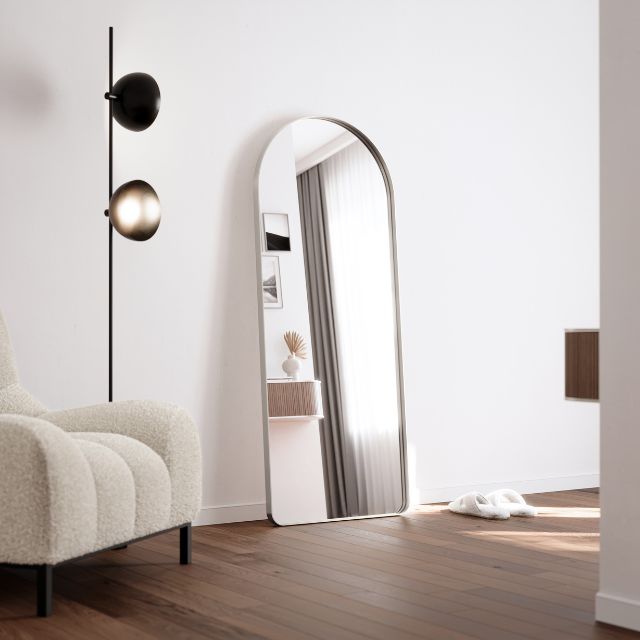
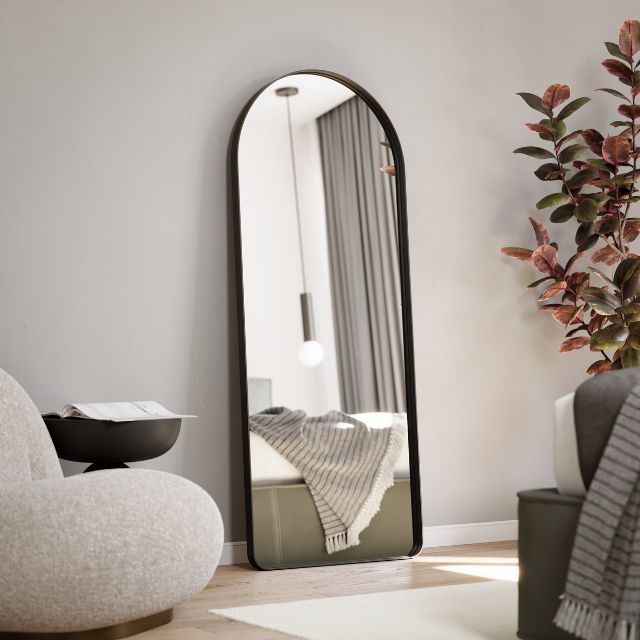




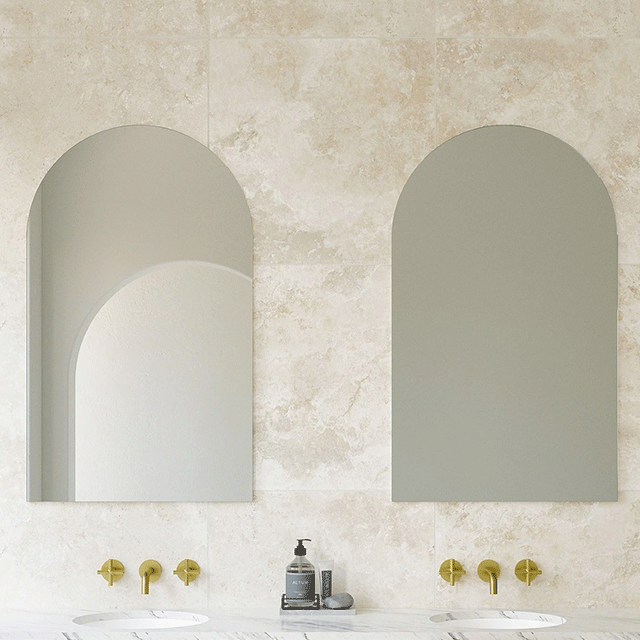

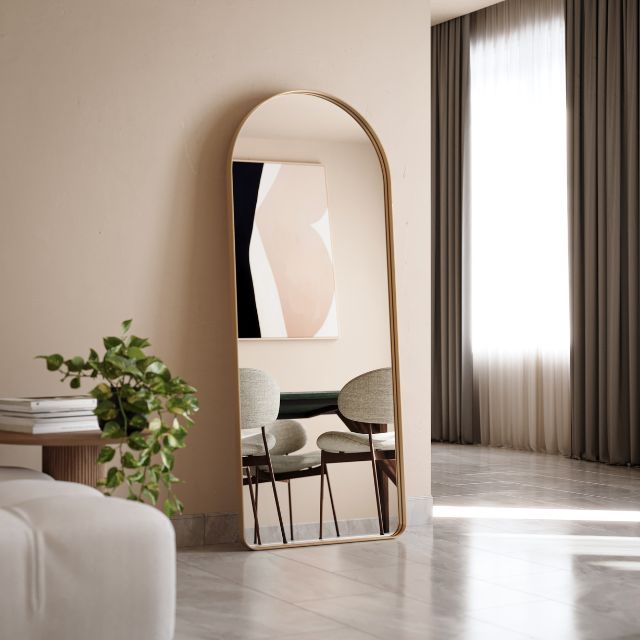
An arch mirror is a rectangle with a curved top, and the curve is the reason to choose it. It softens a bathroom built from straight lines, it draws the eye upward, and it suits a single vanity or two matching mirrors over a double. The practical call: choose an arch no wider than the vanity, hang it so the centre sits at eye level, and add light to the glass only if the room needs it. The sections below cover what the shape does, width, height, hanging, lit and unlit versions, frames, floor standing options and care.
Most bathrooms are made of right angles: tiles, vanity edges, shower screens, door frames. A rectangle reinforces those lines and reads as structured, while an arch adds a curve and carries a softer visual weight. The curved top draws the eye upward, so an arch can make a room feel taller, and an arch suits rooms with 2.4m ceilings, where a rectangle can feel boxed in against the ceiling.
The trade-offs are plain. A rectangle is the standard choice above a vanity because it lines up with the vanity top and the wall edges. An arch needs enough wall height above the vanity, and if it sits too close to the ceiling the curve gets lost. A rectangle also has slightly more reflective area at the same overall height, because the curved top of an arch mostly reflects the ceiling. So the call depends on the room: an arch for a bathroom with room to spare above the vanity and straight lines to soften, a rectangle where the wall is short or you want every centimetre of glass in front of your face.
Width follows the vanity. The simplest rule is to choose the largest width that is no wider than the vanity. A little tighter, when the mirror is not the same width as the vanity, is to make it 70 to 80 per cent as wide, so it looks smaller than the vanity without looking shrunken. Both rules agree on the direction: do not overhang the vanity.
The arches in this collection are narrow and tall, which suits the shape. Widths run from about 430mm to 750mm for the standard arches, with heights from 800mm to about 1030mm. The Timberline Church mirror comes in 430mm by 830mm and 630mm by 1030mm. The Marquis Arco is 550mm by 800mm. The Thermogroup Church polished edge mirror comes in 500mm by 800mm and 750mm by 1000mm, and the Ingrain timber framed arch is 600mm by 1000mm. The Timberline Melody is a half-moon at 1200mm by 800mm, and the Radiant Ark runs from 1000mm to 1800mm.
Hang the mirror so its centre meets your eyes. Heights differ a little, and the range is worth knowing. A centre at about 150 to 160cm from the floor works for many households, with 15 to 25cm between furniture and the bottom of the mirror. Leave 100 to 200mm between the tap or splashback and the base of the mirror, and never less than 100mm. Average eye level runs from 1600 to 1750mm and households vary, so measure the people who will use it.
With an arch the top matters as well. The curve needs clear wall above it, so check that the top edge still sits well below the ceiling after you fix the centre at eye level. If a tall person and a short person share the bathroom, choose an arch tall enough to cover both rather than hanging it higher. The tall arches here, at 1000mm and above, give more room to adjust than the 800mm versions.
The arch is one of several soft shapes, and the others do different jobs. Round mirrors suit pedestal basins and bathrooms with many hard surfaces, and they leave more empty wall at the corners than a rectangle does. An arch keeps a flat bottom edge that sits parallel to the vanity and curves only at the top. A pill shape has two curved ends, and an oval is curved all round. The alternatives are on round mirrors, oval mirrors and pill shape mirrors.
Fixing is the part most buyers skip. The basics are simple. Fixings are not usually supplied, so buy ones rated for the wall and the weight. Solid walls take heavy-duty wall plugs and high-load screws, plasterboard takes heavy-duty cavity anchors or toggle bolts, and stud walls are best fixed into the studs where possible. A stud finder will also detect pipes and cables behind the wall. To find the load each fixing must carry, divide the mirror's weight by the number of fixing points, then fit anchors rated well above that figure.
A lit arch mirror puts light and a demister into the glass, and frontlit and backlit work differently. A frontlit mirror sends light toward the face and is usually stronger at reducing shadows on the cheeks, jaw, eyes and neck. A backlit mirror places the LEDs behind the glass, so the light reflects off the wall first and reads as an ambient glow. Frontlit suits shaving, skincare and windowless vanities, and backlit suits atmosphere and guest bathrooms.
The collection holds both. The Ingrain frontlit arch mirrors, 500mm by 900mm in brushed nickel, matt black or brushed gold, and in a frameless version, suit makeup and shaving, with a touch sensor, stepless dimming and a built-in demister, at 6500K. The Ingrain frameless backlit arch is 500mm by 900mm with backlit LED for ambient light. The Thermogroup Ablaze backlit arch is 500mm by 800mm with a choice of warm or cool white light and an integrated demister that comes on with the light. The Radiant Ark is a frameless LED mirror with touch sensors, four brightness levels, three colour settings and a defogger.
Power is the main constraint. The Ingrain lit mirrors require hardwired installation by a licensed electrician, and the Thermogroup Ablaze arch is hardwired only, with a separate switch needed. The Radiant Ark is hardwired with the wiring concealed behind the mirror. Bathroom lighting is licensed work in Australia, and an electrician confirms the wet-zone boundaries on site. The lit mirrors carry an IP44 rating, the common bathroom benchmark. Decide the light before the wall is closed, so the supply can be placed behind the mirror. For the whole lit group, see Ingrain LED mirrors or LED mirrors.
The construction is worth reading before you buy, because it is what keeps a mirror clear for years. The Thermogroup Juno arch has a safety backing film and copper-free glass, and its frame wraps 7mm around the front of the mirror. The Thermogroup Church polished edge mirror is 5mm thick with a commercial-strength vinyl backing and comes with metal hangers, with a glue-to-wall option available on request. The Marquis Palmer has a polished edge that catches the light. The Timberline mirrors use copper-free glass, and the Church frame is finished in a two-pack polyurethane that is durable and easy to clean. Depths run from 18mm on the slim Timberline frame to 25mm on the Marquis mirrors and 31mm to 38mm on the Ingrain arches.
Some searches ask for an arched floor mirror or an arched full length mirror. The Ingrain full length arch mirror is 600mm by 1500mm and can be wall hung or used as a floor standing mirror, in brushed nickel, brushed gold or matt black. It comes with screw fixing for the wall and brackets for floor standing. A full length arch suits a hallway, a bedroom or a dressing area more than a bathroom vanity wall, and it is a different job from the vanity arches above. The full range is on full length mirrors.
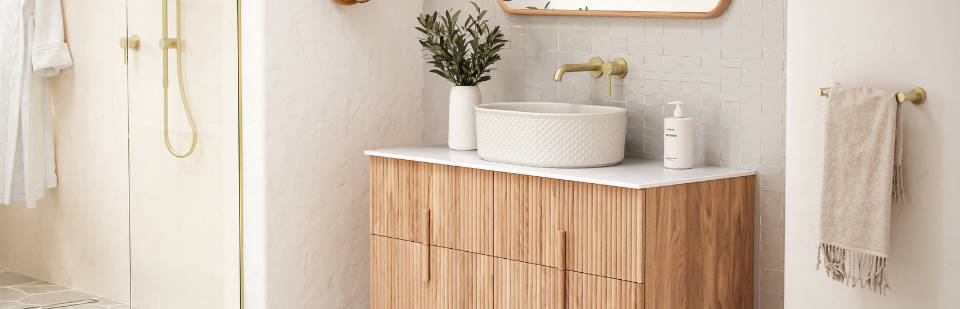
Arch mirrors come in brushed nickel, matt black, brushed gold, gold, black, white, painted finishes and ash timber in this collection. Choose the frame to suit the style of the room: ornate for traditional, simple and slim for almost any room. A frame finish that matches the tapware ties the vanity wall together, so choose the mirror and the tapware on the same day. For brushed nickel see brushed nickel tapware, for black black taps, for brass brushed brass taps, and for chrome chrome taps.
Dry the flat bottom edge as well as the curve. An arch collects splashes along its base, where the glass meets the frame, so a quick pass with a dry cloth after cleaning keeps water from sitting in the join. Dust the crown of the arch too, since it is the part you see least and the part most likely to be missed.
Clean the glass with a soft microfibre or lint-free cloth rinsed in warm water and wrung out well, then wipe gently with a soft dry cloth. Avoid glass cleaner, window cleaner and chemical agents, because they can damage the silver coating and leave brown marks. Wipe the surface rather than spraying it so liquid does not run into the edges, and keep cleaner away from the touch sensor on lit mirrors.
A short route through the decisions:
The final check is the same for every arch: width against the vanity, height against the eye line, the top edge against the ceiling and the fixings against the wall. For the other shapes see round mirrors, pill shape mirrors and wall mirrors, or return to mirrors.


