
*View accurate shipping rates and availability






41 Items



Up to 70% off across the store, plus free towels and mirrors up for grabs on orders over $800*


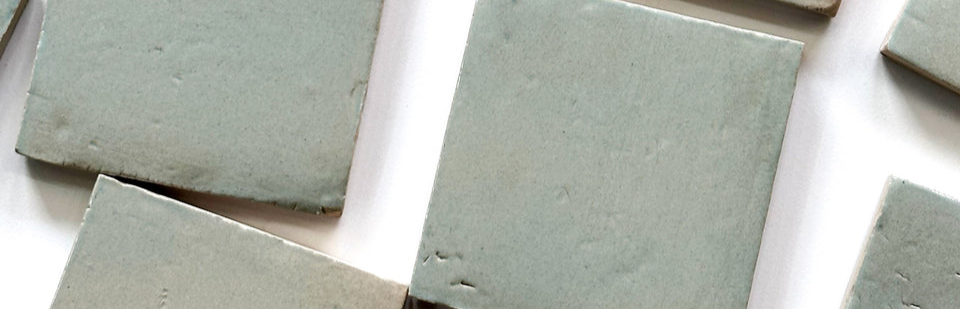


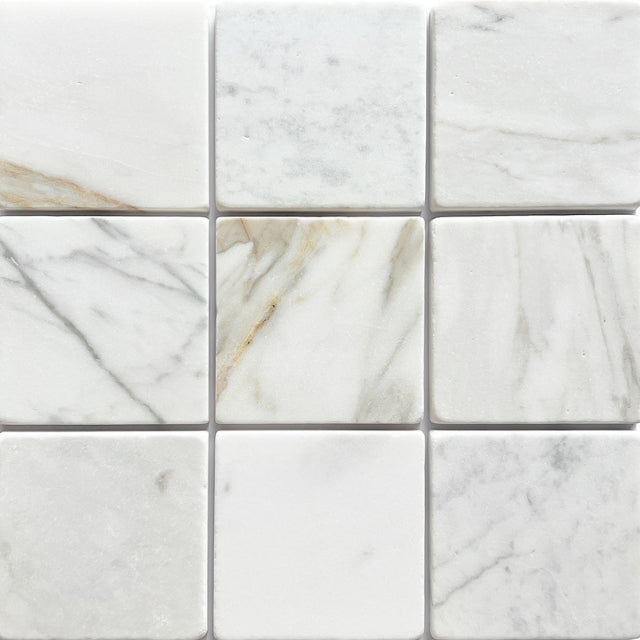


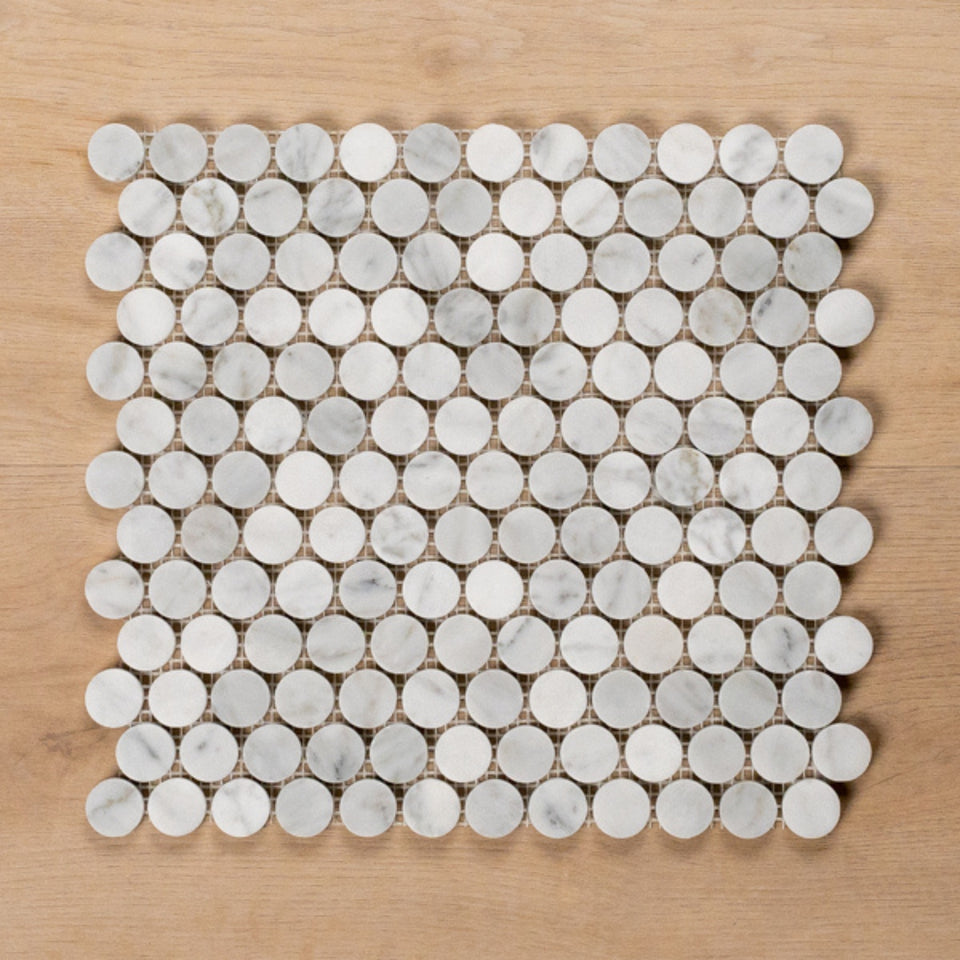


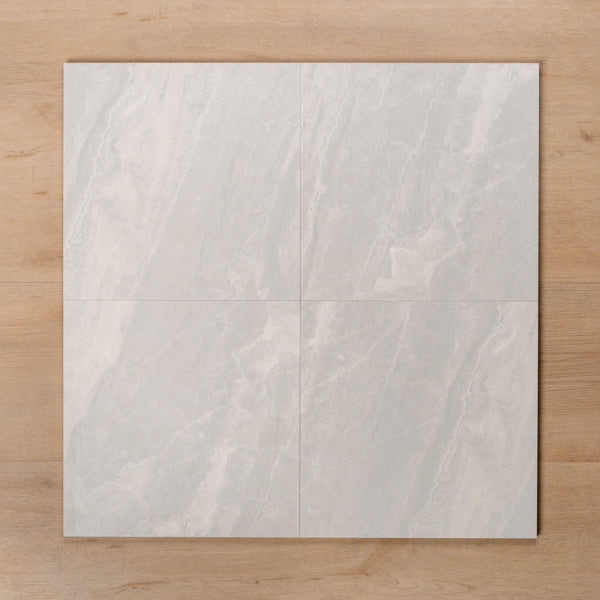
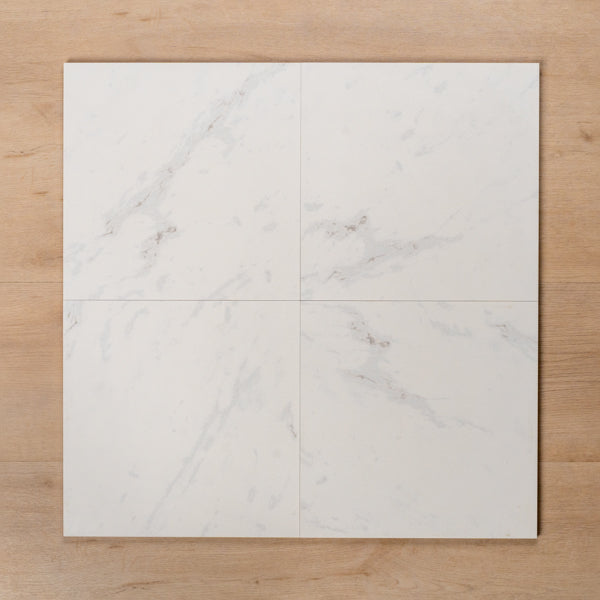


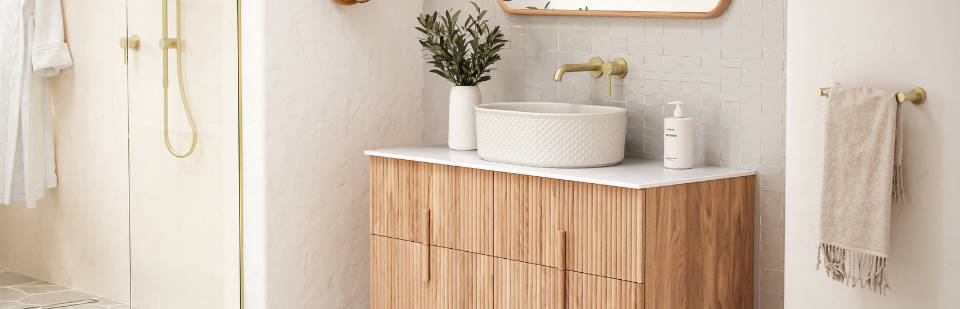


Marble tiles come in two kinds. Real marble is cut from natural stone, with veining and variation no factory can repeat. Marble-look tiles are porcelain or ceramic made to resemble it. This collection holds both: a run of honed marble mosaics and a tumbled natural marble subway, alongside marble-look porcelain and ceramic in larger formats.
The choice between them comes down to depth against upkeep, and the sections below set out what each asks of you, how finish changes a room, and what the product pages print. For rooms, the bathroom tiles collection and the kitchen tiles collection sort the full range.
Marble is a metamorphic rock formed when limestone is subjected to extreme heat and pressure deep in the earth's crust. The process recrystallises the calcium carbonate in the rock, producing a dense, hard stone. The veining forms as mineral impurities move through it during that recrystallisation. Because that happens differently in every deposit, no two marble tiles carry the same pattern, and that variation is what makes a large marble floor look so varied.
Marble is also cool underfoot and heavier than manufactured tiles, with natural, unique patterns. Both affect how it behaves in a room.
Marble tiles are cut from natural stone, with natural veining, unique variation and the cool, weighty feel of the real material. Marble-look tiles are porcelain or ceramic printed to resemble marble. They're more uniform, and more durable in high-traffic and wet zones. The trade is depth: quarried stone has a character a printed surface can't match.
The practical differences follow from that. Porcelain is dense and suited to wet areas, and marble-look porcelain and ceramic resist staining because their glazed surface is non-porous, with maintenance as simple as regular cleaning. Natural marble is porous, so all of it should be sealed before use and resealed periodically. Marble also typically needs a professional installer because of its weight and complexity, and cutting it produces more waste than cutting a tile made in consistent sizes.
So marble-look porcelain suits wet rooms and busy kitchens, and real marble suits a mosaic, a splashback or a niche. The product pages here state which is which, in the Material line, and the natural stone tiles print a care consideration that requires sealing.
Finish changes how marble looks, feels and performs. Polished marble has a glossy, reflective surface that shows off the veining and adds depth to a room. Honed marble is ground to a smooth, soft matte finish. It reads as more contemporary, shows the veining clearly, hides scratches better than polished and gives more slip resistance. Tumbled marble is mechanically tumbled to soften edges and surfaces, so it looks like stone that has worn naturally over time, with a gentle texture and rounded edges. It suits an aged, informal character and it's forgiving to cut and lay, because the soft edge hides minor chipping. Sandblasted marble has a fine, lightly textured surface, and antique marble is brushed and tumbled for the look of stone aged over decades, with slightly softened veining and warm character. Antique finishes are often chosen for traditional or heritage-influenced rooms.
The same logic applies to marble-look porcelain. Polished or gloss surfaces reflect light and have lower slip resistance, so they suit walls and dry floors. Matte or honed surfaces look softer and more understated, have higher slip resistance and suit bathroom floors and busy kitchens. A polished surface also shows smudges and watermarks more readily, and a matte one hides footprints and water spots.
In this collection, the product pages print honed, matte and three-dimensional finishes. The marble mosaics here are honed, which is the practical choice for a floor, and the polished marble-look porcelain such as Perisher belongs on walls or in dry rooms. Slip lines vary: the Kings Marble page prints P2 and calls the slip risk high, and the Sofia pages print P2, so check the line for any tile you want on a floor.
Honed Carrara and Calacatta marbles are popular for bathroom floors and walls. They offer subtle grey veining, a clean modern look and enough slip resistance for wet zones. Marble mosaics suit shower floors and niches, where the extra grout lines add grip. A classic and practical combination is a larger format on the walls with a marble mosaic on the shower floor.
Polished marble suits walls, splashbacks and low-moisture areas, where its sheen is the feature. Marble also stays cool underfoot, pleasant in summer, and underfloor heating warms it in winter. For a wet room where you want the marble look, a matte or textured marble-look porcelain gives better slip resistance than polished natural stone.
Floor-to-ceiling shower walls in marble-look tile look like a hotel bathroom when the veining runs continuously, and a book-matched feature wall behind a freestanding bath becomes the focal point. The mosaic tiles collection and the herringbone tiles collection cover the small formats.
Marble-look tiles run from small mosaic pieces up to slabs close to the proportions of real marble. 600 x 600 and 600 x 1200 are the most popular floor sizes, with honed, matt, polished and semi-polished as the usual finishes, and formats reaching 1600 x 3200mm at the top end. Large formats show fewer joins, so the veining reads as one continuous surface. Small formats give more grout lines.
The collection sits at the practical end of that spread: 300 x 300 and 300 x 600 ceramics, 600 x 600 and 600 x 1200 porcelains, and the small mosaic shapes. For a floor, the larger porcelain sizes keep joins to a minimum. For a splashback or a shower niche, the smaller formats suit the smaller area.
The body of the tile decides where it can go. Ceramic marble-look wall tiles belong on walls, because ceramic is lighter than porcelain, while porcelain can run from wall to floor. Paradise, the ceramic range here, is a floor and wall package at 300 x 300 and 300 x 600, so read the Area line on any ceramic tile before planning a floor with it.
Coloured marble-look tiles suit living areas, bedrooms, dining spaces, laundries and kitchen splashbacks, with some options also rated for outdoor areas. For this collection, the Area and Material lines on each product page are the guide.
Add 10 to 15 percent on top of the measured area for wastage, and 20 percent for large formats such as 600 x 1200mm and bigger. Rooms with more cuts need more again, so confirm the quantity with your builder or tiler before ordering.
A worked example: a bathroom floor of 2.4m by 1.8m is 4.32 square metres. A 600 x 600mm tile covers 0.36 square metres, so the floor takes 12 whole tiles, and with 15 percent for cuts the order is 14. A 300 x 600mm tile covers 0.18 square metres, so the same floor takes 24, and 28 with the allowance. Start the layout from the doorway and keep the thin cuts to the back wall, where a vanity hides them, and order every box together so the veining matches across the floor.
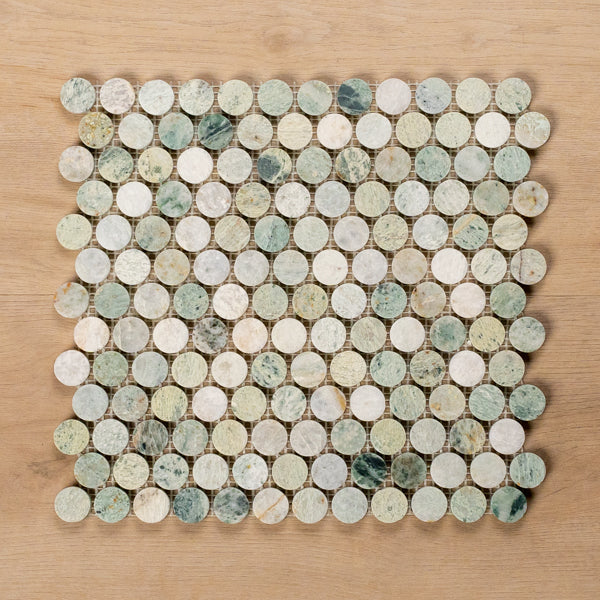
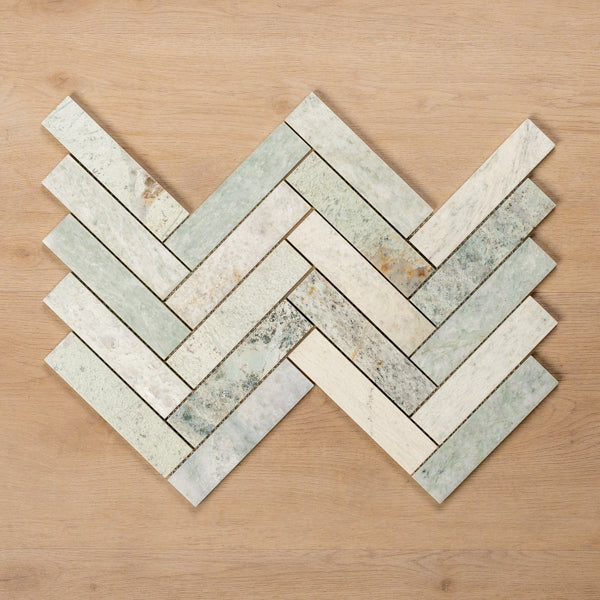
White and soft grey bases, in Carrara and Calacatta styles, are the most popular colours. They carry the classic bright look. Dark options, such as charcoal, deep green or black with white or gold veining, work on feature surfaces. Warmer cream and beige tones suit Mediterranean and coastal homes. The colour tags in this collection run from white and grey through beige, blue, black, green and pink.
For one colour across the store, the white tiles collection and the grey tiles collection gather tiles by shade, and the terrazzo look tiles collection is the stone-chip alternative.
The product pages print the details for each range.
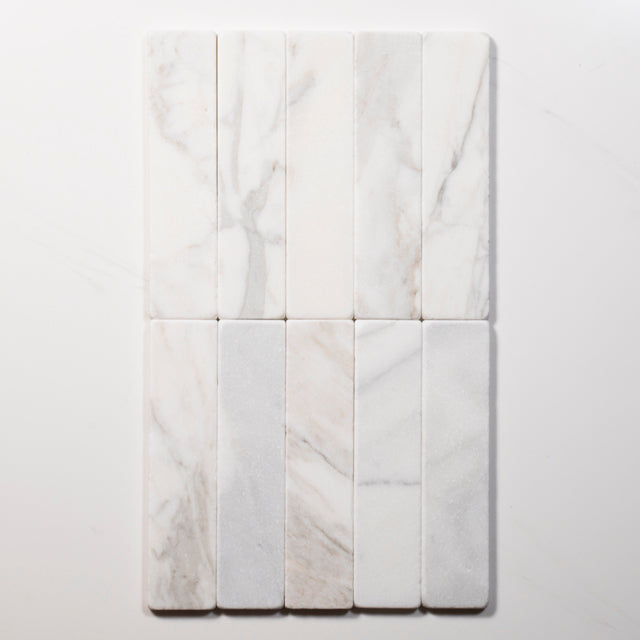
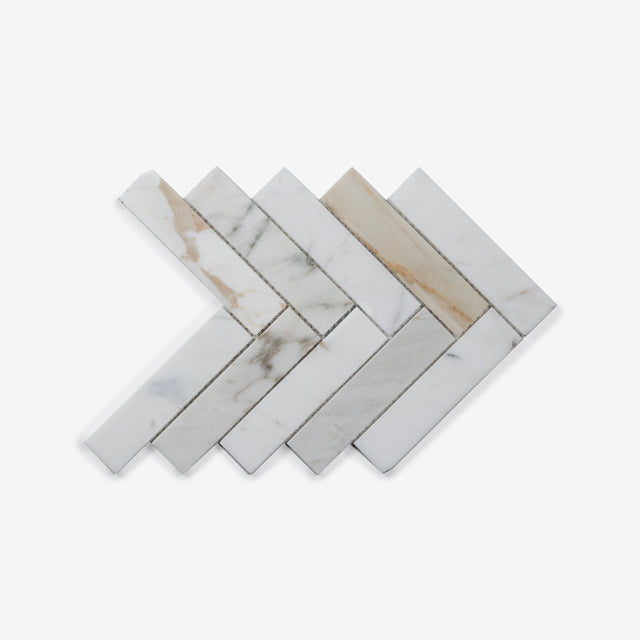
Cottesloe is a series of real marble mosaics, honed, in a 23mm penny round, a 35 x 150 herringbone, a 50 x 130 feather subway and other shapes. They are delicate, subtle marbles with substantial variation in colour and texture, and sharp-edged tiles allow grout lines of 3mm or less. Installation must be carried out by a licensed tiler to the appropriate Australian standards. The tumbled natural Calacatta Gold marble subway is a 50 x 200 natural stone with a tumbled finish, and it requires sealing.
Sereno is a honed marble-grain porcelain at 600 x 600, with soft tonal variation. Sofia is a honed marble porcelain at 600 x 1200 and 6.5mm. Perisher is a polished, rectified porcelain at 600 x 600, an alternative to Statuario marble. Kings Marble is a Carrara-look ceramic at 300 x 300 in matt with a cushioned edge, and Paradise is a marbelised ceramic for walls and floors in 300 x 300 and 300 x 600.
For a wider run of marble-look porcelain, see the Matrix marble look porcelain tiles collection, and for other stone tiles the natural stone tiles collection and the tumbled natural stone tiles collection.
Real marble asks for a routine. Sweep or vacuum regularly to lift dirt and grit, then mop with warm water and a pH-neutral stone cleaner. Avoid vinegar, lemon, bleach and anything acidic, because acid etches the surface. Wipe spills quickly, and reseal every one to two years to maintain the finish and keep the tiles protected. Sealing slows stain absorption, which gives you time to wipe a spill before it soaks in.
Marble-look porcelain doesn't need any of that. Most of the porcelain and ceramic tiles here are easy to clean, and several need no sealing.
Start with the room. For a bathroom floor, a kitchen floor or a busy family space, choose a matte or honed marble-look porcelain and check the slip rating. For a shower wall, a splashback or a feature, choose either, depending on how much of the real stone's character you want. For a mosaic floor or a niche, honed marble mosaics add grip and variation. Match the grout to the tile either way, and put bold veining where it can be seen.


