
*View accurate shipping rates and availability






2 Items
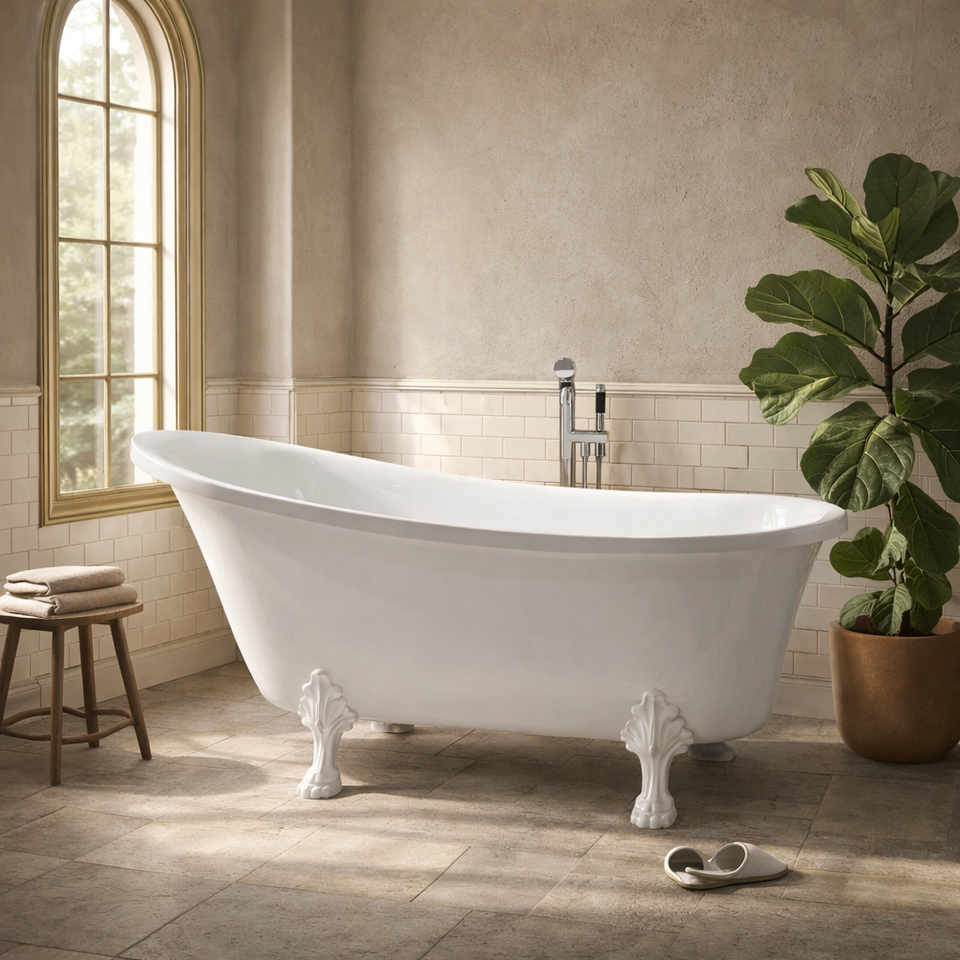

A slipper bath is a freestanding bath with one or both ends raised above the rim, so the bather reclines with the head and back supported. This page holds two Fienza baths in that shape: a traditional slipper-shape claw foot bath with a roll-top edge, in gloss white acrylic, with either semi-gloss white feet or matte black feet. Each comes in 1500mm or 1700mm lengths. Slipper bath, slipper bathtub, slipper tub and bath on feet all describe the same search. The sections below cover what a slipper bath is. They also cover single and double ended baths, size, comfort and the Fienza build, and what to check on taps, waste, shower use and the floor before ordering.
A slipper tub has one or both ends raised, with a high, inward-sloping wall that supports the head, neck and back, and the rim can also serve as an armrest. A slipper bath is a freestanding, traditional roll-top bath with a sloped profile that rises at one end. All slipper baths are freestanding, but not all freestanding baths are slipper baths, because a slipper bath does not have a uniform height all the way round. The freestanding baths page covers the wider group.
A single-ended slipper bath has one raised end and is made for one bather. The taps sit at the non-reclined end and the plug is usually at the end opposite the raised section. A double-ended bath is raised at both ends, so either side can be used for reclining. Its drainage is usually in the middle, and the taps sit in the middle too. A double-ended roll-top bath is called a boat bath, and a double slipper tub has room for two people. The Fienza baths here are a traditional slipper shape with a roll-top edge. Check the specification sheet if the position of the raised end matters.
The raised end supports the back and neck, and the depth suits long soaks. The slope lets a bather relax without a full-length tub, and the raised walls give the comfortable lounging position you take on sitting down. The trade-offs are weight, shower use and floor loading, covered below. A slipper bath also needs space around it to look its best, because it is freestanding.
Tall bathers should check the length. Tall users may find 1500mm short on legroom, and 1700mm is the safer choice for them. The Fienza baths come in both lengths.
Slipper baths run from about 1500mm for a compact bath to 1600mm for the common size, and up to about 1700mm for large suites or taller users, with widths of 450mm to 800mm. A compact option is about 1500mm by 700mm. Single slipper tubs are typically 1520mm to 1830mm long and 760mm to 915mm wide. The two Fienza baths come in 1500mm and 1700mm, which sit at the compact and large ends of that range.
Both Fienza baths are produced from Lucite PMMA acrylic that is UV stabilised, which helps the bath not to yellow over time. They have an inbuilt metal support frame with adjustable steel legs, sanitary grade acrylic, a chrome overflow and a chrome waste included. The roll-top edge and the claw foot design are the traditional parts. The feet are the colour difference between the two: one has semi-gloss white feet and the other matte black feet. The claw foot bath tubs page covers claw foot baths in general, and the acrylic bathtubs page covers the material in full.
Slipper baths are made in several materials, and the weight differs a great deal. A cast iron slipper bath is far heavier than an acrylic one, and a stone one is heavier again. Acrylic is lightweight and easy to repair. The Fienza baths are acrylic, so they are at the light end. The stone baths page covers the heavy end.
Acrylic is a non-porous plastic formed into a bath shell and backed with fibreglass, resin or a frame. The reinforcement behind the sheet matters as much as the sheet. The Fienza baths have an inbuilt metal support frame with adjustable steel legs, so the frame and the specification sheet are the details to read. Extruded acrylic is a thin sheet cut to size and more prone to cracks and faults, and cell cast acrylic is poured into a glass mould and is stronger. The Fienza baths are Lucite PMMA and sanitary grade acrylic.
Every Fienza acrylic bath has an inbuilt metal support frame and adjustable legs. The black feet are a colour choice, and the black baths page covers the black options, with white baths for the whites. Installation follows the maker's instructions in every case.
Two design words come up beside slipper. A roll-top is a curved or folded-over rim for a vintage look, and it can be applied to acrylic, stone or cast iron. A claw foot is a style with four feet. Slipper styles include clawfoot, with imperial or lion paw feet and suited to traditional, mid-century modern and modern farmhouse designs, floor-resting, typically contemporary with clean lines, and pedestal, which bridges vintage and modern. The Fienza baths combine the roll-top edge with claw feet, so they sit on the traditional side of that range, and the semi-gloss white or matte black feet change how traditional they look.
Freestanding slipper tubs can usually go nearly anywhere in the bathroom, provided the plumbing layout lines up with the necessary piping, and a drop-in drain kit simplifies installation. The order of work is to measure the room and choose the material for the floor, then level the floor and plan access to the plumbing. Position the bath, fit the taps and seal around the base and drain, and hire a fitter if you are unsure about the pipework or the weight loading. The Fienza baths come with installation instructions and a specification sheet, and those documents decide the details for these baths. Altering or extending existing plumbing is a task for a licensed plumber.
The tap position follows the shape. Floor mounted taps bring the pipes up through the floor beside the bath, usually with a cover plate. Wall mounted taps suit baths placed fairly close to a wall, and some roll-top baths have pre-drilled tap holes for deck mounted taps. A tub filler is essential for any freestanding slipper tub and the plumbing layout must line up with the necessary piping. The Fienza baths have no tap holes, so a floor or wall mounted mixer is the usual match, and the freestanding bath mixers page lists floor mounted sets. Decide the tapware before the plumber sets the rough-in.
Both Fienza baths come with a chrome overflow and a chrome waste, so the waste is included. The usual waste types are click-clack, which opens and closes with a push, pop-up with a lever or button, and plug and chain. Australian building codes require fully removable bath wastes in some situations, so consult a plumber before purchase. The bath wastes page holds other wastes if you want to change it.
A slipper bath is a poor base for a fixed shower screen. A rigid screen is difficult to fit because the raised end gives no flat surface, and a curtain will not seal well and may splash water onto the floor. There are three options: a bath and shower mixer with a handheld head for a quick rinse, a separate bath and walk-in shower enclosure, or a shower bath with an attached showerhead. A freestanding bath is not the right base for a shower over it, because the bath is not fixed to a wall and cannot securely support a screen.
A filled bath is heavy even when acrylic. A standard bath of about 300 litres adds roughly 300kg of water, and upstairs floors are often suspended timber, so heavier baths carry more risk there. Consult a structural engineer for heavy options. A bath's weight must be properly supported during and after installation and the floor checked. Acrylic is lighter, which matters on upper floors. Timber floors usually need reinforcement for heavy baths, and a structural engineer should assess a timber floor where the combined load is high.
Leave at least 700mm between a freestanding bath and other fixtures, and allow roughly 2200mm by 1400mm of total space for a compact bath, though a very small room may need less clearance. A freestanding bath needs at least 50mm on each side and 50mm to 100mm around it for cleaning and plumbing access. A 1500mm bath can work in a room 1650mm or longer, and a 1700mm bath generally needs a wall of at least 1800mm. Measure the room against the plumber's plan. The 1500mm baths and 1700mm baths pages group each length across makers.
The Fienza baths are Lucite PMMA acrylic, which is more resistant to household cleaners than standard acrylic but scratches more easily and needs a polishing kit for scratches. Acrylic is non-porous, so it wipes clean. Use a soft cloth and a mild cleaner, and check the care sheet before choosing a stronger product. Deeper scratches may need a professional.
Start with the room. Measure the wall, the floor and the route in. Decide the length by the bather: 1500mm for a compact room, 1700mm for a taller bather or a larger room. Pick the feet to suit the room, then plan the tapware and confirm the floor. Read the specification sheet and installation instructions before the plumber and the tiler start.
For the full range across shapes and materials, return to bathtubs, and see Fienza baths for the maker's other baths.


