
*View accurate shipping rates and availability






95 Items


Up to 70% off across the store, plus free towels and mirrors up for grabs on orders over $800*









Chrome is a bright, cool, reflective silver. This page holds polished chrome, satin chrome and chrome plated cabinet handles, knobs and pulls for kitchen, bathroom, laundry and wardrobe cabinetry. Chrome is a sleek, high-shine finish that blends with most interior styles, from minimalist bathrooms to classic rooms. Four questions decide the order: what chrome is and how it is made, how it wears, which type and size fits the door, and what it will sit beside. The sections below take them in that order. For handles in every finish, start at cabinet handles.
Chrome is a surface, not a metal you can buy as a solid bar. Decorative chrome plating is a thin layer of chromium electroplated onto a metal object, usually over a layer of bright nickel. In the most durable version a copper layer goes on first, then nickel, then chromium. The chromium layer in a decorative finish is very thin, usually between about 0.13 and 0.25 micrometres, and it can be applied over steel, aluminium, copper alloys and zinc alloys. The result is the shiny finish you see on a handle, and the chromium layer can make a part easier to clean.
Chrome is often the most scratch resistant of the common silver finishes, and brushed finishes are better at hiding small marks. Wear depends on the plating and the base metal. Chrome on zinc alloy with thin plating often shows wear within 12 to 18 months in a busy kitchen, dulling first at the grip point, and the finish can pit in a humid kitchen when wiped with cleaners that contain acid or bleach. Chrome and stainless steel suit low-traffic kitchens, and a thick coating on brass or stainless steel suits a busy one better than thin plating on zinc alloy. Electroplated chrome is hard, easy to clean and tolerant of harsh cleaners on tapware, which shows how much the answer changes with the quality of the plating.
The two are the most common pair of choices. Chrome has a cooler colour temperature and a brighter, more reflective silver, while brushed nickel is softer and warmer, with a semi-satin look that hides fingerprints, smudges and dirt, and it is generally easier to clean. Some people find chrome cold or clinical, while others find its reflective finish suits modern and traditional rooms alike. Chrome fits almost any palette and is easy to match to existing fittings. It sits best with crisp whites, cooler greys, black and glass, and it needs care with warm or earthy palettes, such as creamy stone or warm timber, where its coolness may feel out of place. You do not have to match exactly, and chrome tapware can sit well beside brushed nickel handles. The brushed nickel page covers the softer option, and the stainless steel page covers the cooler, more industrial one.
A knob fixes with one screw and suits doors and small drawers, while a pull fixes at two points and gives a firmer grip on wide drawers and pantry doors. The page includes knobs, bar handles, D handles, T-knobs, cup pulls and an appliance pull. See cabinet pull handles, cabinet knobs, cup pulls and appliance pulls.
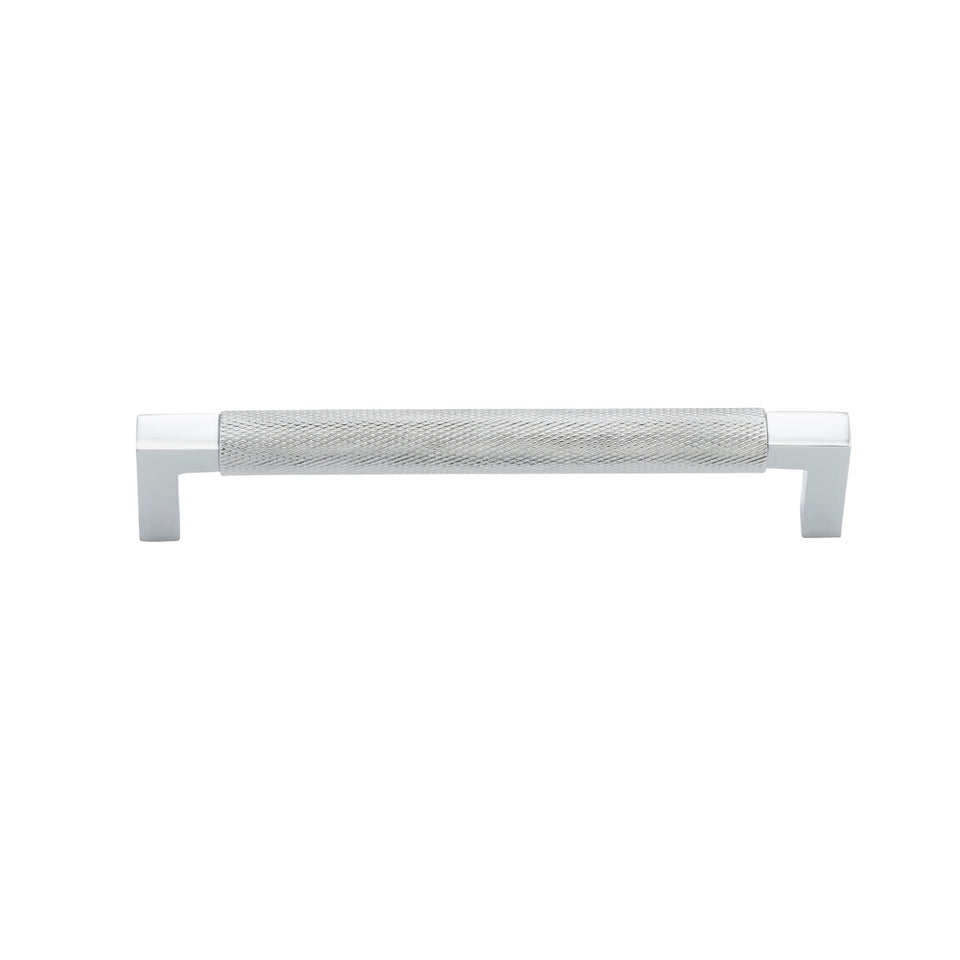
The ranges group by design idea. Slim, plain ranges suit modern rooms: the Iver Cali has a slimline edge, the Iver Baltimore is a slimline pull, the Turner Hastings Fanetta is a slim bar, and the Momo Handles Dallas and Livorno are D handles. Textured ranges add grip and catch the light, and here the Castella Monaco has knurling, the Iver Brunswick has diamond-cut cross knurling and the Turner Hastings Sassari has knurled detailing. Classic ranges suit traditional and Hamptons rooms, and the Castella Century is inspired by classic Italian design, the Castella Windsor is a decorative handle and the Castella Buckhurst draws on Art Deco. The Iver Puerto is a smooth spherical knob, and the Iver Sarlat has a ring at each end of a curved bar.
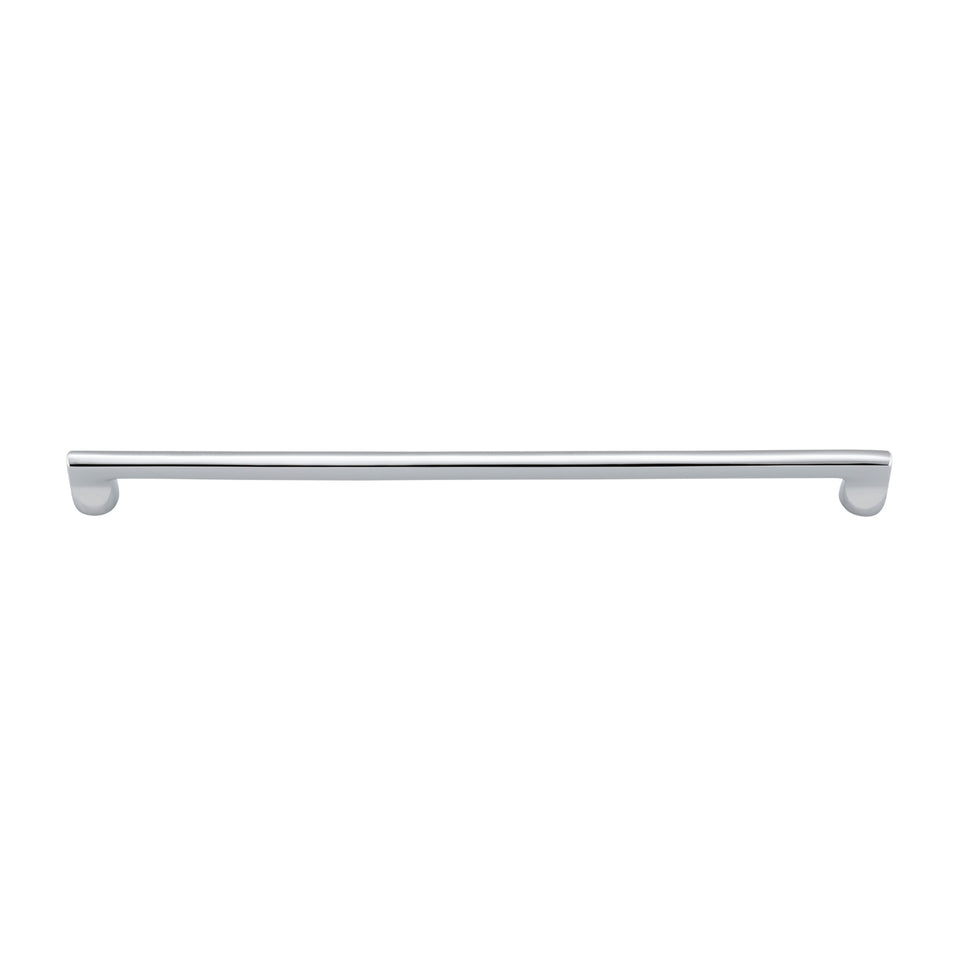
The Iver pulls on this page are brass with a lacquer finish in polished chrome, and each comes with M4 x 25mm and M4 x 45mm bolts. The Iver Cali 256mm pull is 290mm overall, 9mm wide and 28mm off the door. The Iver Helsinki 160mm pull is 205mm overall, 11mm wide and 36mm off the door. The Iver Sarlat 160mm pull is 178mm overall and 43mm off the door, the deepest grip of the group. The Iver Baltimore 320mm pull is 340mm overall, only 8mm wide, and 36mm off the door. The Iver Brunswick 450mm pull is 463mm overall and 40mm off the door, and it fixes on 450mm centres for a tall pantry or wardrobe door. The Iver Puerto 32mm knob is brass with an electroplated finish and stands 29.5mm off the door.
The Castella Century handle is chrome plated zinc alloy in three sizes on 96mm, 128mm and 160mm centres, with overall lengths of 109mm, 140mm and 174mm and two 22mm screws with double-screw fixing. The Castella Cove D pull in chrome is aluminium, 7mm thick, on 128mm, 192mm and 320mm centres with a 30mm projection. The Castella Buckhurst handle, chrome in an Art Deco style, is zinc alloy on 128mm and 192mm centres. The Momo Handles Halden bow handle is chrome plated zinc alloy with a subtle curve on 128mm centres, and the Momo Handles Florencia plain knob is a 29mm chrome plated knob for traditional cabinetry. The Turner Hastings Verona T-knob is brass, while the Sassari knob and Fanetta T-bar are cast iron, all with an electroplated finish and a fixing kit included, for cabinets 28mm to 35mm thick. On some ranges the collection also holds handles in polished nickel, a close relative of chrome with a warmer tone.
A pull is sized by the distance between its two screw holes, measured centre to centre, and not by its overall length. If you are replacing handles, measure the holes in your doors first. The centres people ask for most are 128mm and 160mm, and the exact figures are on each product page. The Momo Handles Dallas D handle comes with fixing distances from 96mm to 448mm, a 12mm width and a 27mm projection, and it suits cabinet thickness of 16mm to 20mm. The Iver Osaka 96mm pull is 111mm overall, 15mm wide and 30mm off the door. The Nero Mecca 36mm knob is 36mm across and 26mm deep, for 15mm to 35mm cabinet thickness. The Castella Century oval knob is 30mm by 19mm with a 17mm projection, and the Zanda Mayfair knob is 32mm. Chrome handles in the wider market run on hole centres from 64mm to 900mm.
A starting rule for length is one third of the width of the drawer or door, so a 600mm drawer points to a handle near 200mm. A standard drawer 450mm to 600mm wide takes 128mm to 160mm centres, a wide drawer takes 256mm to 320mm or two 128mm pulls, and a door takes 96mm to 128mm or a single knob. Knobs of 30mm to 38mm are the usual range. See cabinet handles for the full sizing guide.
Most pulls and knobs on this page fix from the back of the door with M4 screws or bolts, and the spec line says which come in the box. The Momo Handles Dallas D handle lists standard 22mm handle screws as included, and the Iver Osaka comes with M4 x 25mm and M4 x 45mm bolts, so one handle suits two door thicknesses. The Nero Mecca and Turner Hastings knobs list screws and a fixing kit as included. The Castella Windsor handle in this collection lists a 15mm cabinet handle thickness with two 22mm M4 screws, and the Castella Century lists 12mm, 14mm and 16mm for its three sizes. Check the cabinet thickness line against your door, and mark the positions with masking tape or a cardboard template before you drill.
Bathroom handles are where the plating question matters most. Bathrooms are more humid than kitchens, so look for solid brass, stainless steel or a quality PVD finish, and avoid thin electroplated zinc alloy handles in shower splash zones, where they may fail within a few years. Vanity drawers and doors are usually narrower than kitchen ones, so 96mm and 128mm centres are the most common, and handle finishes should be coordinated with the tapware and accessories. Chrome is the finish that most often matches the tapware already in a bathroom, so if your taps are chrome, a chrome handle ties the room together. Finishes need not match exactly, so a chrome tap beside a brushed nickel handle also works. Dry the handles after use, because water spots are what dull chrome. The bathroom vanities page covers the vanity side.
Chrome is the neutral of handle finishes. It suits crisp whites, cooler greys and black, and chrome tapware is a natural match for it in kitchens and bathrooms. Chrome and brushed nickel are classic cool metals that pair easily with stainless steel appliances. If you mix metals, pick one dominant finish and use two at most, and keep the undertones consistent, warm with warm and cool with cool. Black handles with polished chrome is a known pairing, and contemporary kitchens match chrome or brushed nickel bar pulls. Bathroom tapware is on the taps and mixers page. The sibling finish pages show the neighbours: black, white, brushed brass and gunmetal grey.
Chrome care is a short routine: mild dish soap and water on a soft cloth or non-abrasive sponge, a soft toothbrush for crevices, then rinse and dry. Blot chrome dry after use, and an occasional chrome polish adds shine. Avoid abrasive cleansers, ammonia, bleach, acids and steel wool.
For chrome door levers and pulls, see chrome door handles. For makers with a wide chrome range, see Momo premium and the Castella cabinet handles.


