
*View accurate shipping rates and availability






656 Items


Up to 70% off storewide, free metro shipping over $500, and free gifts from $800. Spend more to unlock luxury towels and mirrors.*


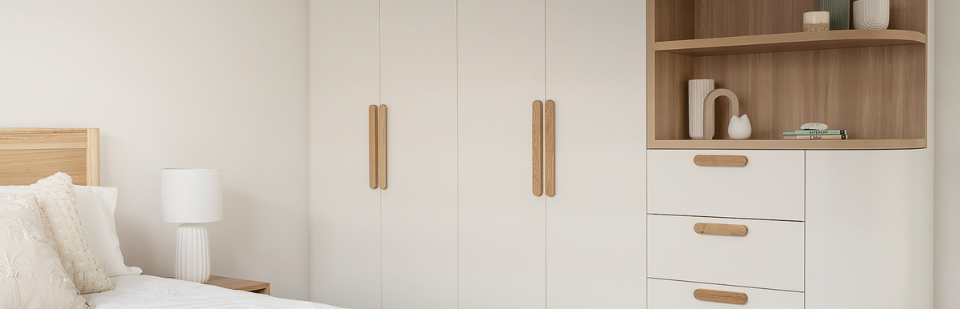


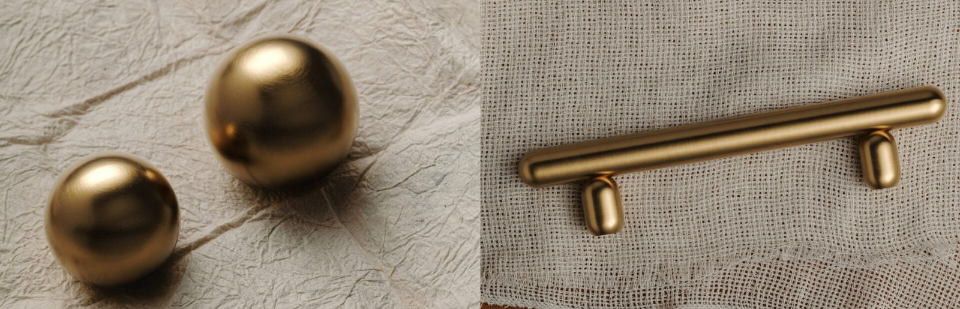


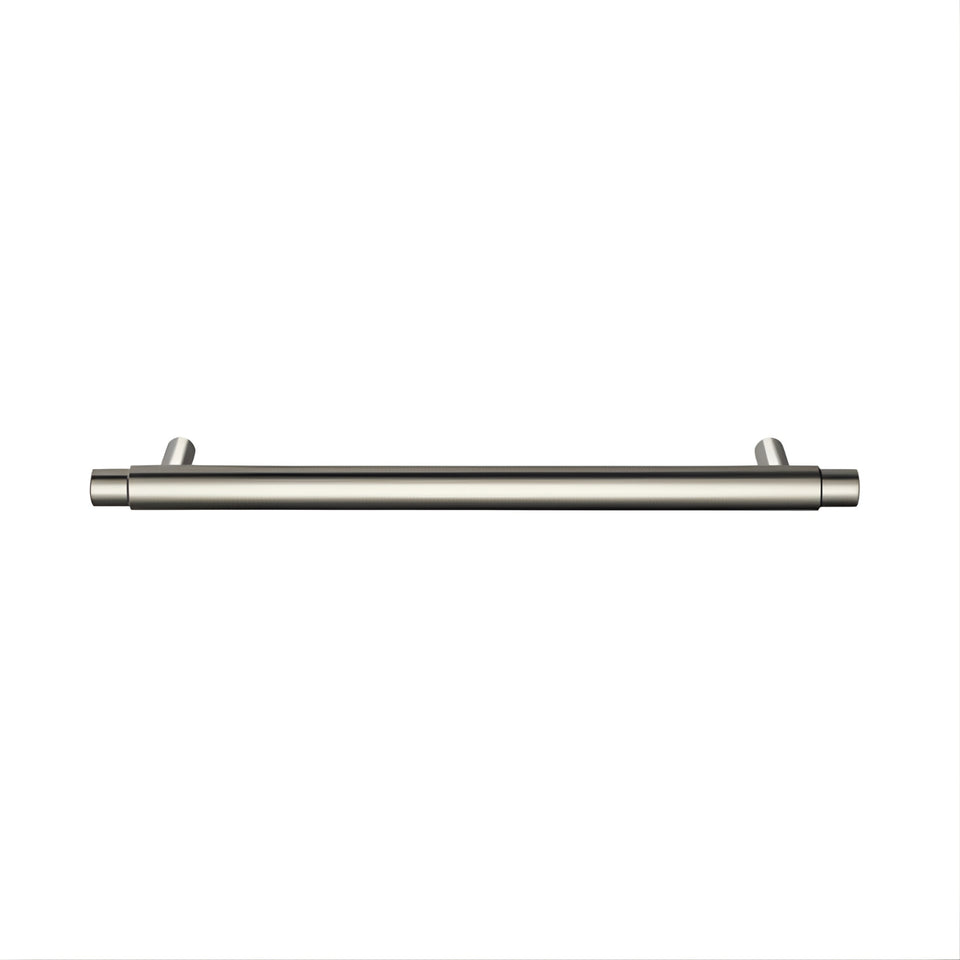
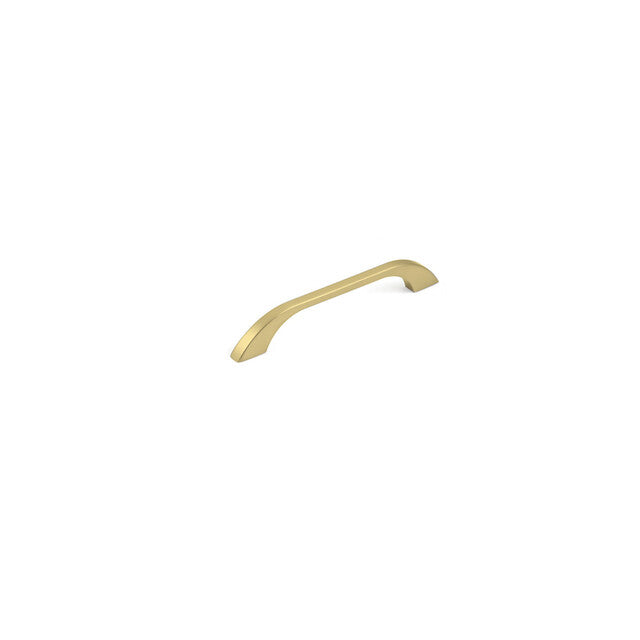
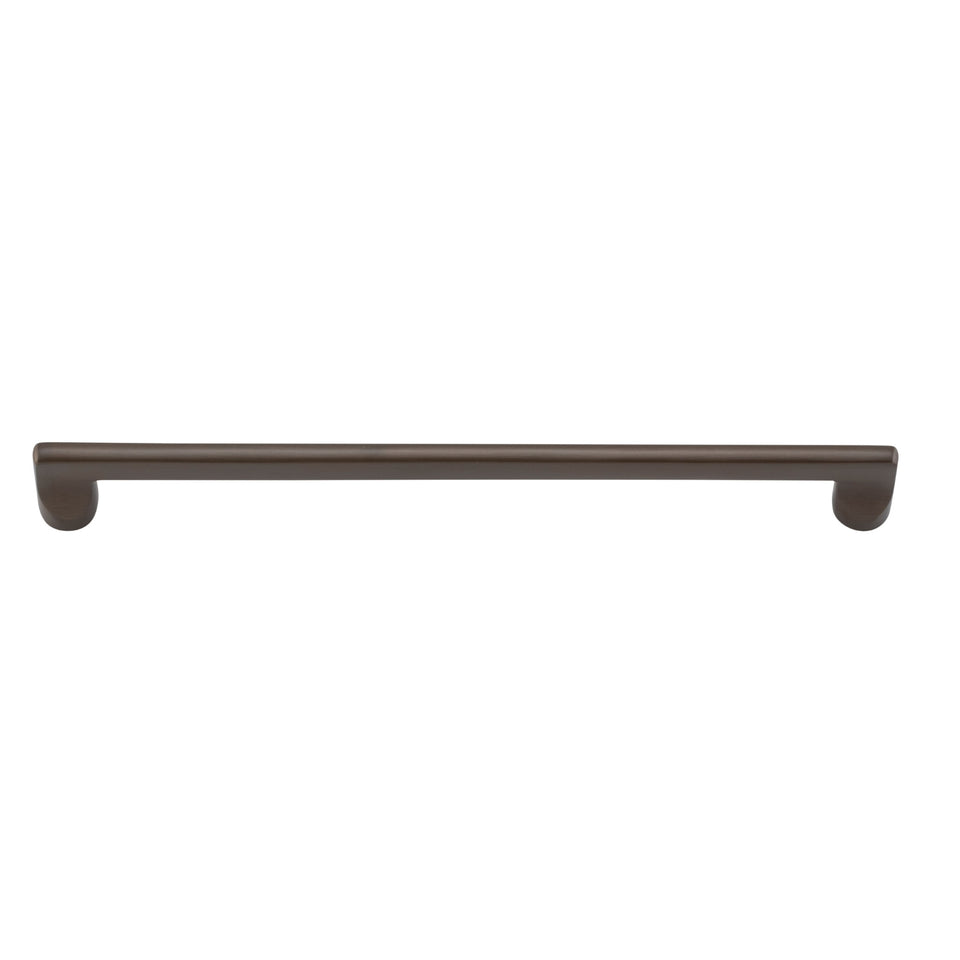


A cabinet pull handle fixes to a door or drawer at two points and gives you a bar, loop or curved shape to grip. This page holds the pulls: bar handles, D handles, T-pulls, bow handles and cup pulls in brass, stainless steel, zinc alloy, aluminium and timber, for kitchen, bathroom, laundry and wardrobe cabinetry. Five decisions settle the order: pull or knob, the size and the measurement it is judged by, where it goes on the door or drawer, the finish, and the fixing. The sections below take them in that order. For handles of every type, start at cabinet handles.
A pull has two mounting points, and a knob has one. Pulls are typically three or four times larger than a knob, and the two mounting points hold up better on heavy drawers. Knobs are simpler to install and can be hard to grip for people with larger hands or limited mobility. Using both is common: knobs on all the doors and pulls on all the drawers, or knobs above the benchtop and pulls below. Handles give a larger, more comfortable grip and more control, while knobs make a smaller kitchen look less busy and fix with one screw.
Two other types sit close to the pull. A lip pull fixes to the edge of the door, and the lip pull handles page covers it. A J-pull is not a handle you buy. An AI answer on the topic describes it as a J-shaped channel cut into the edge of the door or drawer front itself, so it is a joinery profile. Pulls on this page fix to the face of the door. For single-screw handles see cabinet knobs, for the hooded half circle see cup pull handles, and for the long pulls on integrated appliances see appliance pull handles.
Pulls are sold by overall length and by the distance between the two screw holes, measured from the centre of one hole to the centre of the other. Those two numbers are different. Use the overall length when you judge proportion, because it decides how the pull looks, and the centre-to-centre distance when you drill and order, because it decides whether the pull fits the holes. The gap depends on the style: a bar pull with end caps may be three quarters of an inch to an inch longer overall than its centres, and a minimalist edge pull only a quarter of an inch. Read both lines on the product page.
The usual starting point for length is the one-third rule: choose a pull whose overall length is about one third of the drawer width. On a 600mm drawer that points to a pull near 200mm, on a 450mm drawer near 150mm, and on a 900mm drawer near 300mm. It is a rule of thumb and not a law, since style, the sizes available and the feel of the room can justify a different choice. A modern look can run pulls to 40 to 50 percent of the drawer width, and oversized pulls spanning two thirds or more of a drawer suit a sleek, modern look. A smaller, understated look can take a shorter pull.
Apply the rule to the overall length and then choose the nearest centre-to-centre size. By drawer, drawers under 300mm wide suit a pull of 70mm to 100mm or a 25mm knob, tall pantry and cabinet doors suit longer vertical pulls that improve grip and weight balance, and integrated appliances suit pulls of 320mm to 384mm for most models. Doors are tall and not wide, so the rule applies to them only loosely. Use 4 to 6 inches overall for a classic standard door, longer for a modern one, and 10 to 18 inches or more for a pantry door if you want drama.
Placement follows a few rules. On a slab door or drawer, fix the end of the pull 2 to 3 inches, about 50mm to 75mm, from both edges of a door. Drawers can be centred left to right and top to bottom, or centred left to right and kept the same distance, 2 to 3 inches, from the top of every drawer. On a framed door, the traditional position is where the lines through the middle of the stile and the rail cross, and the modern one is centred on the stile. The common layouts: a drawer pull runs horizontally and a door pull vertically, a base cabinet door pull sits near the top corner on the edge opposite the hinge, and a wall cabinet door pull sits near the bottom corner. Keep the position consistent across a run so the handles line up.
Before you drill, test the size with tape. Cut masking tape to the overall length of the pull, stick it where the pull would go, and look from six to ten feet away. Compare three sizes, the target, one shorter and one longer, and check the result against the whole kitchen. A knob should not be wider than the door frame, so it does not extend past the edge and interfere with nearby hardware, appliances or cabinets. See cabinet handles for the full placement guide.
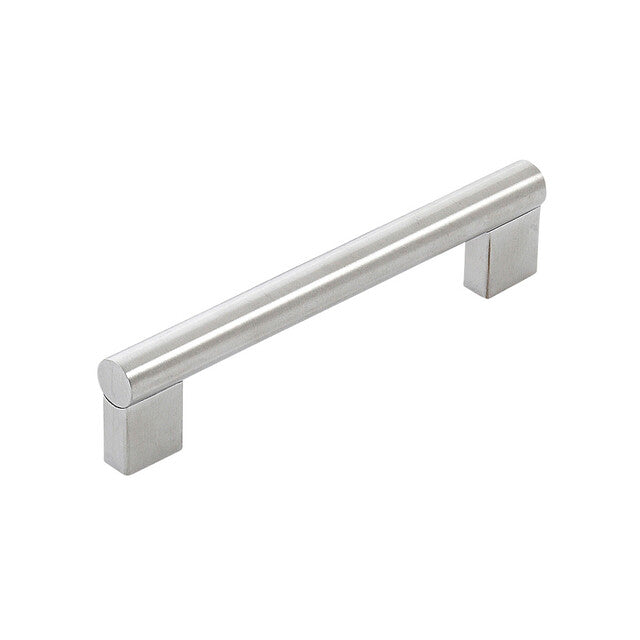
The shape tags on this page are D shaped, square, round, eclipse, rectangular, bow, cup pull, oval and arch. A D handle curves back towards the door and gives a generous grip, a bar handle is straight on two posts, and a bow is an arch of metal. D handles and bar pulls are the styles most often chosen for kitchens, for their easy grip and their fit on drawers, cupboards and pantry doors. The shape pages sort the same pulls by outline: D-shaped, round, square, half-moon and eclipse and arc-shaped.
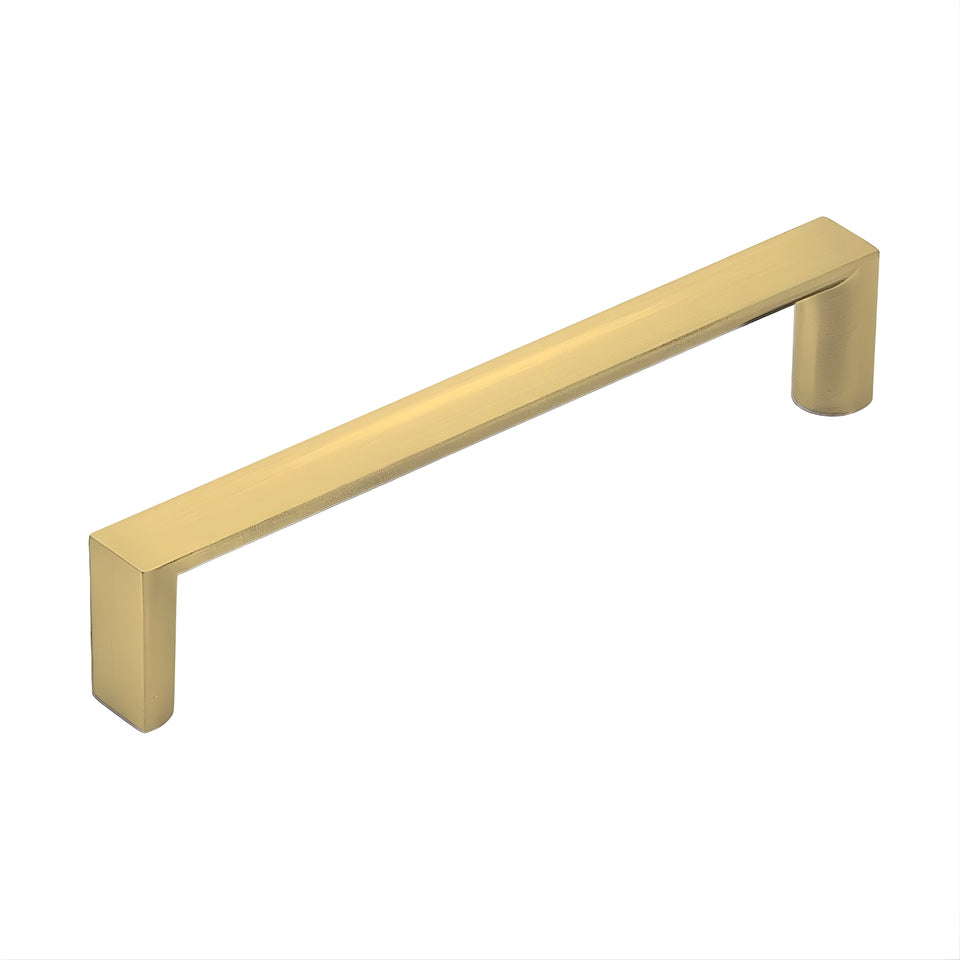
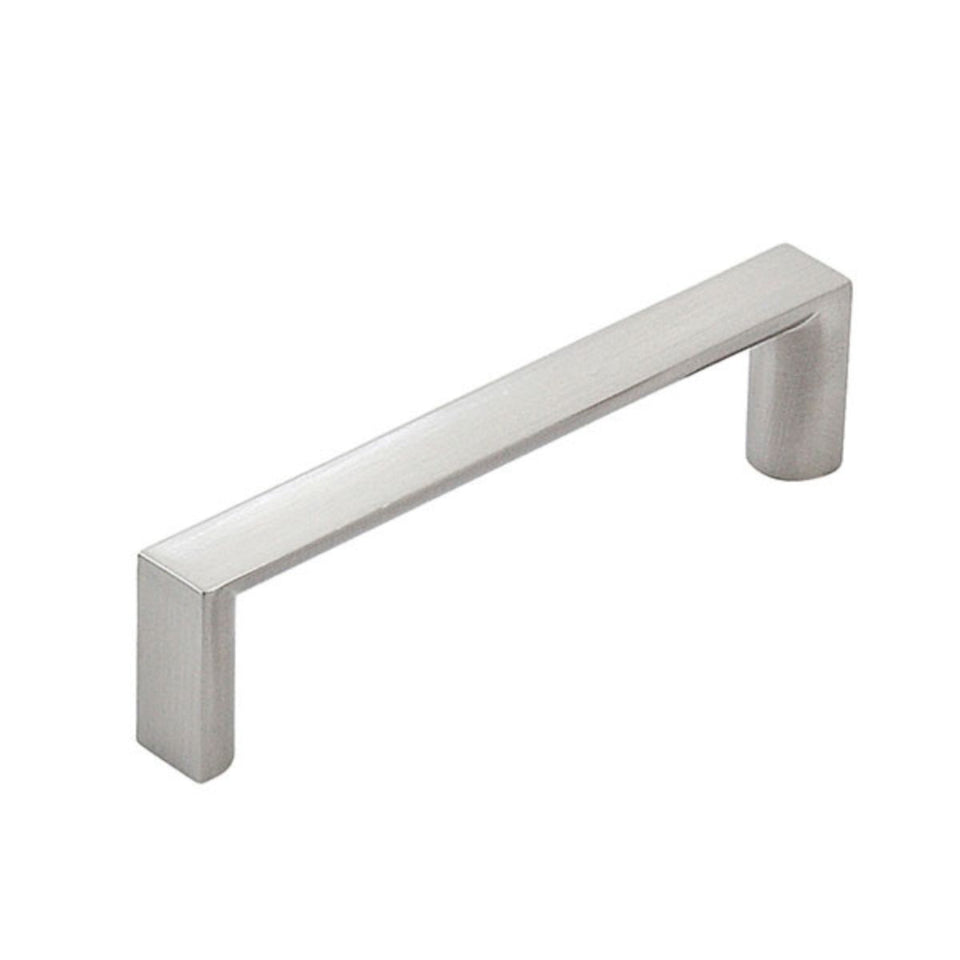
Exact sizes are the best guide to what each range looks like on the door. The Iver Cali 128mm pull is 162mm overall, 9mm wide and 28mm off the door, and the Iver Osaka 256mm pull is 271mm overall, 15mm wide and 30mm off the door. Both are brass with a lacquer finish. The Iver Brunswick 320mm pull is brass with a PVD finish, 330mm overall and 40mm off the door, and all Iver pulls on this page come with M4 x 25mm and M4 x 45mm bolts. The Castella Terrace bar handle comes on 160mm, 224mm and 320mm centres, with overall lengths of 168mm, 232mm and 328mm, an 18mm width and a 29mm projection. The Castella Reed handle is zinc alloy, 10mm thick, on 160mm, 224mm and 320mm centres with a 35mm projection and two 25mm M4 screws. The Castella Stream is a tubular 304 stainless steel pull on centres from 96mm to 480mm with a 32mm projection.
The Nero Mecca 330mm pull is stainless steel, 12mm wide and 34mm off the door, for cabinets 15mm to 35mm thick, and it comes with screws and a fixing kit. The Meir Oppen round pull in 200mm is stainless steel with a PVD finish on 160mm centres and a 30mm projection, and it suits 13mm to 18mm cabinet walls. The Turner Hastings Verona 160mm pull is brass, 200mm overall and 20mm off the door, and the Sassari 160mm pull is cast iron on 128mm centres. The Otti Nord pull is brass in five lengths from 130mm to 380mm on centres of 96mm to 320mm. The Momo Handles Dallas D handle is zinc alloy on fixing distances from 96mm to 448mm with a 27mm projection and standard 22mm handle screws included. The Momo Handles Brooklyn D handle runs from 160mm and 320mm to a 1065mm pull on two sets of 528mm centres, and it is sold without screws. The Momo Handles Liberty bar handle comes on 160mm and 320mm centres, 171mm and 333mm overall, and 30mm off the door.
Vanity drawers and doors are usually narrower than kitchen ones, and 96mm and 128mm centres are the most common there. Bathrooms are more humid than kitchens, so look for solid brass, stainless steel or a quality PVD finish, and avoid thin electroplated zinc alloy handles in shower splash zones, where they may fail within a few years. Coordinate the handle finish with the tapware and accessories. The bathroom vanities page covers the vanity side.
The finish decides the character of a pull, and the material decides how it wears. The catalogue covers brass, solid brass, zinc alloy, stainless steel, aluminium, cast iron and timber. Brass and stainless steel are the durable bases, with a coating such as PVD, electroplating or lacquer over them. The finish pages go into each in detail: brushed brass, brushed nickel, black, white, chrome, gunmetal grey, bronze, champagne and timber. For materials, see solid brass, stainless steel and aluminium.
Most pulls fix from the back of the door with M4 screws or bolts, and the spec line says what comes in the box. Some handles include the screws and some do not, and the Momo Handles Brooklyn is sold without screws, so check the line before you order. Match the screw length to the door thickness. Mark the positions with masking tape or a cardboard template and look at them from standing height before you drill.
You can replace cabinet pulls without touching the doors if the new ones fit the old holes. Measure the centre-to-centre distance of the existing holes, and choose a pull with the same centres. Matching the spacing means no new holes are needed in the cabinet faces, which spares you patching and repainting. If you want a different size, a backplate or an edge pull can cover the old holes. For new doors, decide the centres first and have the cabinet maker drill to them, then choose the pull to suit.
For pulls on entrance and internal doors, see door pull handles. For makers with a wide pull range, see Meir Oppen, Momo premium and the Castella cabinet handles.


