
*View accurate shipping rates and availability






3 Items
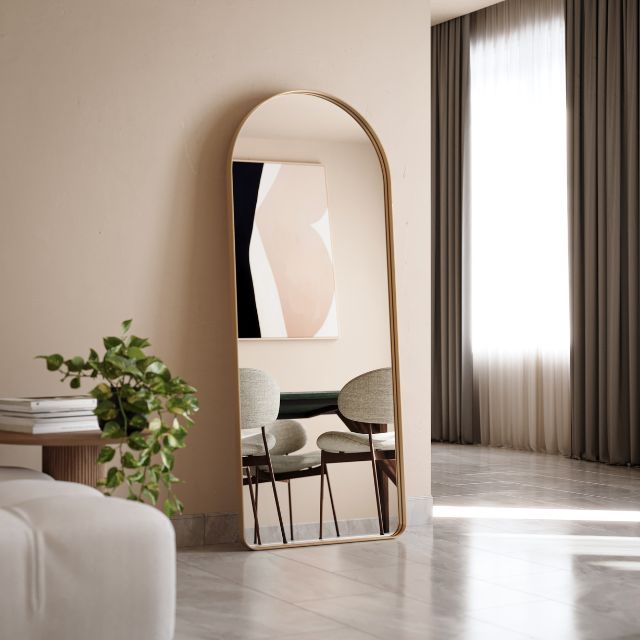
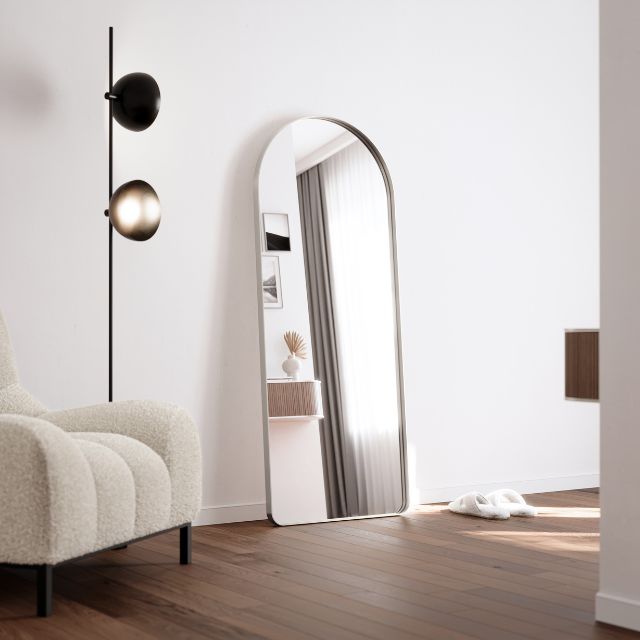
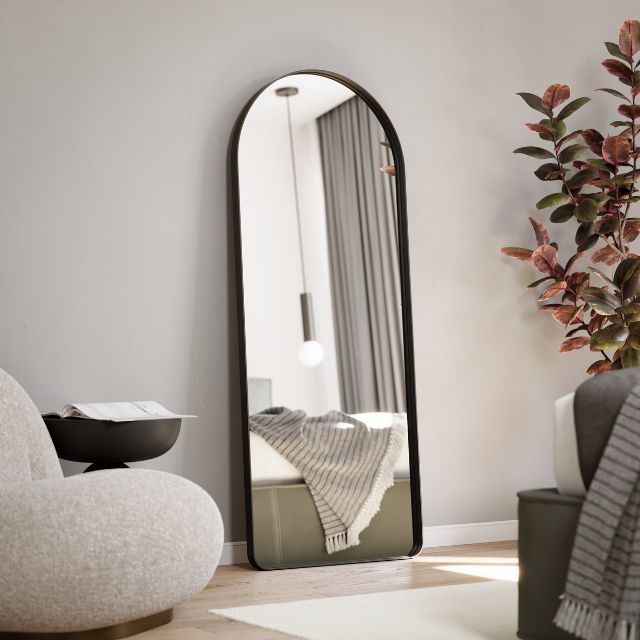
A full length mirror has to be tall enough to show you from head to foot, wide enough to feel balanced, and fixed so it cannot tip. The practical call: a mirror 1500mm to 1800mm tall and 500mm to 800mm wide, hung or leaned with the base a short distance above the floor, and anchored into the wall rather than relying on plasterboard alone. The mirrors in this collection are arch shaped, 600mm wide by 1500mm tall, in brushed nickel, brushed gold and matt black, and each can hang on the wall or stand on the floor. People search for them as full length, full body, long and full size mirrors, and the buying questions are the same. The sections below cover size, width, height, mounting, placement, frames and glass.
The collection holds one design: an arch shaped aluminium-framed mirror 600mm wide and 1500mm tall, 38mm deep, portrait only. It can be wall hung or used as a floor standing mirror, with screw fixing for the wall and brackets for floor standing, and the glass is 5mm copper-free. It comes in three finishes, brushed nickel, brushed gold and matt black. There is no frameless, rectangular or wider full length mirror in this collection. For lit arch mirrors and shorter arches, see arched mirrors, and for mirrors of every size on the wall see wall mirrors.
Height is the defining figure, and the range is well settled. Full length mirrors commonly measure between 1.5 and 1.8 metres in height. Most people choose 150 to 180cm to see their full reflection in bedrooms, hallways and dressing areas, and taller mirrors of 180 to 220cm suit high ceilings and feature walls. In feet and inches, 1500mm is about 59 inches, 1800mm is about 71 inches and 2000mm is about 79 inches.
Width follows the wall and the space. A medium width of 50 to 80cm is the safest choice for balanced proportions, with narrower mirrors suiting tight spaces such as hallways and small bedrooms. In inches, 16 to 20 inches suits narrow spaces, 20 to 30 inches is the most common full size width, and 30 inches and above suits large statement mirrors. By placement, 20 to 30 inches suits a wall-mounted bedroom mirror, 24 to 32 inches a dressing area, 18 to 24 inches a hallway and 30 inches and over a decorative living room mirror.
The 600mm width of the mirrors here is about 24 inches, inside those ranges. It suits a hallway, a bedroom wall and a dressing area. Head-to-toe visibility with space around you needs at least 30 inches, or about 760mm, so a 600mm mirror shows a narrower view of the sides than a wider one. For small bedrooms, 18 to 24 inches is the usual width, which is where this mirror sits. A second rule applies to the wall: a mirror covering about two thirds to three quarters of the wall space is a good rule of thumb, which suits a feature wall, not a narrow arch.
This mirror can be wall hung or floor standing, so the choice is yours. Floor or standing mirrors need no installation, which suits renters, and leaning mirrors need no drilling. Wall-mounted mirrors keep the floor clear in compact spaces. This mirror includes brackets and hardware for plaster or masonry walls, which helps prevent tipping.
A leaning mirror needs securing at two points on the wall to prevent tipping or slipping. Anti-tip hardware or adhesive strips can anchor the base of a leaned mirror without drilling, and an anti-tip strap is a sound addition in homes with children or pets. The Ingrain mirror comes with brackets for floor standing, so use them as intended and add a wall anchor at the top if the mirror leans. A full length mirror is tall and has a high centre of gravity, so a mirror left leaning unsecured is a safety risk.
A full length mirror carries weight, and the fixing rules are clear. Mirrors heavier than 20kg need heavy-duty wall anchors or metal brackets. The fixings must reach solid material, which means studs or noggins behind plasterboard, or masonry behind tiles, and plasterboard alone will not hold a tall mirror. Fixings are usually not supplied, so choose ones rated for the wall and the weight, and find the load each must carry by dividing the mirror's weight by the number of fixing points.
Hanging a full length mirror comes down to the base and the top. Place the bottom of the glass a short distance above the floor or skirting, and check that the top clears the tallest person's head. There is no fixed figure, so work it from your own measurements. With a 1500mm mirror, a base 100mm above the floor puts the top at 1600mm. Average eye level runs from 1600 to 1750mm, so work from the people who will use it, measure their eye height and check where it falls on the glass.
Familiar positions work best. Full length mirrors suit the living room, bedroom, hallway and dining room, behind a sofa, beside a window, opposite a feature wall or in a corner, with tall, narrow mirrors for narrow hallways. Standing mirrors work well near wardrobes and wall-mounted mirrors suit entryways, and tall mirrors add vertical emphasis. A narrow arch, 600mm wide, fits those hallway and wardrobe uses well.
Check the route into the room before you order. A mirror 1500mm tall and 600mm wide fits through a standard doorway on its edge, but a turn on a stair or a tight hallway can stop it, so measure every doorway and corner between the delivery point and the wall. Measure the floor too. A leaning mirror sits best on a flat, hard floor, and a thick skirting board holds the base away from the wall, which changes the angle of the glass.
A tall mirror takes little floor space and gives a small room depth. Tall, narrow mirrors suit narrow hallways, and a mirror should cover at least half the wall it is on, with long mirrors suiting narrow walls. A 160cm mirror in either shape makes a small space feel bigger, and the curved top of an arch draws the eye upward, which suits a room with a low ceiling. A mirror across from a window reflects natural light, and pointing lamps at a mirror makes it reflect more light.
Thin frames suit modern interiors and thick frames suit larger rooms and traditional settings, and metal frames in gold, silver and bronze are among the most sought-after finishes. The Ingrain arch mirrors have aluminium frames in brushed nickel, brushed gold and matt black. Pick the finish to match the room: brushed gold for warmth, matt black for contrast and brushed nickel for a cooler, neutral look. If the mirror is in a bathroom, match it to the tapware: brushed nickel tapware, brushed brass taps or black taps.
The glass is 5mm copper-free, which is what gives it corrosion resistance. That matters in a bathroom: moisture gets into a mirror through the edges and through micro-scratches in the protective paint on the back, and copper-free or edge-sealed glass slows the oxidation that causes black spots. Timber frames can swell, MDF can delaminate and metal frames can rust, and powder-coated aluminium suits frames. A full length mirror in a bathroom should sit out of direct shower spray, and the exhaust fan should run during the shower and for at least 15 minutes afterward. A full length mirror is tall, so it spans more of the wall that gets steam than a vanity mirror does.
The facts sit in a fixed order on the product page, so check them in turn. Start with the overall width and height, 600mm by 1500mm, then the depth, 38mm, and the orientation, portrait only. Read the installation line, which states wall hung or floor standing, and the wall mounting line, which states screws and hangers. Check the glass line for 5mm copper-free glass, and the box contents for the mirror and an installation and owner's guide. A specification sheet and a product manual are available for download, and both are worth opening before you drill, because the hanger positions and the weight are on them. If you plan to lean the mirror, confirm that the floor standing brackets suit your skirting and floor.
Clean an LED demister mirror with a soft microfibre or lint-free cloth rinsed in warm water and wrung out, then wipe gently with a soft dry cloth. Avoid glass cleaner, window cleaner and chemical agents, because they can damage the silver coating. On a full length mirror, wipe the frame as well as the glass, and keep liquid away from the bottom edge, where a floor standing mirror collects splashes and dust. Check the frame and fixings once a year for rust, swelling or deterioration.
The short version:
The final check is the same for every full length mirror: height against your own, width against the wall, fixings against the weight and light against where you stand. For the other shapes and sizes see round mirrors, framed mirrors and Ingrain mirrors.


