
*View accurate shipping rates and availability






28 Items


Up to 70% off across the store, plus free towels and mirrors up for grabs on orders over $800*
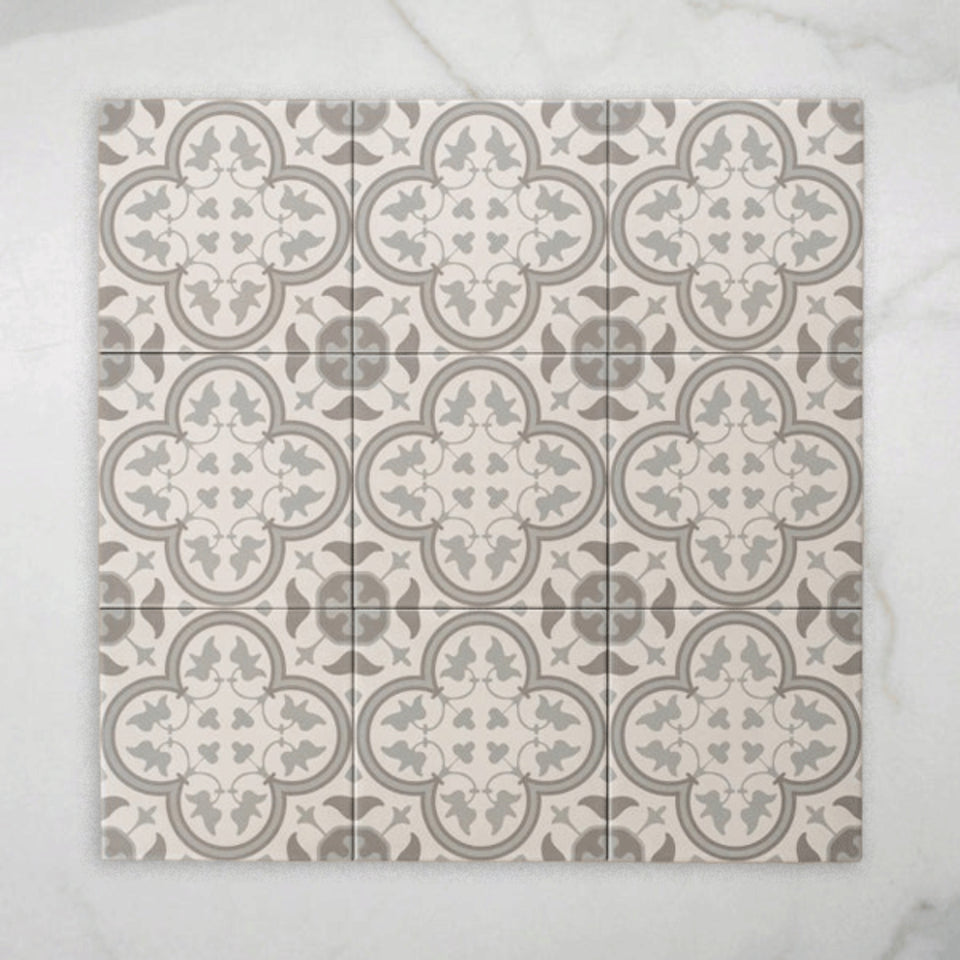


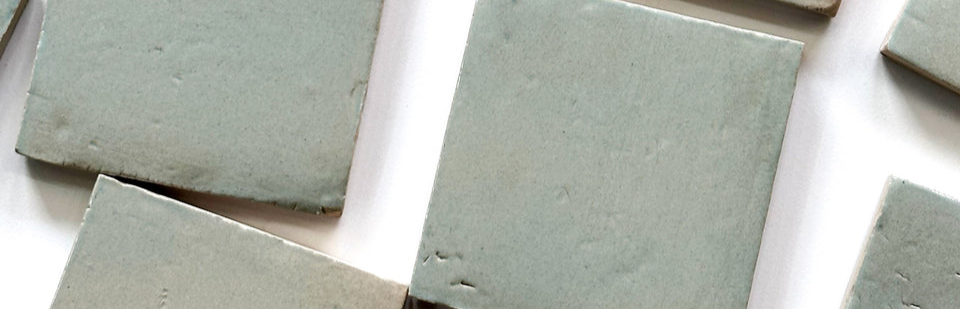


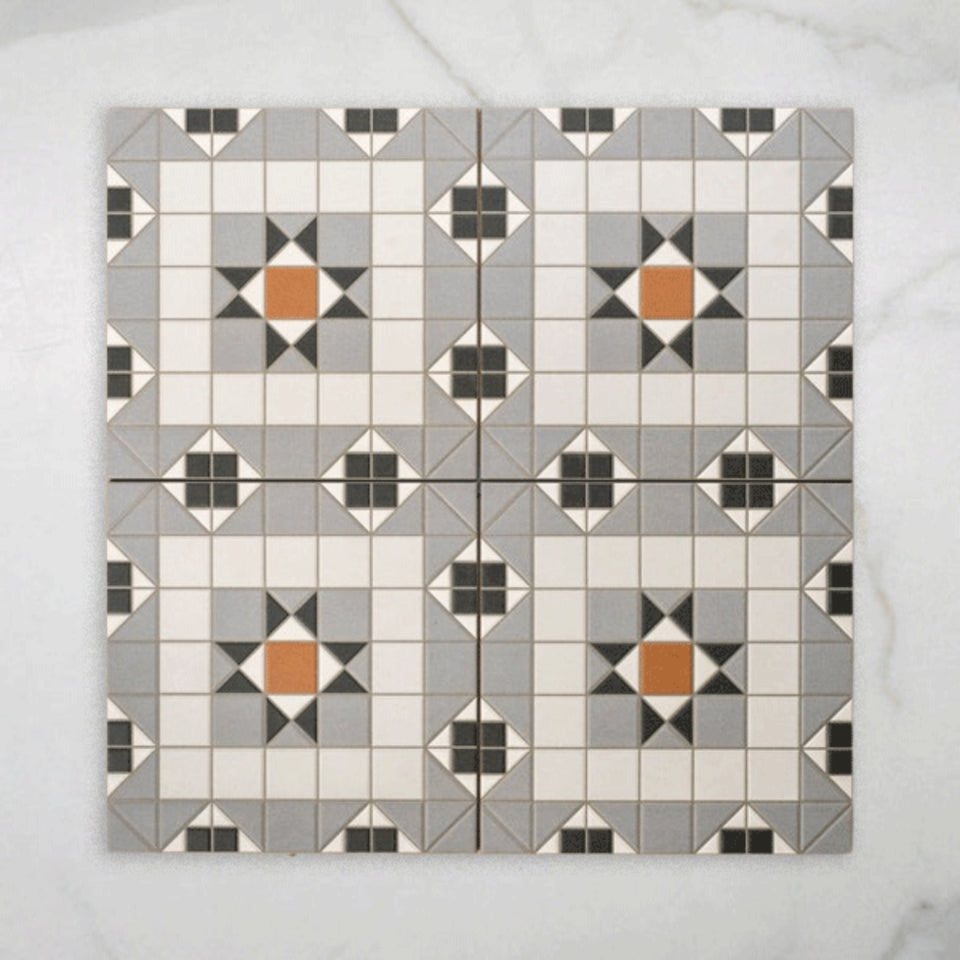




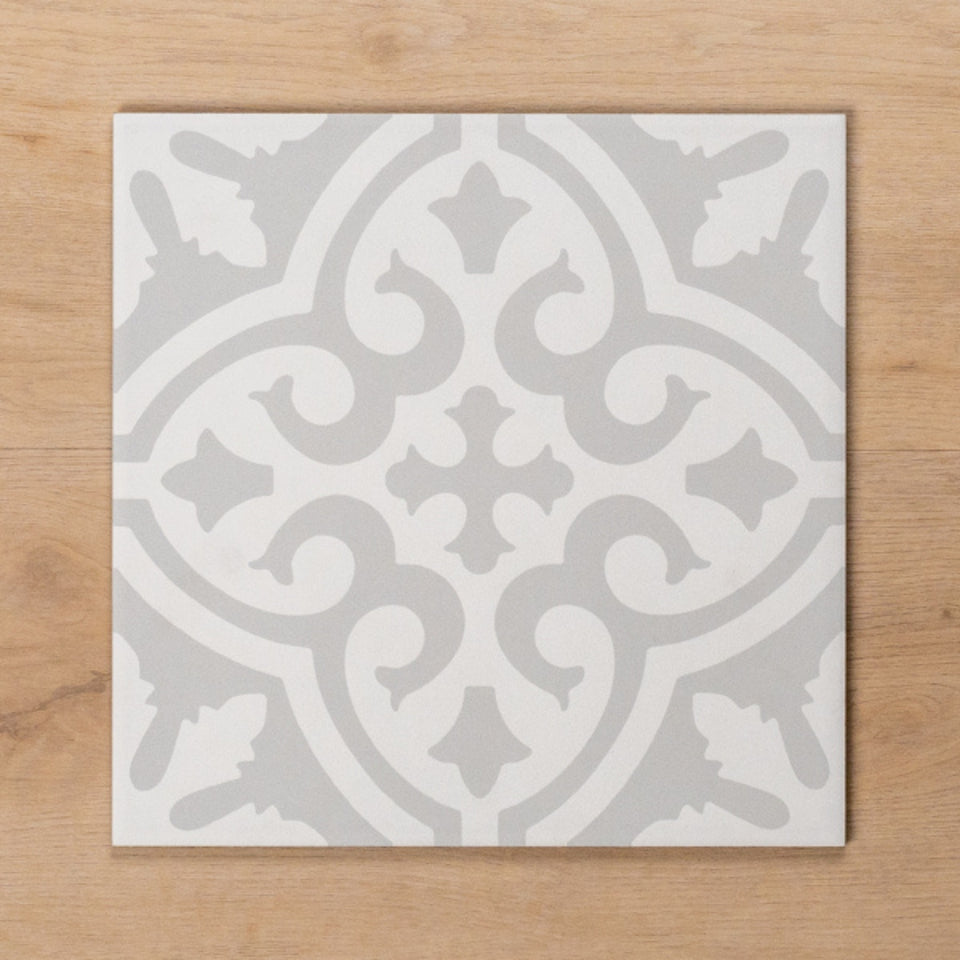
Patterned tiles carry a repeating design instead of a plain colour. This collection holds seven ranges in glazed porcelain: Tamarama, an encaustic pattern, St Kilda, an octagon and dot mosaic, Alicante, federation style geometrics, Airlie, a traditional pattern, Meander, a fish scale, Soluna Arc, an arc design with embossed gloss, and Matrix, a tessellated marble look. Most are small squares from 150 x 150mm to 316 x 316mm.
The sections below explain how porcelain differs from cement encaustic tiles, which ranges suit a bathroom floor, how to scale and pair a pattern, and what each tile carries in its spec block. For related looks, see the Moroccan tiles collection, the mosaic tiles collection and the feature tiles collection.
Encaustic tiles are cement tiles, also called concrete tiles, made with steel stencils and wet, dyed cement that creates the pattern in contrasting colours. The craft is still done by hand in workshops around the world. Because cement is porous, the tiles need sealing before installation, so adhesive and grout do not mark them, and resealing every couple of years depending on wear.
A porcelain encaustic look tile is the choice for a shower base and for outdoor areas fully exposed to the weather, because porcelain can handle moisture and the pressurised water and calcium build-up in a shower. Porcelain pattern tiles replicate the encaustic look but are fired at high temperatures, which makes them non-porous and means they need no sealing.
That is what this collection holds: patterns printed on and fired into glazed porcelain. You get the look of an old cement tile floor with the care of a porcelain one. The actual cement tile is a different product, with a sealing routine of its own.
Each range carries its own details in the spec block. These show the spread.
Tamarama is a modern take on a classic encaustic pattern, in a matte finish on a 300 x 300mm tile. It is Australian made and comes in five colours. Alicante is a federation style range of six patterns and colour palettes in geometric shapes, in 316 x 316 x 9mm tiles with a cushioned edge. The tiles are Spanish made and draw on old world tessellated mosaics.
Airlie is a traditional pattern in 200 x 200mm tiles, in three colour mixes. Meander is a fish scale curve in 200 x 200mm, in beige, green and blue. Matrix is a tessellated marble look in 200 x 200mm. Soluna Arc is a 150 x 150mm tile with a patterned arc design, alongside plain colours.
St Kilda is the mosaic: 97 x 97mm octagons with a contrasting dot, set on 300 x 300mm sheets, in white with a black dot and cream with a burgundy dot, in matte and gloss. For that style on its own, see the octagon dot tiles collection. For Tamarama's colours and the other made in Australia ranges, see the Australian made tiles collection.
Bathroom floors are one of the best places to use patterned tiles. The pattern gives the room interest at ground level, and the walls can stay quieter. Choose tiles that suit wet area use and check slip suitability before buying, using AS 4586:2013, the Australian slip resistance standard commonly used for these ratings.
AS 4586 classifies the slip resistance of new pedestrian surface materials, and its wet pendulum test uses ratings from P0 to P5. The rating applies to floors people walk on, not to feature walls. The floor-rated ranges in this collection are Tamarama, Alicante, Airlie, Meander and Matrix, which are P3. Tamarama adds the right level for wet areas such as bathrooms, kitchens and laundries: P3 or greater. Alicante, Meander and Matrix are P3 and suitable for flooring in dry areas.
Read that wording closely. A P3 tile is a moderate slip risk, and the dry area note on three of the ranges means they are for floors that stay dry. No single rating suits every bathroom, so confirm what the exact surface needs with your builder or tiler. The floor tiles collection explains slip and wear ratings, and the bathroom tiles collection sorts tiles by room.
Not every range is a floor tile. St Kilda has a Wear Rating of 2, suitable for floors in light traffic areas with soft soled shoes, with a high risk of scratching, and it suits bedrooms and bathrooms. Soluna Arc carries Application Walls and Not Slip Rated, so it is a wall tile only.
Patterned walls work well in powder rooms behind a vanity, where people spend less time and a bolder tile is easier to place, and in kitchen and laundry splashbacks, where the tile adds detail without taking over the room. For wall formats by size, see the wall tiles collection.
Pattern scale changes how a room reads. A small repeat can feel busy in a large area, while a large pattern can lose impact in a narrow space, and scale is hard to judge from a single sample, so bring room measurements when you choose. Larger tiles can make a room feel more spacious, while smaller tiles create texture and visual interest.
The tiles here are mostly small, which gives a fine repeat. In a small bathroom or powder room that suits the scale of the space. Across a very large floor, use care: a pattern that looks right on a single tile can feel much stronger when it covers a big area. A 316 x 316mm Alicante tile has a larger repeat than a 150 x 150mm Soluna tile, so the same pattern idea reads differently by range.
The easiest way to make patterned tiles work is to pair them with plain tiles that share one colour or tone. Choose a wall tile in one of the background tones of an encaustic look floor, and treat patterned tiles as a feature choice and not a whole room default.
A simple rule follows. Use the pattern in one zone, such as the floor, the vanity wall or the splashback, and let the surrounding tiles stay quiet. A plain tile in the pattern's background colour ties the two together. For plain colours across the store, see the tiles collection.
Meander has a calm matte finish that suits kitchens, bathrooms, laundries and more, and the fish scale curve adds warmth, movement and a touch of playful texture. Splashbacks sit in a defined area, so the tile adds detail without taking over the room, and laundries often have simple cabinetry and not much else, so a patterned splashback can bring the room to life without changing the layout.
Pair a strong pattern with a calm benchtop, and sample it beside a heavily veined one first. Lay a sample against the benchtop and the cabinet door before you order, and view it in the room's own light. For a calmer neighbour, a plain tile or the terrazzo look tiles collection gives pattern with a softer repeat.
All the ranges here are non-rectified, and several have a cushioned edge, a soft, tactile edge. Non-rectified tiles need a wider joint than rectified ones. Meander and Matrix need a gap of over 3mm, and Airlie and Alicante carry no gap line. The cushioned edge tiles have naturally irregular edges.
The joint matters more on a pattern tile than on a plain one, because the grout line becomes part of the design. A joint close to the background colour of the tile keeps the pattern continuous, and a contrasting joint outlines each tile. Ask your tiler to confirm the width for the range you choose, and lay a few tiles dry to see how the pattern joins at the corners.
The sizes run from 150 x 150mm to 316 x 316mm, with St Kilda in 300 x 300mm sheets of small octagons. A 300 x 300mm tile has its own page too, and the 300mm x 300mm tiles collection covers that format across the store.
Thickness differs by range: Alicante is 9mm, Airlie is 8mm, Meander and Matrix are 7.5mm and Tamarama is 6.3mm. If a patterned floor meets another tile, check the Thickness lines, because a difference at the threshold is something to plan with your tiler.
If the pattern you want is not here, the neighbouring collections cover it. For small handmade look tiles, see the zellige tiles collection. For tiles laid at an angle, see the diamond tiles collection. For a speckled pattern, see the terrazzo look tiles collection, and for a marble pattern, the marble look tiles collection.
Order an extra 15 percent of tiles over the exact quantity required, to cover breaks and offcuts. A pattern tile also needs spare for cuts that fall at awkward points in the repeat. Colour, size and texture may vary from batch to batch, so ordering enough at once lowers the chance of a mismatch if more is needed later.
Keep spare tiles from the same order. Patterned tiles are printed in batches, and the colour of the pattern can shift slightly from one batch to the next, so one order for the whole floor keeps the repeat even and gives you tiles for later repairs.
An entry floor 1.8m by 1.2m is 2.16 square metres, or 2.48 square metres with 15 percent for cuts. A box of Tamarama 300 x 300mm covers 1.98 square metres, so the order is 2 boxes.
Start with the room. For a dry bathroom floor or a hallway, the P3 ranges are the ones to read first. For a wall, any range can work, and Soluna Arc and St Kilda are the ones made for walls and light traffic. Then pick the scale: a large repeat for a feature, a fine repeat for a small room.
Then settle the pairing and the joint. Use plain tiles in one background colour, keep the pattern in one zone, and choose a joint that either quiets or outlines the design. Order a sample, lay it flat and upright, and look at it under the light of the room.


