
*View accurate shipping rates and availability






6 Items


Up to 70% off across the store, plus free towels and mirrors up for grabs on orders over $800*
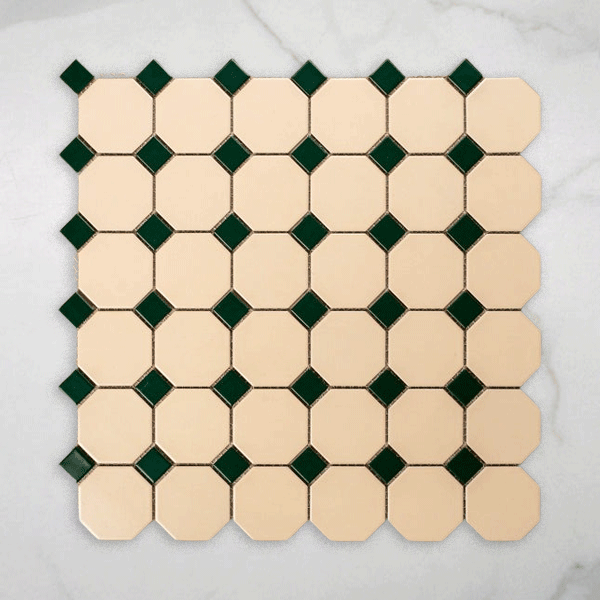
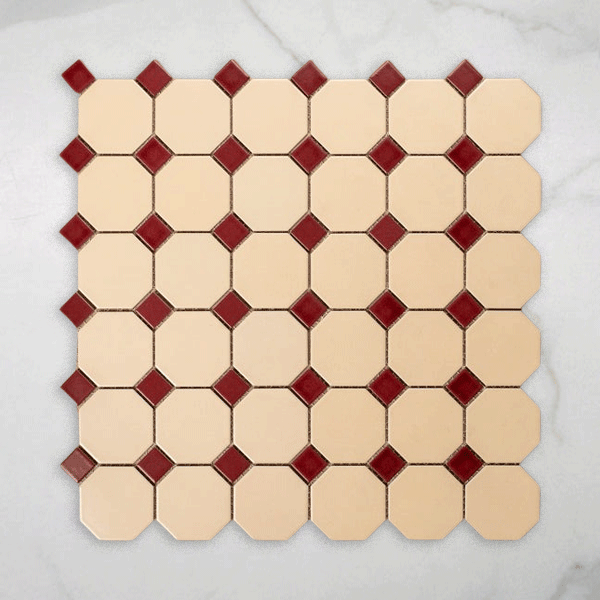
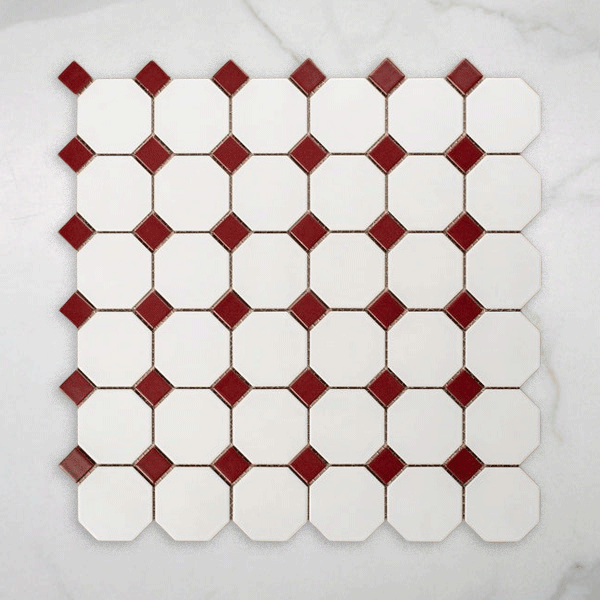
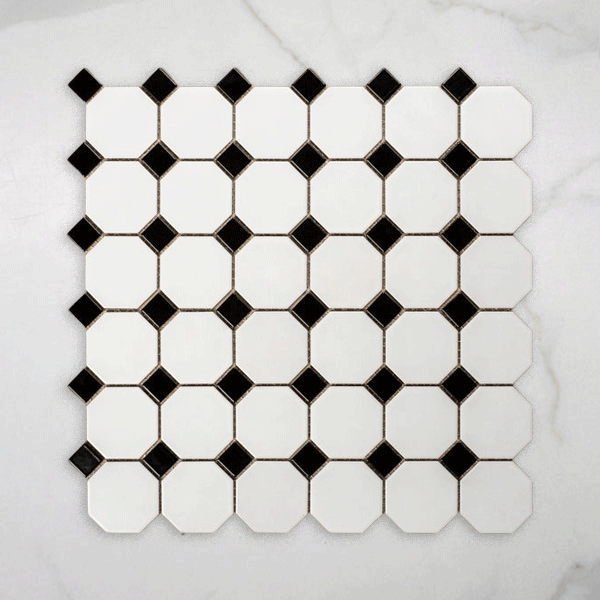
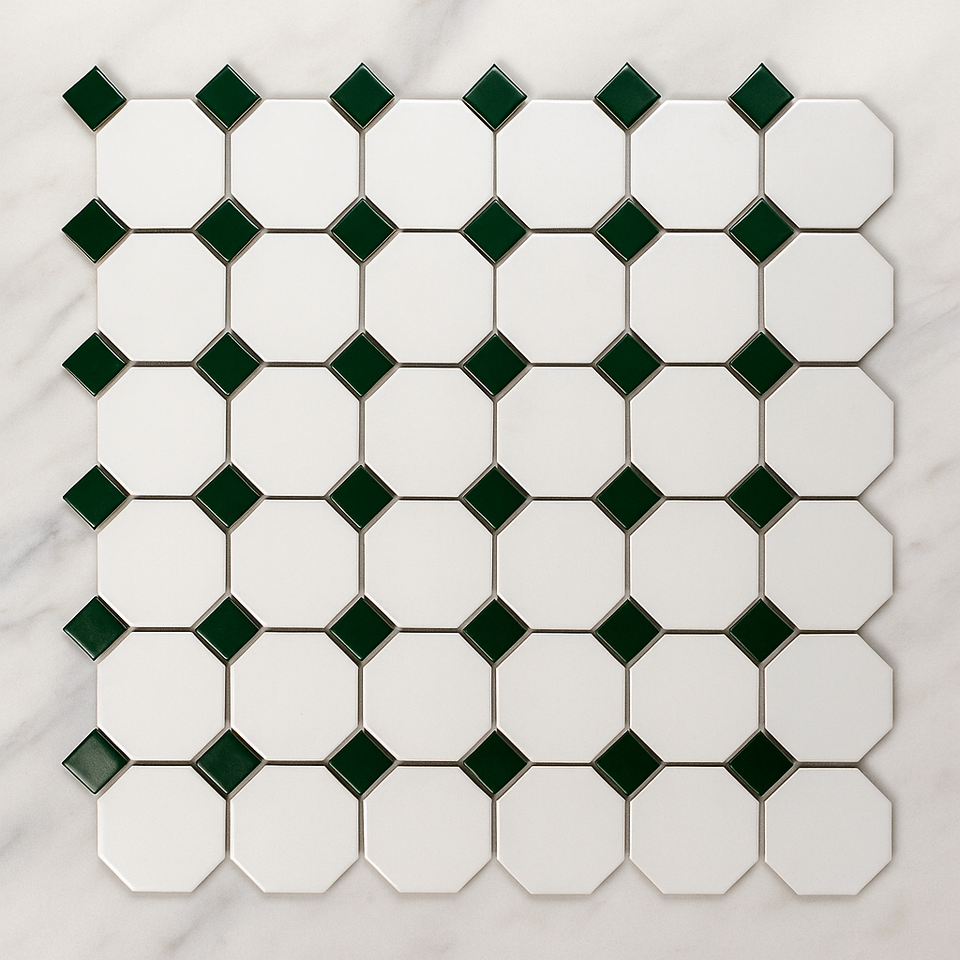
An octagon and dot tile is an eight-sided tile with a small contrasting square, the dot, filling the gap where four octagons meet. This collection holds one range, St Kilda, in porcelain. The tiles come as mosaic mosaics of 97 x 97mm octagons, in white with a black, green or burgundy dot, and in cream with a burgundy or green dot, in matte and gloss.
The sections below explain the pattern, what each St Kilda tile carries for wear and edge, where the tiles can go, and how to grout and pair them. For related collections, see the mosaic tiles collection, the patterned tiles collection and the bathroom tiles collection.
The octagon and dot layout is a tessellation: octagons cannot fill a surface alone, so a small square tile fills the space between them. On the St Kilda mosaics the octagons are white or cream and the dots are black, green or burgundy. The effect is tonal contrast between light and dark accents against a clean matte surface, a classic period style with a modern twist.
All six tiles share the same format. The octagons measure 97 x 97mm, set on a mosaic of about 310 x 310mm, and the Dimensions line on the matte pages reads 300 x 300mm. The material is porcelain, the edge is cushioned and non-rectified, and the Appearance line reads V1, a uniform overall appearance with minimal texture and colour variation.
Because every mosaic looks the same, a floor made of St Kilda will repeat cleanly. There is no shade variation to blend across boxes the way there is with a stone look. What changes between tiles is the colour pair and the wear line. The pattern comes in other colour combinations too, including white and black, white and green, white and burgundy, cream and green and cream and burgundy, which matches the range of colours here.
For other small formats and mosaics, see the small tiles collection.
The wear line is the one to read first, because it differs by tile. The matte white tiles with a black, green or burgundy dot have a Wear Rating of 2, suitable for floors in light traffic areas with soft soled shoes, with a high risk of scratching. They suit bedrooms and bathrooms.
The gloss white and black tile is Floor Category 1. It suits interior wall and floor surfaces exposed to low-abrasion wear with bare or soft-soled shoes, such as a residential ensuite bathroom with no external entry. The cream and burgundy tile is Floor Category 2, suited to regular wear with soft shoes or bare feet and occasional exposure to abrasive dirt, with bedrooms or main bathrooms as common uses.
Put plainly, these are light-duty floor tiles. They suit a bathroom or bedroom where people walk in barefoot or in soft shoes, and they are not the tile for an entry that takes street shoes and grit. For heavier floors, see the floor tiles collection.
None of the six carries a slip rating. AS 4586 classifies the slip resistance of new pedestrian surface materials, and its wet pendulum test uses ratings from P0 to P5. The rating applies to floors people walk on, and it does not matter for a feature wall.
That has a practical consequence. For a wet bathroom floor, a shower base or any area that gets wet underfoot, ask the store for the slip rating before you order, and confirm with your builder or tiler what the area needs. A tile with a gloss finish needs the most care here. For a wall, such as a splashback or a feature panel, the missing slip line does not matter.
Most of the St Kilda tiles are tagged as floor tiles, and two are tagged as wall tiles. The same tile can be used on a floor if the wear line allows it and on a wall without a wear question at all. Bathroom floors are one of the best places for patterned tiles, because the pattern gives interest at ground level and the walls can stay quieter, and powder rooms can handle stronger pattern because people spend less time in them.
A patterned wall behind the vanity makes a powder room feel finished without many accessories. An octagon and dot mosaic is a good candidate for that wall: the pattern is strong, the mosaic is easy to set, and the wear question does not arise. For wall formats, see the wall tiles collection.
The cushioned edge tiles need grout lines of 3mm or more for a classic tiled appearance, and the cushioned edge gives a soft, tactile feel on the matte tiles. Rectified tiles with a square edge can have tight joints, but a tile with a cushion edge most likely needs a joint of 3 to 5mm.
Smaller joints are generally better, with 1 to 3mm ideal, because grout is the part of a tiled surface that needs the most care, so larger joints mean more grout to maintain. For a cushioned edge mosaic the wider joint is part of the design. Agree the joint with your tiler before the first mosaic is set, and look at a dry-laid mosaic to see how the dots line up between mosaics.
One mosaic covers a small area. A box covers 2.3226 square metres on two of the tiles, and the mosaic is a modest 310 x 310mm. Plan in whole mosaics, and ask your tiler to set the layout out from the centre of the room or the focal wall so cuts fall at the edges.
A worked example: a bathroom floor of 2.4m by 1.8m is 4.32 square metres. A 310 x 310mm mosaic covers 0.0961 square metres, so the floor takes 45 mosaics, and with 10 percent for cuts the order is 50. A powder room floor of 1.5m by 1.2m is 1.8 square metres, which takes 19 mosaics, and 21 with the allowance. Set the mosaics out from the centre of the room so the border cuts match at each wall.
Grout colour changes everything. Matching grout to the tile softens the pattern and creates a more continuous, modern look, while contrasting grout outlines every geometric shape and makes the pattern stand out. Light stone set against dark grout lines is dramatic and graphic, and the same tile with matching grout is subtle and blended. Pull a physical grout sample alongside the tile sample so you can see the real contrast in your own lighting.
On a white and black octagon and dot, the choice is clear: a white grout lets the black dot carry the pattern, while a dark grout outlines every octagon and makes the mosaic busier. On cream and burgundy, a warm grey grout sits between the two. High quality grouts contain more polymer, which makes them stronger, more flexible and more resistant to water absorption.
For a patterned period floor, let the pattern be the star. Keep walls, cabinets and large furniture simple and neutral, with soft whites, warm greys and natural wood tones, so the floor is not competing with a busy room. Borders define zones, and a secondary colour pulled from the tile works for a wall colour or an accent.
For St Kilda that second colour is the dot: green, burgundy or black. A green dot suggests a muted green on a vanity or a towel, and a burgundy dot suggests a warm timber or brass fitting. The easiest way to make patterned tiles work is to pair them with plain tiles that share one colour or tone, and to give the pattern one clear job. A white wall tile in a matching gloss or matte, with the octagon floor as the feature, follows that rule. For plain white tiles, see the white tiles collection.
Installation must be carried out by a licensed tiler to the appropriate Australian standards. Share the range details with your tiler, including the joint recommendation and the wear line, and agree where the pattern starts. A patterned mosaic has to be set out so the dots read as a regular grid across mosaic joins, which takes more planning than a plain tile.
Order a little over the measured area, in whole mosaics, and place the full order at once. If you need a floor with a higher wear rating, or a different pattern, the tiles collection covers every shape and finish in the store.
Test the pattern on the floor before you order. Lay two or three mosaics in the room, check how the dots line up where the panels meet, and view them in morning and evening light. A white and black octagon reads sharper in daylight and softer under warm lamps, and a cream and burgundy pair does the opposite, so the room's own light decides which colour pair suits.
Keep a few spare mosaics from the same order for later repairs, since the colour pair and the dot can vary slightly between batches, and order the whole quantity at once.
A bathroom floor 1.8m by 1.2m is 2.16 square metres, or 2.48 square metres with 15 percent for cuts. Each sheet is about 0.096 square metres, so the floor takes about 26 sheets. A box holds 2.3226 square metres on the tiles that carry a coverage figure, so the order is 2 boxes.
Start with the room. For a bathroom wall or a bedroom floor, any of the six can work. For an ensuite floor with no outside door, the gloss white and black tile is the one made for it. For a bathroom or bedroom with a little more wear, the cream and burgundy tile carries the higher Floor Category 2.
Then choose the dot colour from the room: black for a crisp white and black look, green for a softer garden tone, burgundy for warmth. Settle the grout and the joint last, order a sample and lay it flat in the room before you commit.


