
*View accurate shipping rates and availability






65 Items


Up to 70% off across the store, plus free towels and mirrors up for grabs on orders over $800*





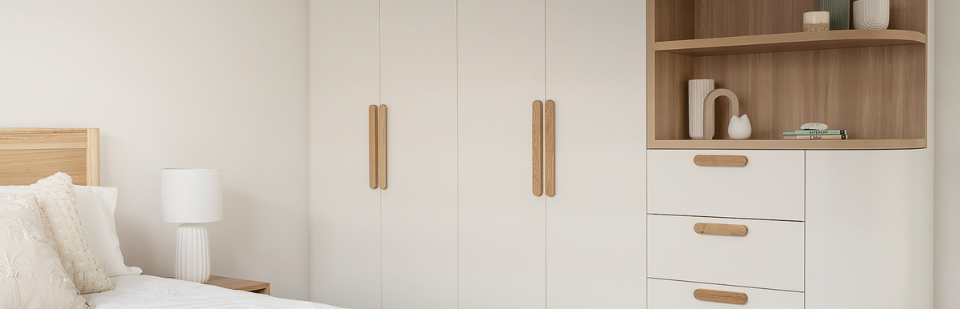


The Meir Oppen range is a small, calm set of stainless steel cabinet handles. It has five shapes, a round pull, an edge pull, a T-pull, an oval T-pull and a knob, and each comes in five finishes: Champagne, Brushed Nickel, Lustre Bronze, Tiger Bronze and Shadow. The design is Scandinavian simplicity and elegance. This page holds the cabinet handles from the range, which people also search for as Meir handles, Meir cabinet handles and Meir Oppen handles, for kitchens, bathroom vanities and wardrobes. The sections below cover what each shape is and how it measures, what the finishes look like, how to size and place a pull, and how to look after the finish. For the wider brand, see the Meir bathroom range, and for handles of every type, start at cabinet handles. Door handles are a separate range and are at interior door handles.
Oppen is a minimal range. The shapes carry no ornament, the profile is slim, and the finish does the work. The handles are 304 grade stainless steel, suit cabinet walls of 13 to 18mm, and suit both bathroom and kitchen cabinets. Each handle ships with a fixing kit and installation instructions. The finishes are designed to match Meir tapware, so a vanity can carry the same finish on the tap and the pull.
Hole centres, also called the fixing distance, are the gap between the two screw holes, overall length is the full length of the handle, and projection is how far the handle stands off the door.
An edge pull sits on the edge of a drawer or door, so the face stays flat. Lip pull handles mount along the edge of a cabinet or drawer front, with clean lines and an easy grip. They suit drawers, cupboards, pantry doors and flat-panel cabinetry, and give the look of handle-free joinery with a practical grip. The Oppen edge pull is elegantly curved to bounce light into the surrounds, while inviting you to pull it open.
There are two kinds of edge pull, and they fit differently. Some edge pulls recess into the edge of the door, which means routing or drilling a groove into the edge, and a professional gives the best result. The Oppen edge pull is a lip pull handle with a fixing kit and installation instructions in the box, so follow those instructions and check the cabinet thickness first. It suits 13 to 18mm cabinet walls. For more on this type, see lip pull handles.
The round pull is the all-round shape and the one that suits most drawers and doors. It is gripped with several fingers and spreads the effort across two fixings. See cabinet pull handles for the wider range. The 520mm size, on 480mm centres, is long enough for a pantry door or a fridge panel, and the larger pulls of this kind are also at appliance pull handles. The T-pull also suits wardrobes, and more wardrobe pulls are at wardrobe handles.
The T-pull and the oval T-pull are small, one-fixing handles that sit in the middle of a front. The knob is sized by its diameter, as every knob is. A guide to cabinet hardware says knobs of 25 to 38mm suit standard doors, while 40 to 50mm or more suits pantry doors and deep drawer fronts, which makes the 30mm Oppen knob a standard-door size. More knobs are at cabinet knobs.
The finishes are Champagne, Brushed Nickel, Lustre Bronze, Tiger Bronze and Shadow. They are covered below.
Champagne is a blend of chrome and rose gold, a subtle but striking look. More are at champagne cabinet handles.
Brushed Nickel is a warm, natural tone with unique brushed lines, made by polishing with a coarse wheel and then applying a PVD coating. The tone is similar to stainless steel, so it matches stainless appliances, which makes it the quietest choice on a kitchen with steel appliances. See brushed nickel cabinet handles.
Tiger Bronze is gold-toned with black veins, hand-made and hand-finished, made by electroplating bronze gold over a brushed black undercoat. It is the one finish in the range with a pattern in the surface. Lustre Bronze is the other bronze in the range, so judge it from the product photographs and a sample against your tap. Both bronzes sit with the pages at bronze cabinet handles.
Shadow is the gunmetal finish of the range, so judge it from the product photographs and a sample. See gunmetal grey cabinet handles.
One practical step helps with every finish: hold the handle against the tap, or against a sample, before you order the whole room.
Pair handles with taps so the fittings share the same tonal qualities. The Oppen finishes are designed to complement Meir tapware, so a vanity can carry one finish from the spout to the drawer pull. It is the simplest way to keep a bathroom calm.
The same rules apply to the rest of the room. Use the same finish through the home, even if shapes and sizes vary, and limit each room to two metal finishes. Either match the handles to the other fixtures, such as brass handles with brass tapware, or contrast them on purpose. For a bathroom, that means the tap and the handle in one Oppen finish, with any other metal as a small accent. For a vanity cabinet, see bathroom vanities.
The Oppen is 304 grade stainless steel. Type 304 is roughly 18 per cent chromium and 8 per cent nickel, which is why it is called 18/8. The chromium forms a passive layer on the surface that protects the metal, and the nickel helps resist pitting. 304 suits repeated washdowns, with kitchen sinks, cookware and dishwashers among its uses. In coastal settings with salt spray, 304 can show surface corrosion known as tea staining, and grade 316 is the usual choice for marine conditions. In a coastal house, wipe the handles and dry them. Other stainless pulls are at stainless steel cabinet handles.
The finish process is electroplated on some products and PVD on others. PVD is colour bonded to the metal at a molecular level in a vacuum chamber, and it is significantly harder than traditional plating. Because the process varies, read the finish line of the handle you choose and keep the cleaning gentle on every one of them.
Hole centres, not overall length, measure handle length. As a rule of thumb and not a strict rule, a pull is commonly about one third of the drawer or door width. Pot drawers and pantry doors take longer handles of 250mm or more, and smaller handles or knobs suit upper cabinets.
Against the Oppen range, the 200mm round pull on 160mm centres suits a drawer front of 450 to 700mm, and the 328mm round pull on 288mm centres suits a wider drawer or a pot drawer. The 520mm pull on 480mm centres is for a pantry door, a tall panel or a very wide front. The 150mm edge pull suits a standard drawer and the 300mm edge pull a wide one, while the 75mm edge pull, the T-pull and the knob suit a small door or a narrow front.
If you are replacing handles, measure the centres of the holes you have and match them unless you plan to fill the old holes. A 128mm handle will not fit 160mm holes without drilling new holes, which can leave marks on a painted or veneered front. The Oppen range is made for 13 to 18mm cabinet walls, so check your door thickness before you order.
Centre the handle on a drawer front. On a base door, place it near the top corner on the side opposite the hinges, and on a wall door near the bottom corner. A long vertical pull on a pantry door sits at hand height and not at the exact middle. The general rule is horizontal handles on pull-out drawers and vertical handles on doors. Horizontal handles on doors give a streamlined look but may not open as naturally. Check also that handles do not hit each other when cabinets open.
Care for these finishes is simple: a soft cloth and warm soapy water, and no harsh or abrasive cleaners or scourers. For stainless steel, wash with warm water and a few drops of mild dish soap on a soft, non-abrasive microfibre cloth, wipe with the grain on a brushed finish, rinse with plain water, and dry with a clean cloth. Bleach and other chlorides, acidic cleaners, steel wool and abrasive sponges are the things to avoid.
Bleach and other chlorides are the thing to keep away from 304 steel in warm, moist conditions. Dry the surface after every cleaning, especially in humid or coastal areas, to prevent water spots and early corrosion.
For the full range of handle styles, return to cabinet handles.


