
*View accurate shipping rates and availability






94 Items


Up to 70% off across the store, plus free towels and mirrors up for grabs on orders over $800*


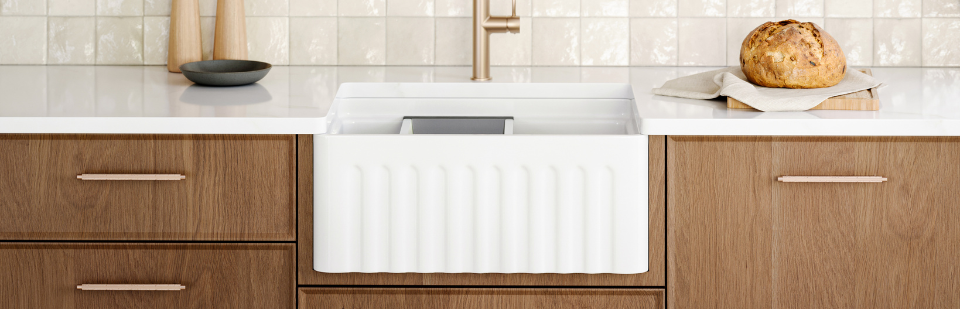




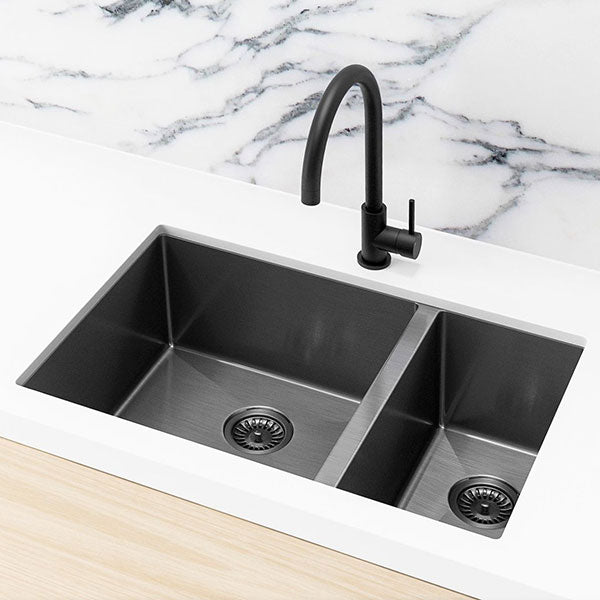


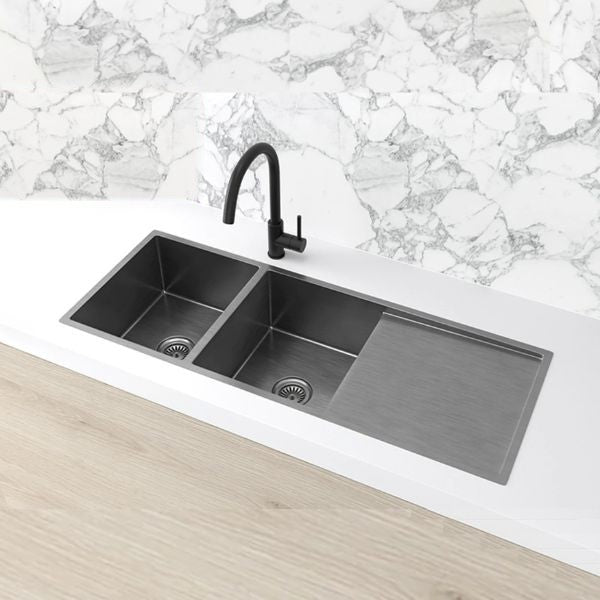
A double sink gives you two working zones: one bowl to wash in and one to rinse in, or one to soak and one to keep clear. It earns its place in kitchens where most of the washing is done by hand and where more than one person works at the sink. In a kitchen that relies on a dishwasher, one large bowl is often the better fit, because large trays and pots still need hand washing and a divider makes them harder to manage. This page covers who a double bowl suits, how equal and offset bowls differ, how to size one to a cabinet, how drainers, tap holes and wastes change the choice, and how to care for one. The practical call for most households that hand wash is an equal double of about 760mm or wider, chosen after you have compared its inside bowl width with the largest items you wash.
A double bowl is two separate basins divided by a partition. The bowls can be equal or offset, with one larger and one smaller. A sink with one smaller bowl is called a one and a half or one and three-quarter bowl. The collection holds all three layouts. A true double has two bowls of similar size, a one and a half bowl has a main bowl and a half bowl, and a one and three-quarter bowl has a main bowl and a smaller prep bowl. See 1.5 bowl kitchen sinks and 1.75 bowl kitchen sinks for the middle options, and single bowl kitchen sinks if one large bowl suits better.
A double bowl suits households that wash dishes by hand and want to soak in one bowl while rinsing in the other. It suits families or couples who cook together, because each person can use a bowl at the same time, and it suits anyone who wants to keep dirty and clean dishes apart, or heavy pots away from delicate glassware. Smaller bowls let you soak a few items without filling a large basin, which may use less water. A double bowl also suits larger kitchens with more bench space.
The most useful buying tip is to check the internal bowl width, not just the overall sink size, because dividers reduce the usable space. The Fienza Hana 760 is 760 x 450 x 200mm outside, with bowls of 340 x 400 x 200mm inside. The Caroma Urbane II double is 770 x 460 x 209mm overall, with each bowl 340 x 400 x 209mm. The Clark Polar bowl is 355 x 405 x 200mm, and the Oliveri Spectra and Sonetto double bowls are 360 x 405mm and 355 x 405mm. Compare those inside figures with the largest tray or pot you wash by hand.
The sink has to fit the cabinet under it, and a double is wider than a single. A large double bowl needs a wider cabinet than a compact single, so check the sink's minimum cabinet size on the product page and leave room for mounting hardware and plumbing. The sink should be at least 70 to 80mm narrower than the internal width of the base cabinet. A 900mm cabinet takes a double bowl about 760mm wide, or a one and a half or one and three-quarter bowl with a drainer. The bowls protrude into the cabinet below, so plan the cupboard space.
The range falls into three bands.
If you searched for a compact or narrow double sink, start with the 670 and 680mm sizes. For benchtop and cabinet guidance for any sink, see kitchen sinks and small sinks.
Double sinks are made for several fitting methods, so confirm the method for the model you choose. The Caroma Urbane II double and the Clark Polar suit inset or undermount, the Seima Oros sinks above or under mount, and the Fienza Tiva 1180 topmount only. Undermount suits a solid benchtop such as stone and needs a polished and sealed cut-out, while a top-mount sink works with any benchtop material, including laminate. For more on fitting methods, see undermount kitchen sinks, inset sinks and drop in kitchen sinks.
The same material choices apply as for any kitchen sink. Stainless steel is the most common double, and for thickness, grade and finish see stainless steel sinks. The Phoenix 4000 Series is 1.2mm 304 stainless steel, hand welded. Fireclay doubles such as the Turner Hastings Cuisine 86 x 50 have two equal 27 litre bowls, a 185mm internal depth, a R12 corner radius and a weight of 38kg, which matters for cabinet support. Quartz and granite composite doubles include the Seima Oros, the Phoenix 5000 Series and the Oliveri Santorini. The Santorini's moulded granite is heat resistant to 280 degrees Celsius, and a surface protector is recommended for hot pots. For ceramic and composite options, see ceramic kitchen sinks and granite and stone composite sinks. For a farmhouse style, see butler and apron sinks, which includes double butler sinks such as the Otti Boston double at 845mm with two 30 litre bowls.
Doubles come in PVD colours as well as plain steel. The Meir double bowl comes in gunmetal black, brushed nickel and brushed bronze gold at 760 and 860mm, the Caroma Urbane II double in brushed brass and gunmetal, and the Fienza Hana in carbon metal and rugged brass. See gunmetal kitchen sinks, brass kitchen sinks and brushed nickel kitchen sinks. With a coloured double, match the tap finish to the sink and keep abrasive cleaners away from the coating. White and black doubles are in white sinks and black kitchen sinks.
Match the tap hole count to the tap. Many doubles here have no tap hole, so the tap mounts on the benchtop or wall. The Fienza Tiva 1180 has one tap hole, the Clark Polar is available with zero or one, and the Turner Hastings Cuisine 86 x 50 has a tap hole. A mixer with a pull-out spray makes rinsing the second bowl easier, and the reach has to cover both bowls. See kitchen taps, pull out sink mixers and sink mixers.
Confirm the cut-out before the benchtop is templated, because stone fabricators often charge to re-cut an opening. Choose the sink before the plumber, cabinet maker and benchtop installer start, so all three work to the same dimensions. Cutting a topmount opening is a job for a professional, because a mismeasured cut can mean a new benchtop, and connecting the water supply and tapware needs a licensed plumber in every Australian state and territory. Caulking along the join needs replacing every three to five years.
The benchtop run settles most of the choice. A double suits a run of 900mm or more, and a single bowl suits a run under 600mm. Between those, the way you wash decides: hand washing, vegetable prep and a separate hand-washing bowl for children all favour a double, while a dishwasher household that often fills large pots and trays is better served by one large bowl. If a double feels cramped for your cabinet, an asymmetrical layout or a single oversized bowl is the alternative, and a one and a half bowl keeps a prep zone without the width of a full double.
Brand collections hold each maker's sinks: Fienza kitchen sinks, Seima kitchen sinks, Turner Hastings sinks, Meir kitchen sinks, Oliveri kitchen sinks, Phoenix kitchen sinks, Caroma kitchen sinks, Clark kitchen sinks and Modern National sinks.
Whatever you choose, read the inside bowl dimensions, wastes and tap hole count, and confirm the cabinet width with the sink's overall length before the benchtop is cut.


