
*View accurate shipping rates and availability






4 Items
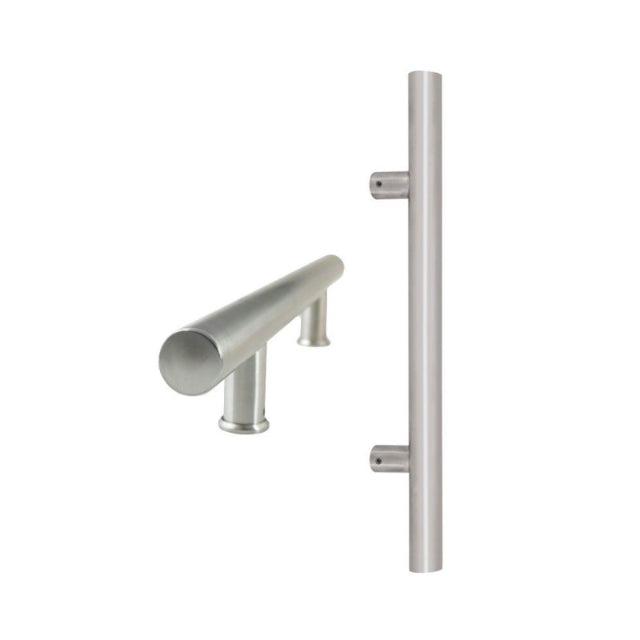


A 900mm pull handle is a long entrance bar for a tall or wide door, and this collection holds four Zanda designs in that length: the Round Profile, the Nitro offset, the Omega offset and the Polo. All are stainless steel, in stainless steel, matte black and satin brass finishes, and each is sold as a back to back set. Searches for a 900mm pull handle, modern exterior door pull handles and bar handles lead here. This guide explains why a 900mm pull suits some doors and not others, how the four designs differ in profile, projection and fixing centres, which finishes and coatings are made, and how to choose, plan and fit one. The wider choice of pulls is on pull handles, and the offset designs are on offset pull handles.
A 900mm pull is a statement. On a door about 2400mm high or a wide pivot door, a bar that long gives a strong vertical line that balances the leaf, and it reads as a deliberate architectural feature from the street. It also offers a long range of grip heights, so a child, an adult and a user in a wheelchair can each find a comfortable place to hold. On a standard 2040mm door, a 900mm bar can look excessive, and a shorter pull is usually better.
The length is the first decision, and the design is the second. A long pull needs a door with enough face to carry it, so check the height of the door and the position of any lock before you choose.
The four share a length and differ in profile, projection and fixing centres.
The Round Profile is a round bar, 32mm in diameter, that projects 76mm from the door, with fixing centres of 700mm. It is a streamlined, elegant handle with a design that explores verticality and the illusion of a continuous extruded piece of metal. The Nitro offset has a 25mm square tube that projects 60mm, with fixing centres of 875mm and an electroplated finish, and it stands away from the door on cranked arms. The Omega offset is a 32mm bar that projects 80mm, with fixing centres of 700mm and a powder coated finish, and it has the deepest reach of the four. The Polo is a 40mm wide bar that projects 60mm, with fixing centres of 860mm and a PVD finish, and it is the broadest.
The profile changes the look. The Round Profile is smooth and soft. The Nitro is slim and crisp. The Omega is bold, deep and sculptural. The Polo is broad and unadorned, in the manner of Modernist design, where form follows function.
The Round Profile and the Polo are straight bars, fixed in line with their fixings. The Nitro and the Omega are offset pulls, with cranked ends that hold the bar a distance from the door. An offset pull gives more room for the fingers and keeps the hand clear of the lock and the escutcheon, so it suits doors where you want the handle away from the locking mechanism. A straight pull is simpler and sits closer to the door, which suits a door where a clean, flat line is wanted. Choose the form to suit the door: an offset for a door with a lock close to the grip or a narrow stile, and a straight bar for a wide, flat door.
The fixing centres are the distance between the two fixing points, and they are the figure the door maker uses to drill the holes. The Round Profile and the Omega have 700mm centres, the Polo has 860mm centres, and the Nitro has 875mm centres. The centres are shorter than the overall length of 900mm, since the ends extend beyond the fixings. A pull with 700mm centres needs holes 700mm apart, and one with 875mm centres needs holes 875mm apart, so choose the pull before the door is drilled.
The different centres also change how much of the bar extends past the fixings. On the Round Profile, 100mm sits beyond each fixing, and on the Nitro only about 12mm, so the Nitro reads as a bar that is fixed almost at its ends, and the Round Profile as a bar with a generous overhang.
The projection is how far the bar stands from the door. The Nitro and the Polo project 60mm, the Round Profile 76mm and the Omega 80mm. A deeper projection gives more room for the fingers, and the Omega's 80mm makes it the easiest to grip with a full hand. The projection is also the number to check beside a sidelight, a wall or a letterbox: a handle that projects 80mm needs about that much clear room, and a long pull near glass can strike it when a hand wraps around the bar. Hold the pull against the door before drilling and check the clearance.
All four are stainless steel. The finishes in the collection are stainless steel, matte black and satin brass. The coating depends on the design: the Nitro is electroplated, the Omega is powder coated and the Polo is PVD. PVD is a hard coating applied in a vacuum chamber, and it resists wear and cleaning better than a plated finish. A powder coat is a tough baked layer, durable against scuffs but able to chip at an edge. An electroplated finish is a thin metal layer that gives the colour and a hard surface.
Stainless steel is a plain silver that suits a modern or industrial look and goes with stainless steel hinges, lock kits and house numbers. Matte black is neutral and gives the strongest contrast on a pale door. Satin brass is a warm gold that suits timber and Hamptons style homes. Choose the finish by the other metal on the door and in the house, and keep one finish across them where you can. See matte black and brushed brass for the wider choice in those finishes.
Each pull is sold as a back to back set, which means two pulls, one for each face of the door, fixed through the door with bolts. The bolts pass through the door and join the two pulls, so the pair clamps the door and the fixing is very firm. The pull on each face looks the same, so the door has the same handle on the inside and the outside, which suits a front door that is seen from both sides. The pack includes the fixing kit and the installation instructions.
A pull is a handle, so the door still needs a way to latch and to lock. A roller latch holds the door closed without locking it, and it is operated by a push or a pull from either side. A euro mortice lock with a cylinder locks the door with a key, and a deadbolt adds a solid bolt for security. Choose by how the door is used, and plan the lock position before the pull, so the lock has clear space beside the grip and the escutcheon sits a hand width from the bar. See entry door lock sets and deadbolts.
Start with the door and the look. For a sleek, modern door with a lock beside the grip, the Nitro offset gives a slim bar with room for the hand. For a bold, sculptural entrance where the handle is a feature, the Omega offset has the deepest reach. For a soft, elegant line on a wide door, the Round Profile is the smoothest. For a broad, unadorned bar with a Modernist feel, the Polo is the simplest. If you are unsure, compare the profile and the projection on the product pages, and think about how the bar will look from across the street.
If the door is new, give the door maker the fixing centres, the length of the pull and the height of the grip in writing, so the holes are drilled in the workshop. If the door is already hung, mark the centres with a level and drill from the face where the handle will sit, so any break-out falls on the back. Use a template to keep both holes aligned, and drill a small pilot hole first. For a back to back set, the holes must line up exactly on both faces, so drill from one face through to the other with the door supported.
The usual grip height is around the middle of the pull at hip height, and the pull is centred on the door stile so it sits clear of the frame. For a 900mm pull, the bar extends well above and below the grip height, so check that the top of the bar does not run into a transom or a light fitting.
A 900mm pull suits tall pivot doors, wide timber doors, full height entrances and double doors where a long line is wanted. On an aluminium framed door with a narrow stile, an offset bar stands clear of the frame, and the door maker will often drill and tap the holes in the workshop. On a glass door, check that the fixings are made for glass. On a pivot door, place the pull with the swing in mind, clear of the pivot point. It does not suit a small or narrow door, where it will look overscaled.
Wipe the pull with a soft damp cloth and dry it. Keep abrasive pads, polishes and acidic or bleach-based cleaners away from the finish. Tighten the bolts once a year, since timber moves with the seasons. Near the coast, rinse the pull with fresh water now and then so salt does not sit on the surface. Matte black and powder coated finishes need a gentle wipe to keep the coating even, and a PVD finish is the hardest wearing.
Does the pull lock the door? No. A pull is a handle, so it pairs with a lock, a deadbolt or a roller latch.
Which 900mm pull has the deepest reach? The Omega offset, which projects 80mm.
Which suits a modern front door? The Nitro offset is slim and crisp, and the Polo is a broad, unadorned bar.


