
*View accurate shipping rates and availability






7 Items


Up to 70% off across the store, plus free towels and mirrors up for grabs on orders over $800*


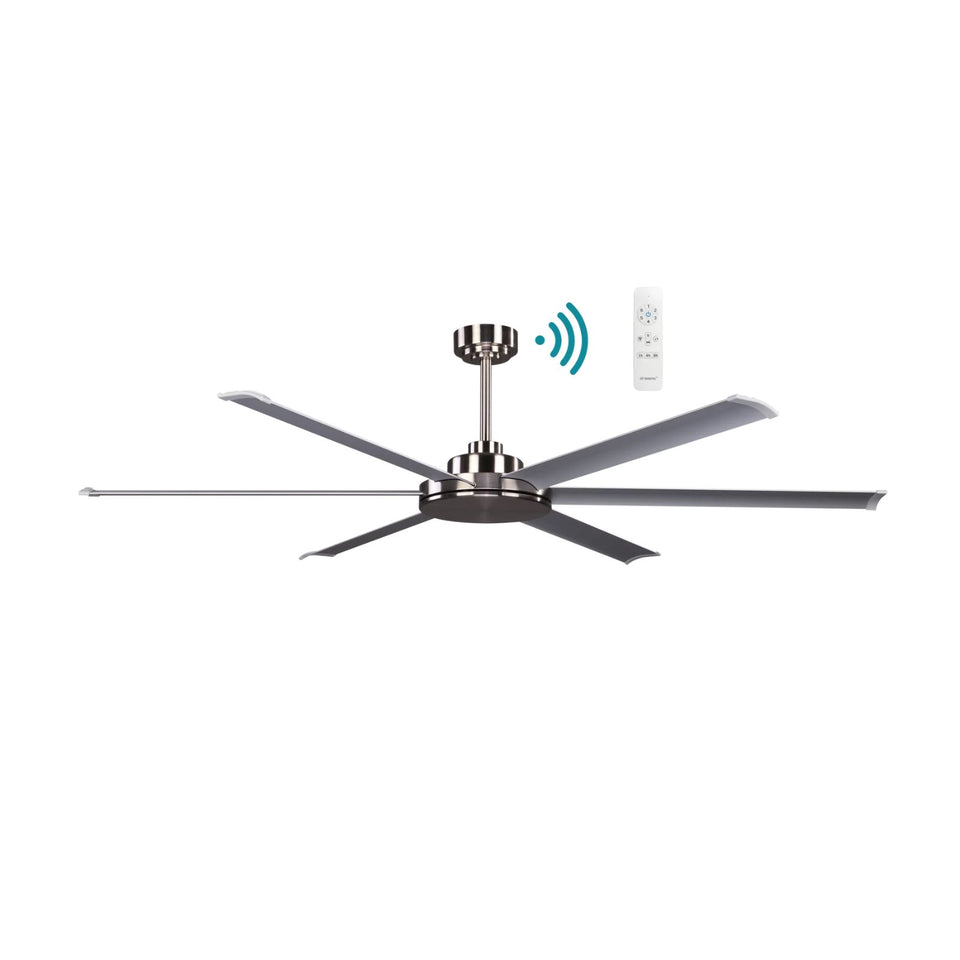
A brushed nickel ceiling fan has a soft, silvery metal finish with a fine grain, and it is a common match for stainless, chrome and nickel fittings. Shoppers who search for brushed nickel fans usually want to know what the finish looks like, which fans come in it and whether it comes with a light. This collection holds the Martec Albatross II in brushed nickel, in 1650mm, 1830mm and 2130mm, with and without a light, and the Eglo Waikiki, a 52 inch AC fan in satin nickel with walnut-look blades. This guide explains the finish names, the specification of each fan, how to choose the size, height and motor, and how to install and care for the fan.
Brushed nickel is a finish, not solid nickel. It has a matte, slightly textured look that hides fingerprints and benefits from regular cleaning with mild soap and water. Satin nickel is smoother, with no visible grain, and names differ on which of the two is shinier, so a photo is more reliable than the name. Polished nickel is the most reflective and tarnishes unless it is lacquered, particularly in humid rooms. Stainless steel is not a plated finish, looks like brushed nickel but cooler, and resists corrosion better. Plated finishes can wear through to the base metal over time. Finish names vary between makers.
The Albatross II has its own page at Martec Albatross II ceiling fans, with the airflow, light and ceiling detail. For other metal finishes see stainless steel ceiling fans, gunmetal ceiling fans and brass ceiling fans.
A 52 inch (132cm) fan is the standard size, 48 inch suits smaller rooms and over 54 inch (137cm) suits larger square rooms of about 5 by 5 metres or more. By floor area, 12 to 20 square metres pairs with a 52 to 60 inch fan, and an area over 20 to 25 square metres works better with a large fan or two. The 52 inch Waikiki suits a standard bedroom or living room. The Albatross II spans, 65, 72 and 84 inch, suit larger rooms and open plan spaces, and the 1650mm is the smallest. A long room does better with several 52 inch fans than one very large fan. See large fans.
Blades must hang at least 2.1 metres above the floor, with 2.3 to 2.7 metres recommended as the mounting height. Arithmetic from the overall heights: on a 2.4 metre ceiling the Waikiki leaves the blades at about 2.13 metres, which clears the minimum. The Albatross II at 330mm to 410mm leaves them at about 2.07 to 1.99 metres, which does not, so the Albatross II needs a ceiling of about 2.5 metres or more. The electrician should confirm the figures. For a low ceiling see low profile fans, and for a high one ceiling fans for high ceilings.
The Albatross II and the Waikiki are both 0 degrees of ceiling pitch, so they need a flat ceiling. Check the figure for your model with us before fitting either to a slope. Fans generally handle about 10 degrees of tilt without a kit, and 20 to 40 degrees usually needs a raked ceiling kit and a longer rod.
AC motors are the older type and usually have three speeds, while DC motors are now the most common, are more efficient and offer up to seven speeds. DC fans use less electricity than AC on average. The Albatross II is DC with six speeds. The Waikiki is AC with three speeds and a pull cord or wall switch, which suits a traditional room where a remote is not wanted. The Waikiki's remote kit and light kit are sold separately. See DC motor fans.
The Albatross II with a light has a dimmable 32 watt LED of up to 3,300 lumens, with colour temperature from 2700K to 6000K. Warm white of about 2700K to 3000K suits bedrooms and lounges and neutral white of about 4000K suits task areas. A fan light near downlights can cause a strobe effect as the blades pass in front of them, and many models are sold as light or no-light versions only. The Waikiki has no light. See ceiling fans with lights and ceiling fans without lights.
Match the finish to the other metalwork in the room, such as tapware, door handles, cabinet pulls and light fittings, because mixed metals can look unplanned. Brushed nickel pairs with stainless and chrome fittings and sits beside warm timber. White blends into a light ceiling and black contrasts, and a silver fan sits between the two. The Waikiki's blades are walnut-coloured on steel and plywood, which adds a warm tone to the silver body. Colour does not change how much air a fan moves. See white ceiling fans and woodgrain ceiling fans.
The Waikiki is for indoor use. The Albatross II is IP20, which is dry indoor use, so work from IP20 and check with us before fitting the fan on a patio. Covered does not mean dry, since sideways rain, mist and sea air can reach a fan near the edge of a roof. For fans rated for outdoors see outdoor ceiling fans.
Clean brushed nickel with a soft cloth and mild soap and water, and keep abrasive pads away because they scratch the grain. Polished nickel tarnishes without a lacquer, so it needs more care than a brushed finish. A plated finish can wear through to the base metal, so avoid scrubbing a spot. Dust the blades every few weeks, and check the care notes before using a spray on the plywood blades of the Waikiki, since moisture damages plywood.
The three finishes look alike across a room and differ close up. Because plating can wear through, a stainless fan lasts longer in a damp spot, and stainless is the better corrosion resister. If the fan is for a dry living room, the difference is mostly looks. If it is for a coastal or damp covered area, see stainless steel ceiling fans and coastal rated fans, and check the application line on the product page.
The Albatross II comes with a remote, and the versions with Wi-Fi add control through the Smart Life app. It has an 8-speed remote and the reverse mode is set by the remote. The light version carries a dimmable LED, and many fans are sold as light or no-light versions only, so decide before buying. Pull cords, wall switches, remotes and apps are the usual controls. The Albatross II is a large fan, and a high ceiling means the fan is out of reach, so a remote or an app is the practical control. See smart ceiling fans.
The Waikiki is a classic AC fan that suits traditional or hamptons style homes, with a pull cord and wall switch for control, and a remote kit and light kit sold separately. It has steel and plywood blades in a walnut colour, an overall height of 273mm, a weight of 6.7 kilograms and a 52 inch span. The reverse mode runs at a low speed, anti-clockwise. Plywood is more stable than solid timber, but it still dislikes moisture, so the indoor usage line suits it. A flat ceiling is required, since the pitch is 0 degrees. See fan accessories for remote kits, and check which kit matches the Waikiki before ordering.
The Albatross II moves up to 20,200 cubic metres an hour, with 15,600, 17,650 and 20,200 for the 65, 72 and 84 inch. The Waikiki has no airflow figure. No blade material has been shown to improve airflow, design, shape and motor quality are what count, and blade count is not a factor. A large fan usually runs at its lowest speed most of the time, so the top-speed figure is a ceiling and not the everyday number.
A hard-wired ceiling fan must be installed by a licensed electrician, and wall-switch fans cannot legally be fitted without one. The electrician checks the ceiling support, the wiring, the switch position and the circuit protection. The Albatross II is a large fan, so the mounting point should be rated for the weight and the movement. A fan that wobbles is louder and less efficient, and a balance kit corrects it.
For every style see ceiling fans. By brand, Martec ceiling fans.


