
*View accurate shipping rates and availability






5 Items
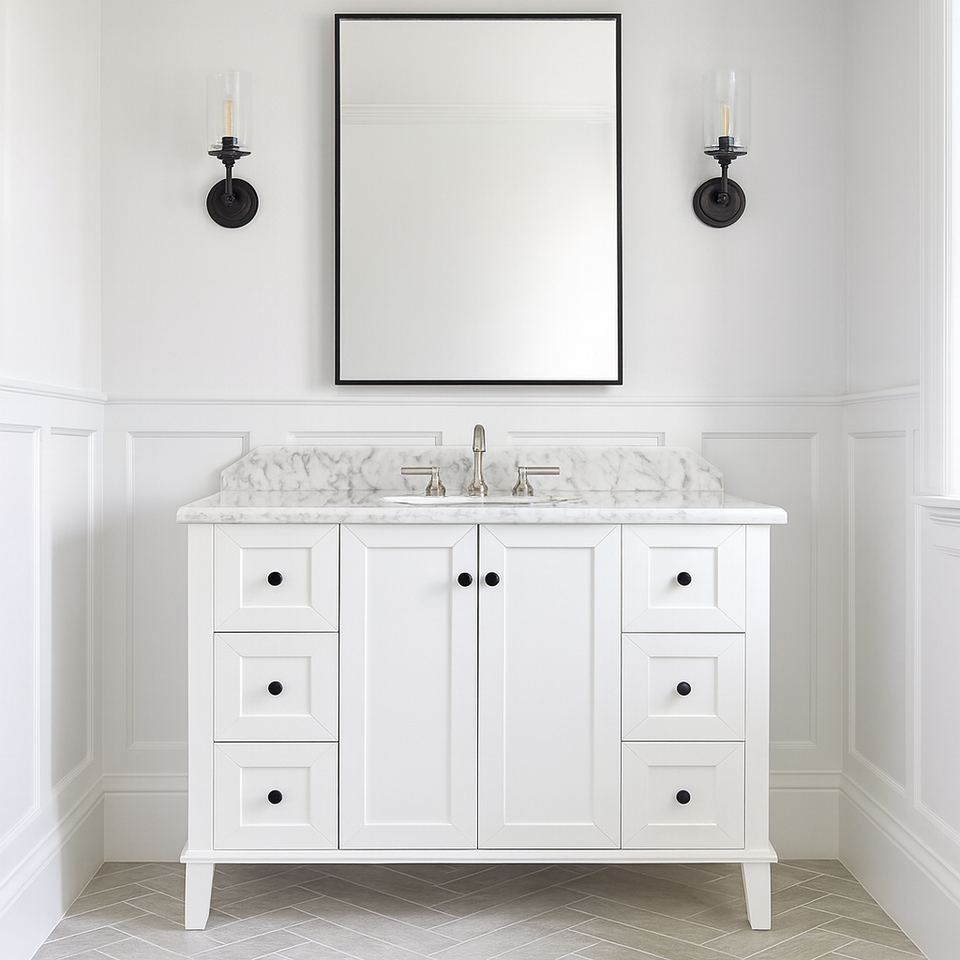
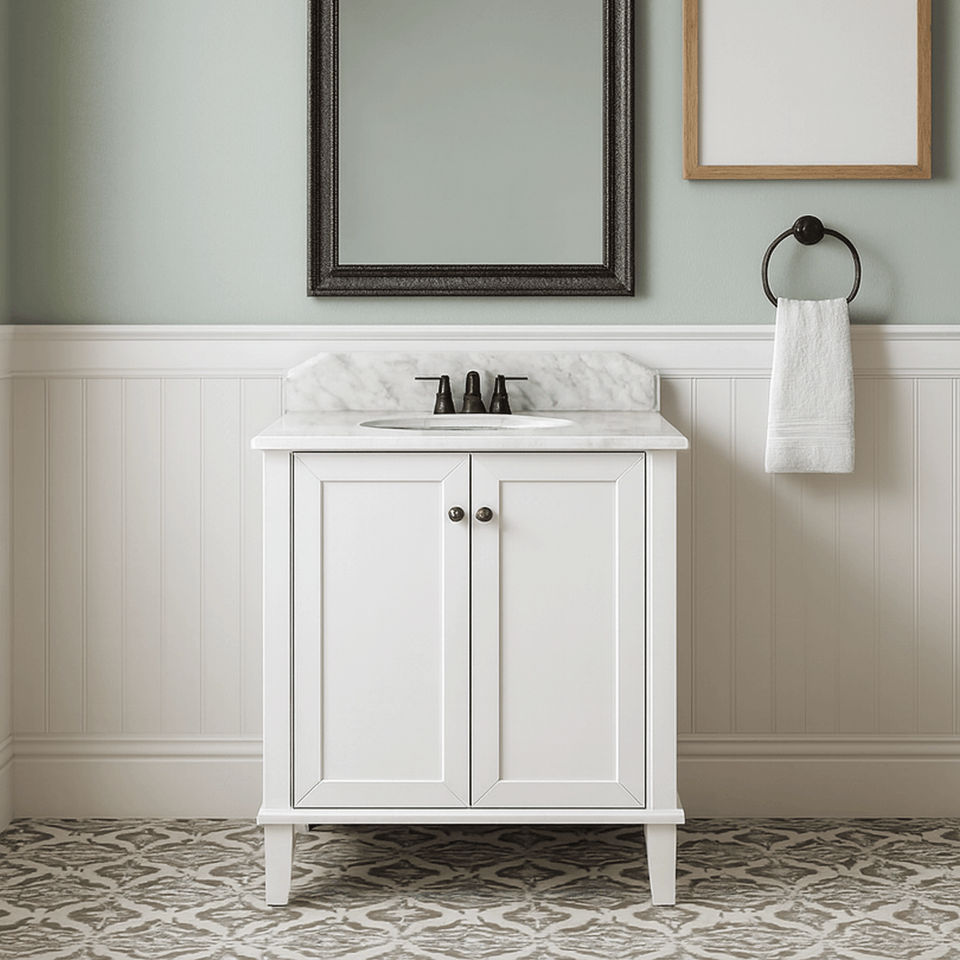
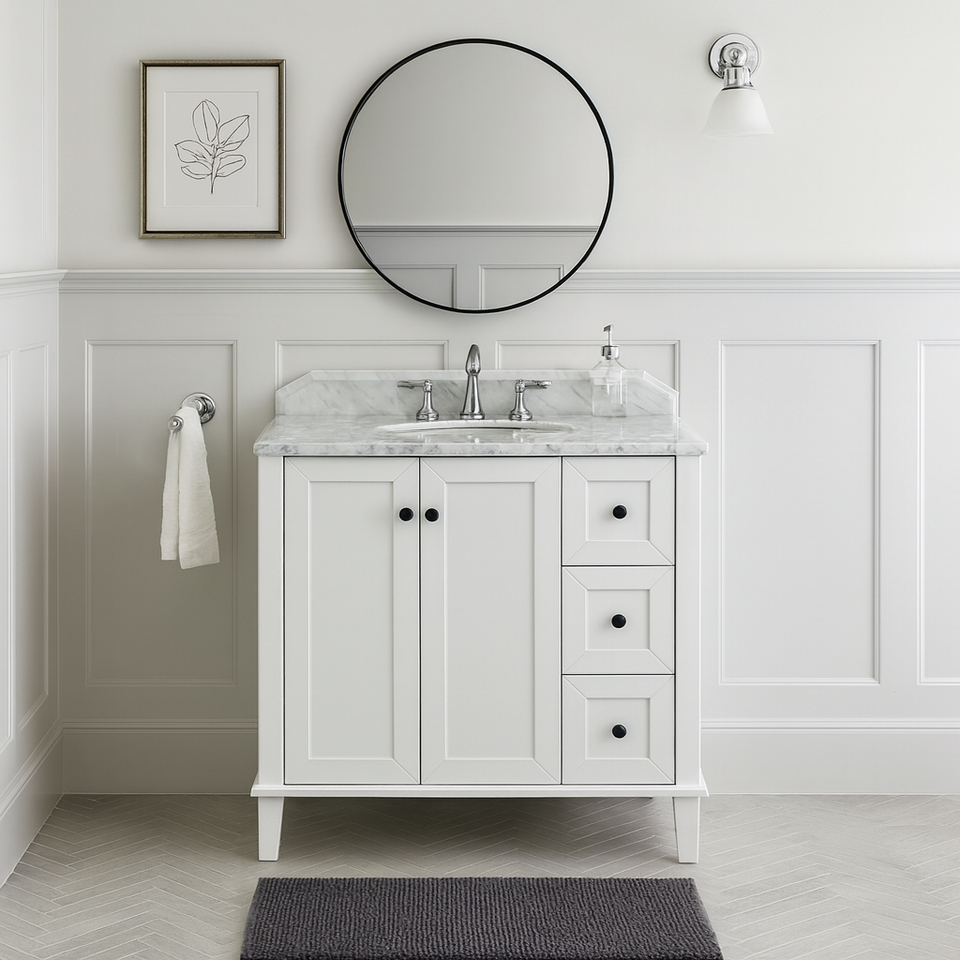


This page holds two floor standing ranges with solid timber on the front: the Turner Hastings Coventry in white, and the Ingrain Round Fluted powder room vanity in Ash stain or matte white paint. The phrase solid timber means different things on different vanities, so this guide starts with what is solid on each one. It then answers the question most shoppers have, whether solid timber suits a bathroom, and covers the finishes, the tops, the tap holes, the sizes, and the fitting and care steps. It sits in the bathroom vanity guide.
The Coventry has detailed panels on solid rubberwood timber doors and sides, with a white polyurethane surround and soft curved corners. The Round Fluted has a moisture resistant plywood carcase, with a front of Ash stained solid timber or matte white painted solid timber and a matching melamine interior. On the Round Fluted, then, the solid timber is the fluted front over a plywood box.
Yes, if the finish is sealed and kept up, and the room is looked after. Solid timber can perform reliably in a bathroom for many years when it is installed properly and kept away from standing water. The finish is the barrier: a polyurethane or painted surface stays stain and moisture resistant for as long as it is intact, so wipe splashes promptly, keep the area around the basin as dry as possible and keep the bathroom ventilated. Timber is a natural product that can expand or shrink with the seasons, so slight movement is normal.
The Round Fluted is built from natural timber, so the finish colour can vary and may differ from the photos. The grain on one piece will not match the grain on another, and that variation is part of the appeal of timber. The Coventry marble top varies as well, and no two tops are the same. If the colour matters, order a sample from the samples collection, and look at it in the light of your bathroom.
The two ranges use different finishes, and each has its own care. The Coventry has a white polyurethane surround and a satin white painted finish, which is tough and wipes clean, and it hides the grain, so the character comes from the panelling and the curves. The Round Fluted comes in Ash stain, where the grain shows through the colour, or in matte white paint, which gives the flutes a soft, uniform look. A stain with a clear coat shows scratches in a different way from paint, and it ages with the light: a bathroom with strong sun can lighten a stain over the years, so keep the vanity out of long direct sun.
The Coventry is a heritage style vanity for heritage or Hampton style bathrooms. Panelled doors and marble tops are the usual pairing in that style, with chrome the traditional tapware finish. It comes with Blum soft-close hardware, an adjustable internal shelf and knob handles in matte black or chrome, with antique brass on request. The rubberwood doors and sides are the solid timber, and the panelling gives them depth that a flat slab cannot. For more in that style, see Hamptons vanities and Turner Hastings vanities.
The Round Fluted is a 400mm round pedestal with a fluted front, a 410mm diameter top, a single soft-close door and an internal shelf. The grooves use light and shadow to add depth to a flat front, and on a round form the flutes wrap around the cabinet, so the vanity looks different from every angle. It suits a powder room where the vanity is the feature. For the other fluted and curved fronts, see fluted vanities, curved vanities and all Ingrain vanities.
The two vanities suit different rooms, and the choice is easy once you know the room. The Coventry is a full-size cabinet for a main bathroom or ensuite, with storage, a marble top and a basin included. The Round Fluted is a small pedestal for a powder room or a corner, with one door and one shelf, and a basin you choose yourself. If you need storage for towels and daily items, choose the Coventry. If you need a small, striking vanity that does not crowd a tight room, choose the Round Fluted. They are not alternatives for the same wall, so decide the room first and the vanity second.
The Coventry works in a room built around a classic palette: white or pale grey tiles, a framed mirror, a pendant or wall lights, and tapware with a traditional spout. Chrome and brushed nickel keep the room crisp, and antique brass on the knobs warms it. Because the cabinet is white and the top is marble, the room needs one or two warm notes, such as a timber stool, a woven basket or a brass accessory, so it does not feel cold. Matching mirror shaving cabinets in a satin white finish are made for the Coventry, so the wall above the vanity can match the cabinet below it.
Timber responds to the air in the room, so ventilation matters more than any other care step. Run the extraction fan during a shower and for 15 to 20 minutes afterwards, open the window when you can, and wipe condensation off the cabinet and the mirror. A bathroom that stays damp for hours is hard on any timber finish, painted or stained, and it is also where mould starts. If the room has no fan or the fan is weak, fix that before you fit a timber vanity, because it protects the whole room.
The Coventry includes an under-counter ceramic white gloss basin and a 100mm marble splashback, in one or three tap hole options, and the 32mm plug and waste is sold separately. Choose the tap before you order, because the tap hole position is set when the top is made. Tighten the waste by hand only, because overtightening stresses the basin, and look for debris or an unlocked plug if it will not hold water.
The Round Fluted comes with no tap hole, to suit wall-mounted tapware, and the basin is sold separately from the small above counter basins. If the vanity sits tight against the wall, use a wall spout between 180mm and 210mm, or a freestanding spout. We also recommend a space saver plumbing kit, with a low profile bend and articulated mini trap that takes the pipework to the back of the cabinet and frees the shelf. See above counter basins, small vanities and taps and mixers.
The Coventry is sold in 75, 90 and 120 sizes, which read as width in centimetres with 55 as the depth, so 750mm, 900mm and 1200mm wide. Check the spec sheet for the exact depth before you fix the plumbing positions. The Round Fluted is a 400mm pedestal for a powder room.
A powder room takes a vanity about 400mm to 500mm wide and 220mm to 350mm deep, and 750mm suits a small main or guest bathroom with a single basin. A 900mm vanity suits a main or family bathroom with one basin, and a 1200mm vanity suits a large single basin or a tight double. The size pages list each width: 750mm, 900mm and 1200mm.
Mark the footprint on the floor with masking tape before you order. If you have to turn sideways to pass, the vanity is too wide, too deep or both. Measure depth from the finished wall to the front of the top, not only to the cabinet face. Allow about 700mm to 750mm clear in front of the vanity to stand and move, and keep at least 450mm from the centre of the toilet pan to the side of the vanity. A mirror looks best slightly narrower than the vanity, about 50mm to 100mm in from each side; see mirrors.
A floor standing vanity must sit level and true, or be packed so it does. The wall must be plumb and straight, because a bowed wall twists the cabinet when it is fixed. Floor standing still needs fixing: fix the cabinet through the back into at least two supports, with horizontal fixings no more than 300mm apart, and make sure the fixings clear water and electrical services. Transport blocks come off only after the cabinet is fixed.
Use a qualified tradesperson, and a licensed plumber for the plumbing. Check the plumbing positions against the cabinet's interior layout, because fittings inside the cabinet can stop a drawer or door closing. Check the vanity for damage when it arrives and do not install one that is damaged.
Run a continuous bead of non-acidic silicone on every edge where the cabinet or top meets the wall or floor, and extend the tiles behind and beneath the furniture. Bathroom furniture should sit at least 300mm from wet areas. The materials resist moisture but are not waterproof, and the room needs ventilation, because steady high humidity damages the materials over time. Run the extraction fan during and after a shower.
Wipe the cabinet with a soft cloth and a weak solution of non-abrasive detergent, and dry any spill. Wipe away pooled water around the basin straight away, and avoid strong chemical cleaners and abrasive pads. Wipe along the grain, and on a fluted front run a soft brush or a microfibre cloth along the grooves, because dust collects in them. Once a week, give the front a wipe. Once a month, check the silicone and reseal any that has lifted. Once a year, look at the finish near the basin and the base for dull or worn patches, and test any touch-up product on a hidden spot before you use it on a stain. Glazed ceramic scratches cannot be repaired, so keep abrasive pads off the basin.
For other floor standing vanities, see freestanding vanities.


