
*View accurate shipping rates and availability






15 Items




Up to 70% off across the store, plus free towels and mirrors up for grabs on orders over $800*


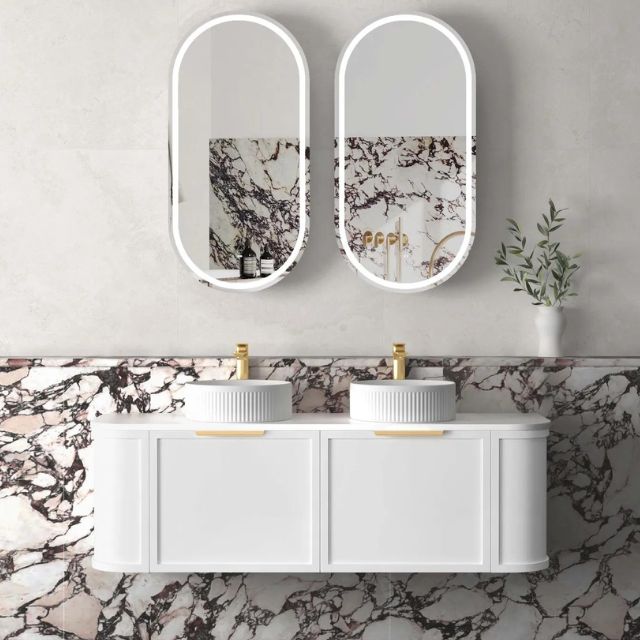
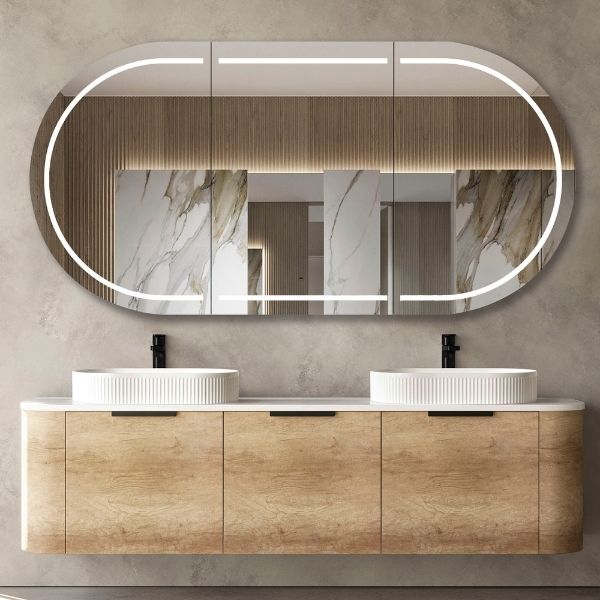
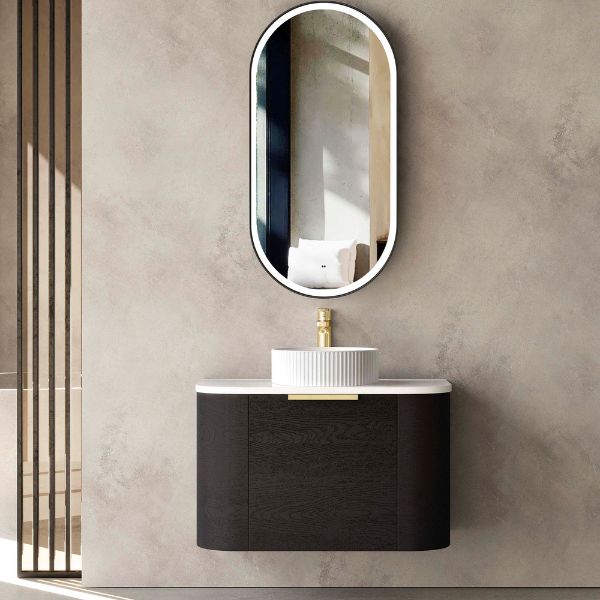
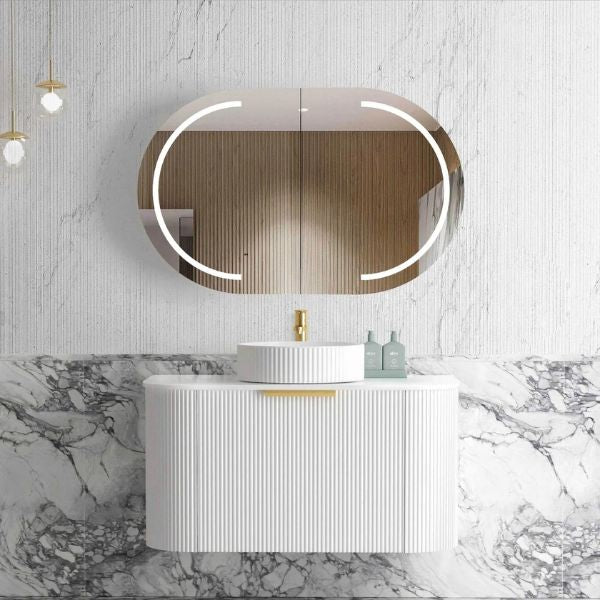


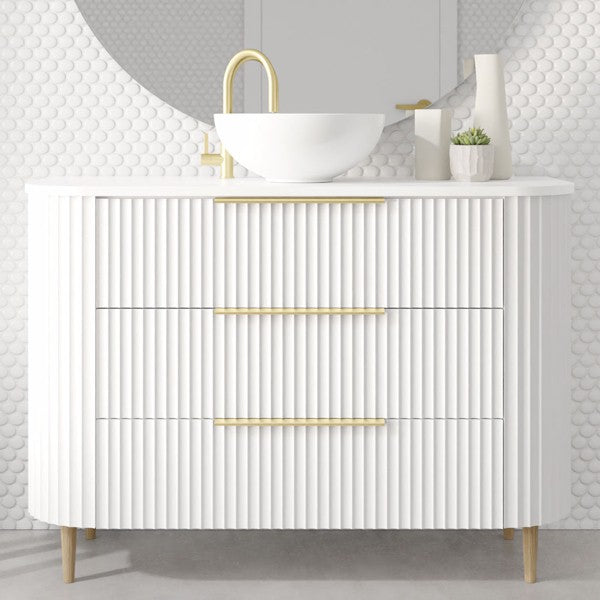
A curved vanity softens the corners or the front of the cabinet, so the room has fewer hard edges. The word covers three different shapes, and they behave differently in a bathroom: a cabinet with curved ends, a cabinet with a curved or bowed front, and a round pedestal. This guide sorts the ranges by shape, then covers how the curve affects floor space, the tops and tap holes, and fixing. None of these are corner vanities, which are units made to fit a 90 degree corner, so if a corner unit is what you need, this is not the page.
Curved ends keep the front flat and round the ends. The Timberline Santos has curved ends and profiled surfaces in painted finishes, with fluted versions in the Dockland and Apollo styles. The Marquis Shore is a gracefully curved cabinet with a choice of fluted designs, offered wall hung with one or two drawers or floor standing on legs. The ADP Waverley has curved ends, and the ADP Flo has curved sides taken from 1920s Art Deco shapes, with slim shaker drawers and a curved splashback.
A curved front bows the whole front. The Otti Bondi is a wall hung curve vanity in Natural Oak, Black Oak or white, and its fluted version is white. The Otti Hampshire is a white wall hung curve vanity. The Ingrain Curved Fluted wall hung vanity has a grooved, stained ash timber veneer front on a moisture resistant plywood carcase.
The round option is a pedestal. The Ingrain Round Fluted Powder Room Vanity is a 400mm floor standing pedestal in matte white painted timber, with a fluted finish, a 410mm round top, a single soft-close door and an internal shelf. If you searched for a round or circular vanity, this is the one.
Measure the depth at the deepest point of the curve, not the middle of the front, and check that figure against the toilet, the door swing and the walkway. You need about 700mm to 750mm clear in front of a vanity to stand and move. The Ingrain Curved Fluted is 500mm deep and 390mm high, which is standard depth for a wall hung cabinet. A curved front does not change how far a drawer travels, so leave room for the drawers to open fully.
Most curved ranges run from 750mm or 600mm to 1800mm: the Santos, Shore, Waverley and Flo from 750mm, and the Bondi and Hampshire from 600mm. The Ingrain Curved Fluted runs from 750mm to 1500mm, and the Round Fluted is a single 400mm size for a powder room. A workable match between width and room follows. A 750mm vanity suits a small main or guest bathroom with one basin. A 900mm vanity is the main and family bathroom size for one basin and is not wide enough for two. A 1500mm vanity is the comfortable double, and 1800mm gives two users separation. To compare other styles at the same width, see 400mm to 600mm, 750mm, 900mm, 1200mm, 1500mm and 1800mm. For a tight room, small vanities is the better filter.
A plain curve reads as one soft shape. A fluted front adds vertical grooves, so it brings texture and shadow to a bathroom that is otherwise flat tile and glass. Choose plain where the room already has pattern, and fluted where it does not. The Bondi, Shore, Santos and both Ingrain ranges come fluted. The fluted vanities collection shows the style across brands. Timber veneer varies from board to board, and the Ingrain finish colour can differ from the photographs, so look at a sample before you commit.
Drawers suit a curved cabinet because you see the whole contents at once. The Ingrain Curved Fluted has one large push-to-open drawer from 750mm to 1200mm and two drawers at 1500mm, on soft-close runners. The Santos includes bamboo storage trays and a solid back panel, and the Bondi and Hampshire have concealed inner drawers on full extension soft-close runners. The Ingrain Round Fluted has a single door and an internal shelf, and a space saver plumbing kit suits it, which takes the pipework to the back of the cabinet and frees the shelf.
Most curved vanities are wall hung, which leaves the floor visible beneath the curve and suits a small room. A wall hung cabinet needs solid backing. Wall hung furniture needs fixing to a support beam fitted between the studs. Extra noggins are added before the wall is sheeted if the cabinet height calls for it, and the noggin must be wider than the vanity. If the walls are already finished, a floor standing unit such as the Shore on legs or the Round Fluted pedestal is the simpler fit, although some floor mount vanities still have to be fixed to the wall, so check the fixing details for the one you buy. See wall hung vanities and freestanding vanities for the wider choice, and the bathroom vanity guide for the two side by side.
The pipes still run to the main body of the cabinet, and a curved front does not change where the waste and supply come out. Have a plumber confirm the positions against the product drawing before you order, especially when you are replacing an existing vanity. The wall should be plumb and straight and the floor level, with the cabinet packed out where they are not, because fixing a cabinet hard against a bowed wall twists it. Every edge where the cabinet or top meets the wall or floor should be sealed with neutral cure silicone, and the vanity kept clear of shower spray. Keep 300mm to 400mm as the clearance from a shower or bath, and use the larger figure where the room allows. Moisture resistant board resists damp but is not waterproof, so wipe water off the cabinet face and ventilate the room.
The curved range comes in white, woodgrain, black and grey. For natural timber, see solid timber vanities, and for the lightest finish, white bathroom vanities. A mirror slightly narrower than the vanity, about 50mm to 100mm in from each side and hung 100mm to 200mm above the bench or basin rim, looks balanced. Browse mirrors by width, and see double vanities and ensuite vanities for the larger and tighter layouts.
A wall hung curved cabinet looks best with a soft glow underneath, and the Timberline Santos is pictured with LED under cabinet lighting. The light sits on the underside of the cabinet and washes the floor, which also gives a gentle night light for the bathroom. Plan the cable route before the wall is lined, and have a licensed electrician connect it. See bathroom lighting for fittings made for bathrooms.
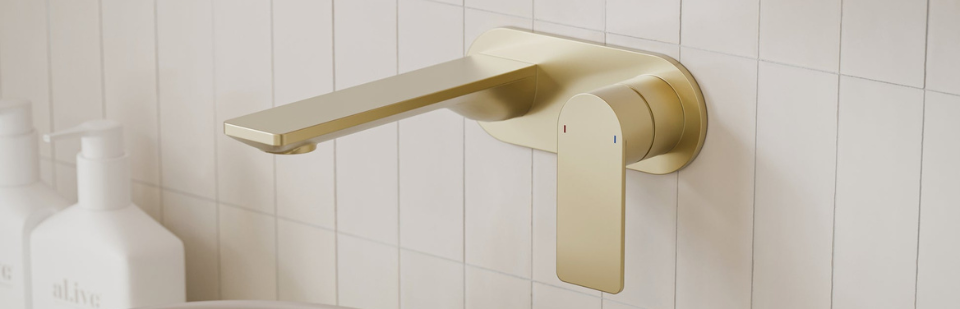
Match the mirror to the curve. A pill, arch or round mirror repeats the soft shape, and a plain rectangle gives a calm contrast. The Waverley is pictured with pill-shaped backlit LED mirrors, the Ingrain Round Fluted with an arched shaving cabinet, and the Shore with an arch mirror and brushed brass or gold tapware. Keep the tap finish in line with the handle finish, so the metal in the room reads as one set.
The basin shape should echo the cabinet or sit in quiet contrast to it. A round or oval above counter basin repeats the curve and suits a soft room. A rectangular basin gives a sharper line against a curved cabinet. Where the top is thin, such as the 12mm porcelain top on the Ingrain Curved Fluted, check the basin size against the top before you order, and make sure the tap hole option matches the tap. Browse above counter basins for the full choice, and see basin mixers for taps that fit a single hole.
For handles on the ranges that take a choice, see cabinet handles. A slim handle suits a curved cabinet, and a push-to-open drawer removes the handle altogether, which gives the cleanest line.
Is a curved vanity the same as a corner vanity? No. A curved vanity has rounded ends or a bowed front and sits against a straight wall. A corner vanity is made to fit a 90 degree corner, and none of the vanities on this page are corner units.
Do curved vanities take up more floor space? A bowed front takes up more depth at its deepest point, so measure from the wall to that point. A cabinet with curved ends takes up the same depth as a straight one, and the rounded corners give you more room to pass.
Is there a round vanity? Yes. The Ingrain Round Fluted is a 400mm round pedestal with a 410mm round top, made for a powder room.
Can I use a wall tap on a curved vanity? Yes, on the tops made for it. The Ingrain Round Fluted is a wall tap design, the Natural Carrara tops on the Otti ranges come with no tap holes, and the Otti Pure White tops can be used with no tap hole at all.
Which curved vanity suits a small bathroom? Choose the 750mm width in a wall hung range, or the 400mm Ingrain Round Fluted for a powder room. A wall hung cabinet shows the floor beneath it, which makes a small room feel larger.
The curved range includes vanities from Otti, Ingrain, Timberline, Marquis and ADP.


