
*View accurate shipping rates and availability






36 Items


Up to 70% off storewide, free metro shipping over $500, and free gifts from $800. Spend more to unlock luxury towels and mirrors.*


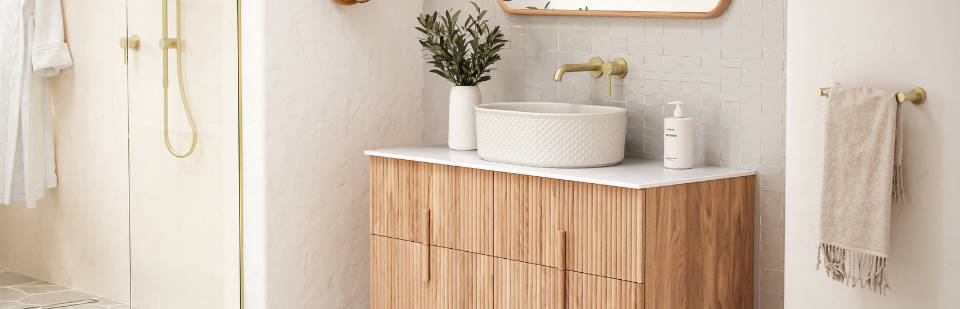


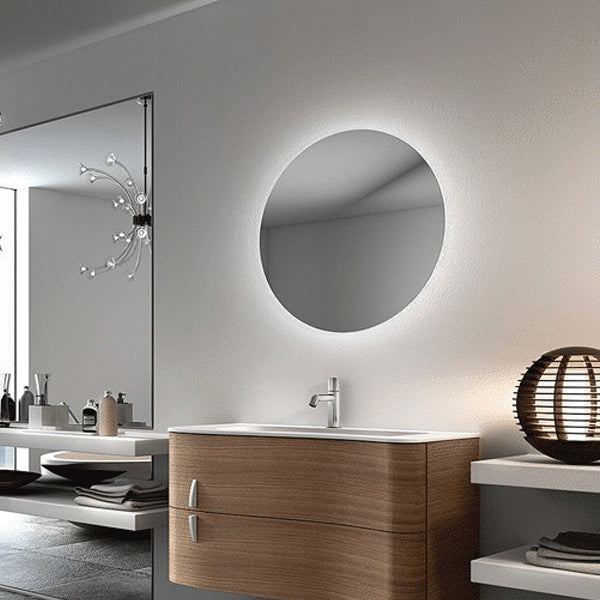


The size of a round mirror comes from the vanity beneath it, and the shape works best where a room is built from straight lines. The practical call: a 600mm or 800mm round mirror over a compact or single vanity, 900mm or 1000mm over a wider one, hung with its centre at eye level. This collection runs from 480mm circles to 1200mm and holds frames in aluminium, ash timber and paint, frameless mirrors with polished or bevelled edges, and lit mirrors with demisters. People search for them as round bathroom mirrors, circle mirrors and big round mirrors, and the buying questions are the same. The sections below cover diameter, height, frames, edges, light, hanging and care.
A round mirror has one dimension to choose, and room size decides it. A 60cm mirror suits compact bathrooms and powder rooms, 80cm is a comfortable middle ground for a single vanity, and 90cm suits wider vanities and larger bathroom walls. Keep 100cm and larger for spacious rooms and feature walls. Over a vanity, a compact vanity takes 600mm or 800mm and a wider one takes 900mm or 1000mm.
Two proportion rules sit alongside. A round mirror should take up about two thirds to three quarters of the furniture piece it hangs above. Over a vanity, work to 70 to 80 per cent of the vanity width when the mirror is narrower than the vanity, and 60 to 70 per cent when wall lights sit either side. On a 900mm vanity, those rules give mirrors of about 600 to 720mm, so a 600mm or 700mm mirror is the safe choice and an 800mm mirror reads large. On a 1200mm vanity, they give about 800 to 960mm, which suits an 800mm or 900mm mirror.
The smallest circles in the collection are the Timberline Oxford at 480mm and the Thermogroup Rio polished edge from 500mm. The Timberline Portland comes in 510mm, 630mm and 930mm, and the Timberline Oxford in 480mm, 600mm and 900mm. These suit a powder room or a narrow vanity, where the 60cm guidance applies.
For big round mirrors, the Marquis Orbit runs from 600mm to 1200mm, and the Radiant Olek frameless LED mirror runs from 600mm to 1200mm. A 1000mm mirror can suit a spacious bathroom with a wide vanity and enough surrounding wall space. A 1200mm circle is a feature mirror and works best on a large wall. If you want a large mirror in a different outline, the Thermogroup Hamilton D-shaped mirror is 1500mm by 1100mm and can be mounted in four orientations, and the Marquis Deco is a decagonal mirror from 600mm to 1200mm.
The shape changes how the mirror sits with the vanity. Round mirrors suit pedestal basins and bathrooms with many hard surfaces, and they leave more empty wall at the corners than a rectangle does. The curved shape contrasts with straight-edged vanities and tiles. A rectangle lines up with the vanity top and the wall edges, so it fits a rectangular vanity and a tiled splashback neatly, while a circle introduces one curve into a room of straight lines.
The call: choose a round mirror when the vanity and tiles are rectilinear and you want contrast, or when the basin is round or the vanity is curved. Choose a rectangle when you want maximum glass at the width of the vanity. For other soft shapes, see oval mirrors, arched mirrors and pill shape mirrors, and for straight edges rectangular mirrors.
Hang the mirror so its centre meets your eyes. Put the centre at 1500 to 1650mm from the floor, leave 100 to 200mm between the tap or splashback and the base of the mirror, never less than 100mm, and keep the top edge at least 100mm below the ceiling. Average eye level runs from 1600 to 1750mm and households vary, so measure the people who will use it. There is no fixed height for a round mirror, so consider the vanity height, the fixtures and the people using the mirror.
A circle has no corners to hide a mistake, so check the numbers first. A 900mm circle centred at 1600mm has its base at 1150mm and its top at 2050mm, which suits a standard 2400mm ceiling. The 100 to 200mm rule shows in examples, such as an 850mm vanity with a 175mm basin mixer, where the base of the mirror falls between 1125mm and 1225mm. Over a double vanity, leave at least 100mm between two mirrors, so two 600mm circles need a 100mm gap or more between their edges.
The frame sets the style. Frameless is clean and minimalist, wood-framed is warm and textured, and metal-framed is sleek in black, gold or silver. Here the Ingrain framed round mirrors have aluminium frames in brushed nickel, matt black and brushed gold, at 600mm and 800mm, and the Ingrain timber framed round mirror is 800mm in an ash timber finish with a soft rounded frame profile. The Thermogroup Georgia round mirrors have slim black, gold or white anodised aluminium frames at 600mm and 900mm, and the frame sits the mirror 20mm out from the wall. The Timberline Portland and Oxford are painted frames in a standard paint colour.
For a black round mirror, the Ingrain matt black frame, the Thermogroup Georgia in black and the Radiant Olek in black are the options. For gold, the Ingrain brushed gold and the Thermogroup gold. The finish also decides the tapware match: brushed nickel tapware suits the brushed nickel frames, black taps suit matt black, and brushed brass taps suit gold. For the full comparison of framed and frameless mirrors see framed mirrors and frameless mirrors. For timber, see Ingrain timber framed mirrors.
Frameless round mirrors differ by edge. The Thermogroup Rio round mirror has a polished edge and the Kent round mirror has a bevelled edge at 800mm. The Thermogroup mirrors have a commercial-strength vinyl backing, copper-free glass and edge sealing to stop foil creep at the edge. The Georgia framed mirrors use a 4mm mirror, and the Ingrain round mirrors use 5mm copper-free glass that resists corrosion.
Those details matter in a bathroom. Moisture gets into a mirror through the edges and through micro-scratches in the protective paint on the back, and copper-free or edge-sealed glass slows the oxidation that causes black spots. A circle has a long edge for its area, so the edge sealing is worth checking on the product page. Run the exhaust fan during the shower and for at least 15 minutes afterward.
Several round mirrors here are lit. The Ingrain round frontlit mirrors, in a brushed nickel, matt black or brushed gold frame and in a frameless version, have a touch sensor, stepless dimming and a built-in demister at 6500K, in 600mm and 800mm, and 700mm and 800mm for the frameless. The Ingrain round frameless backlit mirror is 600mm or 800mm with backlit LED. The Radiant Olek has LEDs around the frame or behind the glass, four brightness levels, adjustable colour temperature and a demister, hardwired, from 600mm to 1200mm. The Thermogroup Ablaze premium back-lit round mirror, from 600mm to 900mm, has warm light at 2700K.
Frontlit and backlit mirrors work differently. A frontlit mirror sends light toward the face and is usually stronger at reducing shadows, while a backlit mirror washes the wall behind it and is more ambient. Lit mirrors need power: the Ingrain and Radiant mirrors need hardwired installation by a licensed electrician, and all the lit mirrors here carry an IP44 rating. For the whole lit group, see LED mirrors, and for the full overview of light and power see mirrors.
The fixing differs for each mirror. The Ingrain round mirrors hang on screws and hangers, the Thermogroup Georgia mirrors use two metal hangers, with a hanger fixing distance of 165mm on the 600mm size and 475mm on the 900mm size, and the Timberline mirrors use a split batten. The Radiant mirrors have brackets built in. Fixings for the wall are generally not supplied. Use stainless steel or nylon fixings in a bathroom so they do not rust, and proper wall anchors for heavier mirrors. Check the weight on the specification sheet before you choose the anchors, and add a safety margin.
Two round mirrors over a double vanity are a classic layout. The Thermogroup Georgia 600mm size is versatile and suits double basin applications, and the gap between two mirrors should be at least 100mm. Centre each circle on its basin, not on the vanity as a whole, and check the gap. If the vanity is 1500mm, two 600mm circles leave a good margin at each end. If the vanity is 1200mm, two 500mm or 510mm circles fit better. A single large circle over a double vanity is the other choice, and the 1000mm and 1200mm sizes serve that.
Wipe a framed round mirror in one pass around the frame, then dry the glass, so no water sits in the join between frame and glass.
Clean an LED demister mirror with a soft microfibre or lint-free cloth rinsed in warm water and wrung out, then wipe gently with a soft dry cloth. Avoid glass cleaner, window cleaner and chemical agents, because they can damage the silver coating. A circle has one continuous edge, so wipe around it and keep liquid off the rim. Check the frame and fixings once a year for rust, swelling or deterioration.
The short version:
The final check is the same for every round mirror: diameter against the vanity, top edge against the ceiling, frame against the room and fixings against the wall. For the brands in this collection see Ingrain mirrors, Thermogroup mirrors, Radiant LED mirrors, Timberline mirrors and Marquis mirrors, or browse wall mirrors.


