
*View accurate shipping rates and availability






141 Items


Up to 70% off across the store, plus free towels and mirrors up for grabs on orders over $800*


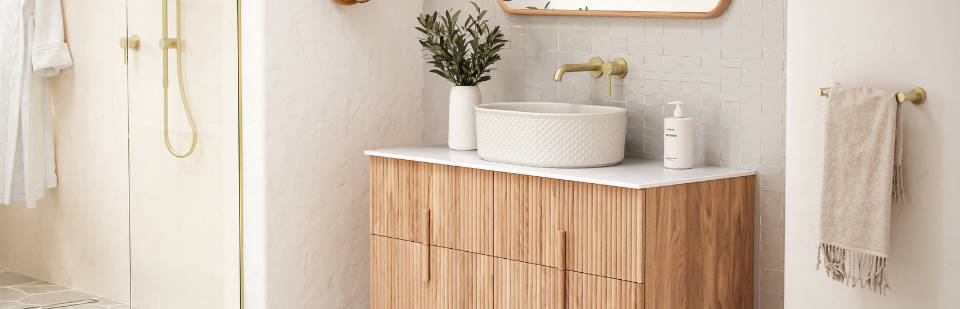


Bronze is a warm, brown metallic finish, closer to a deep tan or a reddish brown than to the silver of chrome or nickel. In this collection it covers shower heads, hand showers, rails, twin sets, arms and ceiling arms from Nero Tapware, Meir, Caroma, Phoenix and Modern National, in finishes called brushed bronze, Tiger Bronze and Lustre Bronze. Bronze is a warm alternative to silver-toned tapware, with the same performance and finish quality, and a warm, tactile focal point for modern or classic bathrooms.
The finish is the easy part to see. What matters for a shower is what sits under it, how it ages and how you clean it, so this page covers those before it covers the types. If you want to compare it with the other warm metals, see brushed brass showers, gold showers and champagne showers. The full range sits in showers.
Bronze goes by several names, and they are not the same finish. The collection holds three: brushed bronze, Tiger Bronze and Lustre Bronze. Brushed bronze is the PVD finish in the Caroma, Nero, Phoenix and Modern National ranges. Tiger Bronze and Lustre Bronze are the Meir names, in PVD and electroplated finishes, and the Meir arms in Lustre Bronze are brass with an electroplated finish and a half inch female thread.
The other names describe finishes you will find elsewhere. Brushed bronze is lighter and more contemporary, matte and smooth to the touch, reflects more light and is easier to clean. Oil rubbed bronze is much darker, a brownish black, slightly slick to the touch, and it needs extra care because hard water leaves spots and crusty rings at the base. Antique bronze is a deeper brown-bronze, moodier and more grounded, with an organic, tumbled texture, against brushed copper, which has a rosier warmth and fine directional brushing. An antique bronze finish is a deep, reddish-brown with warm undertones and subtle variation.
It depends on the finish. A PVD brushed bronze is durable, fingerprint resistant and made to age gracefully with daily use, and its PVD coat is designed to resist corrosion, tarnishing and fading in moisture-heavy settings. A traditional oil rubbed finish needs extra care. So the PVD coat is the stable one, and PVD is the word to look for in the finish name.
Bronze rewards a warm room. It pairs with travertine, brushed concrete or timber-look tiles for added texture. For a richer scheme, use dark timber, textured stone and limewash, and for the lighter copper family, warm timber, marble and terrazzo. Bronze suits heritage, Mediterranean, rustic-modern and classic bathrooms, and works alongside natural materials such as timber, stone and concrete. It carries well across the room. Match the mixer, the towel rails, the robe hooks and the mirror trims, and add a bronze arm and cover plate so the tone runs through the whole shower zone.
Keep the metals few. Use one main finish and at most two. Bronze works as the main metal with a second finish used sparingly, and it can sit beside black for contrast. For the neighbours, see black showers and gunmetal showers.
Caroma lists brushed bronze as a PVD finish across several shower ranges. The Contura II compact twin in brushed bronze has a VJet hand shower with dual check valves. It also has an easy slide rail and a top water inlet, and it is rated 4 star at 7.5 litres per minute. The Contura II rail shower is in the same finish. See Caroma showers.
Nero lists brushed bronze across Opal, Serenity and Mecca pieces and its round arms. The Opal twin shower is solid brass, and for coastal areas the Zen range is the Nero choice, because Zen is made from marine grade stainless steel and is available in all colours. The Serenity ceiling head in brushed bronze is a 295 mm round head in 304 stainless steel with a PVD finish. See Nero Tapware showers.
Meir names its bronze finishes Tiger Bronze and Lustre Bronze, in PVD and electroplated finishes across heads, hand showers, rails, arms and ceiling arms. The Meir round wall curved arm in Lustre Bronze is brass, 400 mm, with an electroplated finish. See Meir showers.
Phoenix lists brushed bronze across Cromford and other ranges. The Cromford twin shower in brushed bronze has a top water inlet that fits existing half inch plumbing, a built-in rotary diverter and dual check valves meeting AS 2845.1, in brass with an adjustable bottom pillar. See Phoenix showers.
The Modern National pieces are in a period style. The Bordeaux twin shower system in brushed bronze has an old world look with white stone handles, a top water inlet with a built-in diverter, solid brass construction and rubber nozzles that flex to break up calcium build-up. The Montpellier arm and rose and the Star round head and ceiling arm are in the same finish.
Rain heads look striking ceiling-mounted or on a curved gooseneck arm, wall-mounted round and square options add warmth without overwhelming a minimalist or classic space, and hand-held and multi-function heads suit family bathrooms and twin shower setups.
Bronze finishes sit on a base metal, and the base decides how the piece copes with salt. Pieces made from 304 and 316 stainless steel with a PVD coating are available, and 316 gives the greatest corrosion resistance and is the better choice for humid or wet areas. 304 suits an inland bathroom, and 316 wants washing every 3 to 6 months at the coast. If you live in a coastal area, consider the Zen range, which is marine grade stainless steel and is available in all colours. So for a coastal bronze, take a 316 stainless piece, and see stainless steel showers and outdoor showers.
Use one main finish with at most two in a room, and keep a single finish across the tapware, shower, towel rails and accessories. Bronze fits that rule well because it is a statement finish. Bronze fixtures can be blended within one space. A warm finish pairs with chrome for contrast and with white for a clean ground, and bronze sits well against both. Black is the other common partner, since a dark frame and a warm metal give contrast without adding a third colour. For the finish neighbours, see chrome showers and white showers.
Brushed bronze is a forgiving finish. The brush lines scatter light, which is why brushed surfaces hide fingerprints and water marks better than polished ones, and PVD brushed bronze is fingerprint resistant. Hard water is still the enemy of any finish. Hard water leaves spots and crusty rings at the base of a fixture, and the answer for every finish is the same: wipe the head and the arm dry after use, and keep a soft cloth in the bathroom. Drying matters most where the water is hard.
Size the head to the shower zone. Round fixed heads run at 200 to 300 mm, with 150 to 200 mm for low-pressure systems and 250 or 300 mm for rain heads, and heads over 250 mm suit good pressure unless a pump is fitted. More nozzles share the same flow on a larger face, so each stream is gentler rather than stronger.
These pieces are rated for an operating pressure of 150 to 500 kPa, and the Caroma Contura II is rated 150 to 1000 kPa on some pieces. A simple check at home is the bucket test. A 10 litre bucket that fills in under 60 seconds under the shower points to good pressure, and large overhead rain heads suit supplies above about 200 kPa.
Set a fixed wall head at 2000 to 2100 mm above the finished floor to the centre of the arm outlet, and 2100 to 2200 mm for a tall household. The top of a rail sits at about 1800 to 1900 mm, and a wall mixer goes at 1000 to 1100 mm. Wall arms project 300 to 400 mm. A rain head on a ceiling arm sits at 2100 to 2200 mm, depending on the ceiling, with at least 20 cm between the head and the user's head. Confirm the heights at rough-in, before tiling.
Use the gentlest method that works. Clean with warm soapy water and a soft microfibre cloth, avoid abrasive cleaners and scouring pads, and clean regularly to keep the finish looking rich. Wipe with a soft cloth and avoid harsh cleaners to maintain the finish. Keep steel wool and abrasive cleaners away from any bronze. Vinegar or rubbing alcohol can damage the finish if left on, so for a PVD bronze warm soapy water is the safe default, and a descaler should be one the maker approves.
In a hard water area, wipe the head and dry it after use. For a deeper clean, tie a bag of warm water with a few drops of mild dishwashing liquid over the head for 30 to 60 minutes, then use a soft toothbrush on the nozzles. Rubber and silicone nozzles rub clean with a finger.
Most pieces are made for replacement. They have top inlets that fit existing half inch plumbing, adjustable pillars and retrofit brackets. A like-for-like head swap is a simple job. Moving an outlet, adding a diverter or changing the arm is not, and it needs a licensed plumber. The rules on what an owner may do themselves differ by state.


