
*View accurate shipping rates and availability






26 Items


Up to 70% off across the store, plus free towels and mirrors up for grabs on orders over $800*




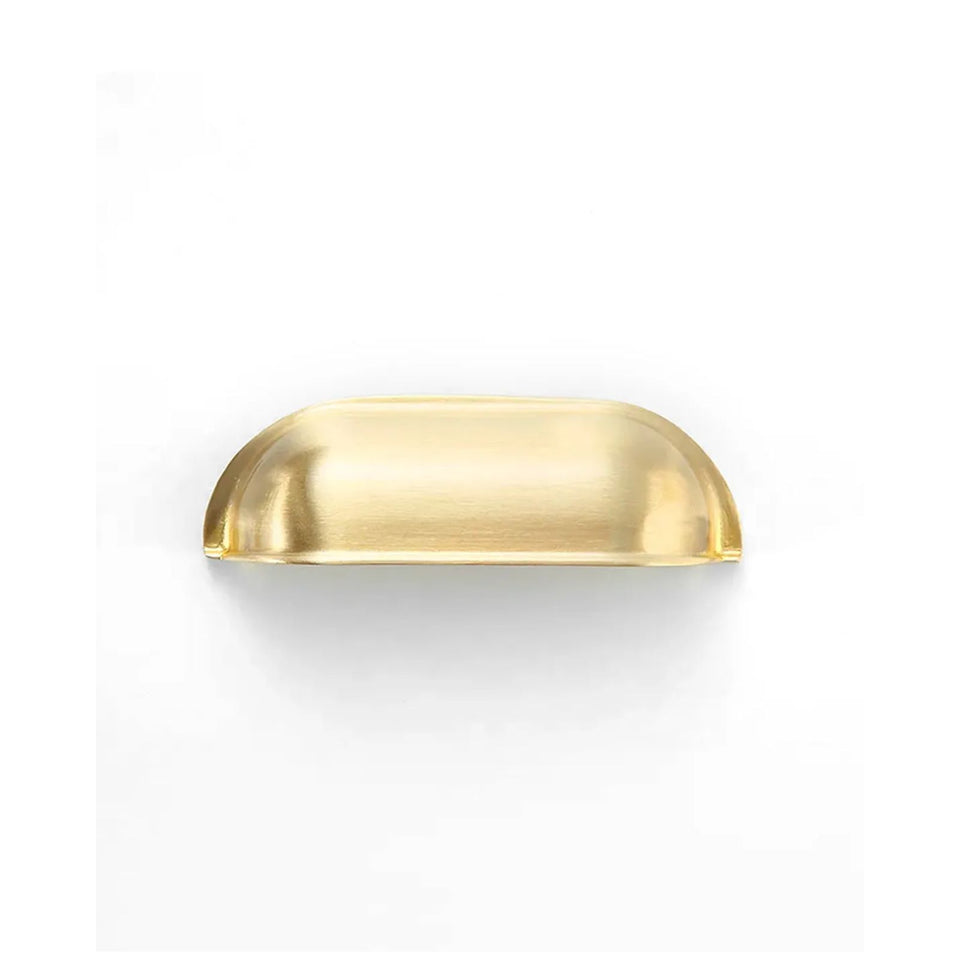




A cup pull is a small, curved pull shaped like half a cup. It fixes to the face of a drawer, and you open it by curling your fingers underneath. This page holds cup pull cabinet handles, also searched as cup handles, cup drawer pulls, cup cupboard handles, bin pulls and half-moon pulls, in brass, zinc alloy and bronze finishes for kitchens, bathroom vanities, wardrobes and furniture. The sections below explain what a cup pull is, where it belongs, and how it differs from a bar pull or a knob. They then cover what each range on this page measures, how to size one, and how to look after it. For handles in every shape, start at cabinet handles.
A cup pull is a small pull shaped like a half-cup or a crescent that mounts flush to the cabinet face. Instead of projecting like a bar or a D handle, it is recessed, so the fingers curl underneath it to open. The same shape is called a half-moon, bin or cup pull, and the names are used for the same form. Semi-circular bin pulls were popular in the late 1800s and early 1900s on kitchen cabinets and utility furniture, and are closely associated with Arts and Crafts furniture, while half-moon pulls were popularised in Victorian-era kitchens.
Cup pulls are used mostly in Hamptons and farmhouse kitchens, typically on lower drawers, paired with knobs on the upper cabinet doors. They suit shaker-style cabinetry and painted finishes, and vintage, traditional, farmhouse and transitional looks. Cup pulls, D handles and knobs also suit Hampton and Shaker kitchens, and bathrooms and furniture.
For a bathroom vanity, a cup pull on a drawer front and a knob on a door is the same pairing at a smaller scale. See bathroom vanities for the cabinets, and cabinet knobs for the knobs that go with cup pulls.
The choice depends on the cabinet and how it is used. Knobs are gripped with the fingers, mount with a single screw and suit small to medium doors and drawers, light use and traditional, vintage or rustic interiors. Pulls are elongated and gripped with the whole hand, use two or more screws and suit large or heavy doors and drawers and high-use areas. Larger cabinets and drawers generally suit pulls, and smaller cabinets pair well with knobs.
A cup pull sits between the two. It fixes with two screws like a pull, and its large surface area makes it comfortable to grip from below and sturdy enough for heavy drawers. A bar pull projects further and is gripped from the front. For a bar pull, see cabinet pull handles. For a pull that sits on the edge of the front, see lip pull handles. For a curved bar, see D shaped cabinet handles and half moon and eclipse cabinet handles.
Hole centres, also called the fixing distance, are the gap between the two screw holes, overall length is the full length of the handle, and projection is how far the handle stands off the door.
Read these against each other. The Hastings has the lowest projection on the page at 22mm, and the Decade the deepest at 36mm. The Hastings and the Decade are brass, while the Verese, New Hampton and Florencia are zinc alloy. The centres run from 64mm to 203mm, and another Australian cup pull range lists sizes and centres of 64, 76, 96, 160 and 203mm, which matches the spread here.
Cup pulls come in antique brass, brushed brass, brushed nickel, matte black and bronze, and Hampton-style ranges add brushed aged brass, dull brushed nickel, matt black and polished nickel. On this page, the finishes include antique brass, brushed brass, brushed nickel, English bronze, dull brushed nickel, matt brass and satin brass. The common ones are easy to place. Brushed brass is warm and elegant and pairs well with white or navy cabinetry, matte black is bold and modern, and satin nickel is versatile. Gunmetal and antique bronze suit moody, industrial or heritage looks, and brushed finishes hide fingerprints better than polished ones.
Brass is heavier than zinc alloy of the same size, and zinc alloy is die-cast, lighter and plated in many of the same finishes. A deep scratch that breaks through plating on zinc shows a dull grey, where on brushed brass, which is solid brass under clear lacquer, a scratch shows more of the same brass. A brass cup pull therefore wears more quietly, and a zinc alloy one is the lighter and more varied choice. For the brass range, see solid brass cabinet handles, and for zinc, zinc alloy cabinet handles.
Test a sample before buying a full set. Check finger room, smooth edges, pull depth, access to the lowest drawer, room for longer fingernails, and grip on a heavy drawer. For a deep pot drawer, test the pull with weight inside. Test on an upper drawer, a lower drawer and a heavy drawer, since each behaves differently. Hold a handle against the cabinet to check the grip.
Cup, shell and bin styles are grip plates, which may or may not have an integral backing plate, and a pull may be fastened to or through an escutcheon plate. One cup pull can be recessed into a drawer front or mounted proud on a shaker-style door, and the arched profile reads cleanly against both flat-panel and shaker door profiles. The Castella cup pulls on this page come with two M4 screws, 25mm for the Decade and 22mm for the Hastings. For the Momo Handles and Otti cup pulls, check what is included before you buy more.
Hole centres, and not overall length, measure handle length. As a rule of thumb and not a strict rule, a pull is commonly about one third of the drawer or door width. Cup pulls run smaller than bar pulls, so the rule gives a guide to the overall width of the cup and not the centres. For a drawer up to about 400mm wide, a knob, a short pull or a compact bar usually looks balanced, which is the range of the 64 to 96mm cup pulls on this page. For fronts of about 450 to 700mm, 128, 160 or 224mm centres are frequently right, which is the range of the 96 to 203mm cup pulls. A typical starting point for placement is 40 to 60mm from the door edge to the centre of the fixing.
If you are replacing handles, measure the centres of the holes you have and match them unless you plan to fill the old holes. A 128mm handle will not fit 160mm holes without drilling new holes, which can leave marks on a painted or veneered front. Plan holes carefully before drilling, since finishes are easy to change later but drilled holes are not, and rear-fix screws make installation straightforward.
Centre the handle on a drawer front. On a base door, place it near the top corner on the side opposite the hinges, and on a wall door near the bottom corner. The general rule is horizontal handles on pull-out drawers and vertical handles on doors, with a check that handles do not hit each other when cabinets open. Put painter's tape where the handle will go to compare sizes, and check that fingers have room to grip. Hold a handle against your cabinet to check the grip, including for larger hands or arthritic fingers.
Wipe the pull with a soft cloth and mild soap and water, then dry it. Abrasive pads, steel wool and harsh chemicals are out, and brass polish should not go on lacquered or coated brass. Because the underside of a cup collects dust and hand oils, run the cloth under the lip as well as over the top. A living brass finish needs less, not more, because trying to keep the surface perfectly uniform can do more damage than letting it age.
For the full range of handle styles, return to cabinet handles.


