
*View accurate shipping rates and availability






72 Items


Up to 70% off across the store, plus free towels and mirrors up for grabs on orders over $800*


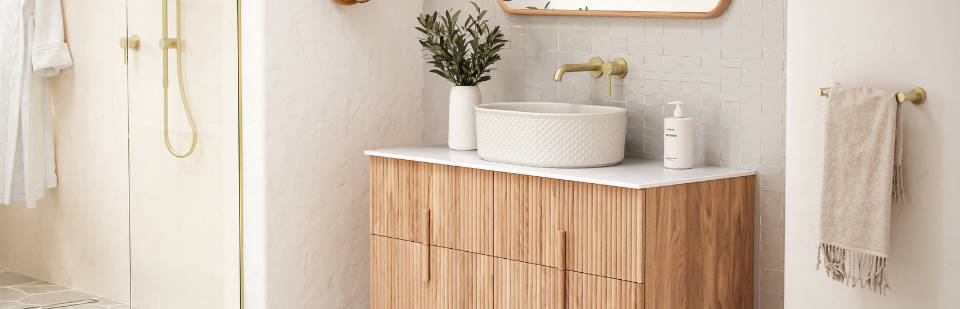


A frameless mirror is a sheet of glass with a finished edge and nothing around it. The edge is polished flat, bevelled, or polished with a sandblasted border, and the glass hangs straight on the wall. That is the whole idea, and it is why the choice comes down to four things: the edge, the size against the vanity, the height on the wall and the fixing. Light and shape come after those. People search for frameless mirrors, frameless bathroom mirrors and mirrors with no frame, and the answers are the same for all three. Each figure below names where it comes from.
A frameless mirror has a clean, polished edge with no surround, and it blends into the wall instead of standing out. It is a single sheet of glass with polished or bevelled edges, mounted directly to the wall. The main point is plain: nothing but the glass edge is visible.
That leaves the edge doing a job a frame would otherwise do. A frame protects the glass edges from knocks, which is why a framed mirror suits a home with children or pets. A frameless mirror asks for a little more care when it is fixed and cleaned, and gives back a plain, flat look that sits behind the vanity, tapware and tiles instead of competing with them. For the framed alternative, see framed mirrors.
The edge is the first thing to read on a product page, because it is the only finish a frameless mirror has. The Thermogroup polished edge mirrors, in rectangle, square, round, oval, pill and arch shapes, have a smooth ground edge with no extra detail. The Thermogroup Rectangle 25mm Bevel Edge Mirror has an angled edge that catches the light, and the Thermogroup Round 18mm Bevel Edge Mirror does the same on a circle. The Thermogroup Rectangle Mirror with Sandblasted Border adds a frosted strip 25mm wide, set 25mm in from the edge on every side, so the glass reads as if it has a quiet picture frame etched into it.
Moisture gets into a mirror through the edges and through tiny scratches in the protective paint on the back, and copper-free glass and sealed edges slow the oxidation that causes black spots. The cut edges of a frameless mirror are exposed to humidity, so a cleanly polished edge resists moisture for much longer than a rough one. A mirror glued tight to a damp splashback deteriorates faster, and good ventilation protects either kind. In practice that means leaving a small gap between the glass and the splashback or benchtop, and running the exhaust fan after a shower.
The clearest width rule is this: when the mirror is not the same width as the vanity, make it 70 to 80 per cent as wide, and 60 to 70 per cent when sconces share the wall. On a 600mm vanity that means a mirror about 420mm to 480mm wide. On a 900mm vanity it means about 630mm to 720mm, and on a 1200mm double vanity about 840mm to 960mm, or one mirror over each basin.
The collection has a wide spread of widths. The Thermogroup rectangle, square and round mirrors run from about 500mm to 1500mm, the Marquis Pane runs from 600mm to 1200mm, and the Radiant Ark runs from 1000mm to 1800mm. A frameless mirror can span a whole double vanity in one piece in a way a framed mirror, built in set sizes, often cannot. Under the width rule, a 1000mm mirror suits a vanity about 1250mm to 1430mm wide, and an 1800mm mirror suits a wall about 2250mm to 2570mm wide.
Hang the mirror so its centre meets your eyes. Put the centre at 1500mm to 1650mm from the floor, with 100mm to 200mm between the tap and the base of the mirror and the top edge at least 100mm below the ceiling. A mirror needs to reach about 30cm above and below the eye line of its users. Two other limits apply: above a sink the mirror should not hang lower than 20cm from the sink edge, and a large frameless mirror should have its bottom edge at least 1.2m above the floor.
Frameless suits a small room for a simple reason: the glass reflects more of the light and the room, so the space feels larger. A mirror 600mm to 900mm tall suits most single vanities, and 150mm to 200mm should stay clear above the mirror from cabinets or exhaust fans. In a compact room a 500mm to 600mm wide mirror at that height fits a narrow vanity without crowding the corners, and a frameless edge adds no extra width to the outline.
A frameless mirror also pairs easily with the rest of the room. With no frame colour to match, it sits with any tapware finish, from chrome to matt black to brushed brass, and with any tile. If you like a finish on the wall, add it through lighting or a shelf rather than the mirror. See LED mirrors for lit frameless options.
Frameless covers every shape, and the collection holds most of them. Rectangle and square mirrors suit the straight lines of a vanity, and the Thermogroup rectangle polished edge mirrors run from 600mm by 750mm up to 1500mm by 900mm, with a 750mm square as well. For more of these, see rectangular mirrors and square mirrors.
Round and oval mirrors soften a room full of tiles and screens. The Thermogroup round polished edge mirror comes in diameters from 500mm to 900mm, the Timberline Oxford round comes in 480mm, 600mm and 900mm, and the Marquis Oval runs from 600mm to 1200mm. For each shape see round mirrors and oval mirrors.
Arched and pill shapes add height. The Thermogroup Church arch comes in 750mm by 1000mm and 500mm by 800mm, the Ingrain arch is 500mm by 900mm, and the Marquis Pane has a gently squashed arch from 600mm to 1200mm wide. The pills include the Thermogroup pill at 500mm by 1000mm and the Ingrain pill at 500mm by 850mm and 500mm by 900mm. See arched mirrors and pill shape mirrors. Geometric options include the Thermogroup D-shaped Ablaze at 900mm by 750mm, 1200mm by 900mm and 1500mm by 1100mm.
Frameless suits a lit mirror because the light sits behind the glass instead of in a frame. The Ingrain lit mirrors have touch sensors, dimming, a demister and 6500K light, and they are hardwired by a licensed electrician. The Radiant Pebl has covered LEDs behind the glass, four brightness levels and a defogger, and the Radiant Ark runs from 1000mm to 1800mm. The Otti LED Newport and Noosa come in 1200mm and 1500mm widths, and the Noosa can be plugged in or hardwired. The Thermogroup Ablaze mirrors are back-lit, from 500mm up to 1200mm.
The lit mirrors carry an IP44 rating, so they suit bathroom zones where splashes are possible. For the whole group see LED mirrors, for the demister pads and sizes see mirror demisters, and for the full guide to light and power see mirrors.
The Timberline mirrors have a painted back, in white or black, and mount on a split batten system. The Oxford is round, with a depth of 20mm, or 36mm when the optional lighting kit is fitted. The Timberline Church is an arch at 400mm by 800mm, 22mm thick, with copper-free glass and satin white edging. For the range see Timberline mirrors.
The fixing differs for each mirror. The Thermogroup polished edge mirrors come with a two-part aluminium hanger, the Ingrain mirrors hang on screws and hangers, the Radiant mirrors have brackets built in, and the Timberline mirrors use a split batten. Because nothing frames the glass, the fixing carries the whole load, so choose it for the weight of the mirror, not for the look. A frameless mirror also needs a small gap off the countertop, so set the hangers with that gap in mind.
Frameless mirrors are mounted with clips, a J-channel or mirror adhesive, often in combination, and failures usually trace to the wrong adhesive or no mechanical support. Use at least two clips along the bottom edge of a medium or large mirror, and avoid wiring, plumbing and areas of high heat or moisture. Weigh the mirror before you choose the hardware, because a frameless mirror shatters if it falls. Tape suits humid rooms, and glue should stay away from the edges of the glass or it will squeeze out and streak.
Clean an LED demister mirror with a soft microfibre or lint-free cloth rinsed in warm water and wrung out, then wipe gently with a soft dry cloth. Avoid glass cleaner, window cleaner and chemical agents, because they can damage the silver coating. Keep liquid off the edges, wipe them dry, and check the fixings once a year. Clean frameless edges regularly, to prevent corrosion. Check for rust or deterioration, which on a frameless mirror means the hangers and brackets.
The trade-off is the edge. A frame protects it, and glass alone does not. If you have children who swing doors or a tight bathroom where the mirror will be bumped, a frame helps. If you want the reflection, the light and a plain wall, the glass alone does the job.
The final check is the same for every mirror: edge against the room, width against the vanity, height against the eye line, and fixings against the weight. For the brands in this collection, see Thermogroup mirrors, Marquis mirrors, Ingrain mirrors, Otti mirrors and Radiant LED mirrors, or browse wall mirrors and full length mirrors.


