
*View accurate shipping rates and availability






13 Items


Up to 70% off across the store, plus free towels and mirrors up for grabs on orders over $800*


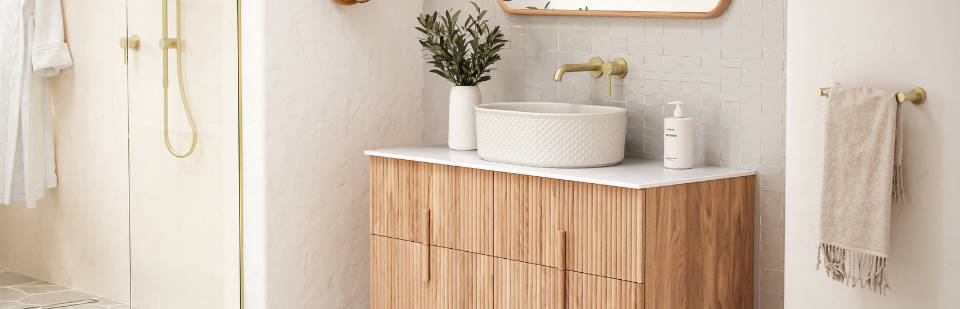


Timberline mirrors are painted-surround mirrors made to sit with a vanity, and the range is built around that pairing. Timberline is an Australian company based in regional NSW that makes bathroom furniture, and the mirrors follow the vanity lines: rectangles in a matching finish, round and square mirrors, arches and a half-moon. The practical call is to choose the shape and finish that suit the vanity, then size the width and height against the basin and the people who use it. The sections below take the ranges one at a time, then cover finishes, size, height, fixing, lighting and care.
The collection runs across six shapes. The round mirrors are the Timberline Oxford, in 480mm, 600mm and 900mm diameters, and the Portland, in 510mm, 630mm and 930mm. The California is square, in 600mm, 750mm and 900mm. The arches are the Church, in a framed version at 430mm by 830mm and 630mm by 1030mm and a slimmer version at 400mm by 800mm, and the Jazz Arch, which comes in both vertical and horizontal sizes. The Melody is a half-moon, 1200mm wide and 800mm high.
The rectangular family is the largest. The Miami, Miami Classic, Halifax, Georgia and Essence all share a height of about 720mm, and the Essence is 739mm. They come in widths of 600mm, 750mm and 900mm, with 1050mm, 1200mm and 1500mm on most of them. The Georgia comes in 600mm, 750mm, 900mm, 1200mm and 1500mm. Those widths fit Timberline vanities, so a mirror can be chosen at the width of the vanity below it.
The five rectangles look similar in a table of sizes and quite different on the wall. The Miami has a surround in the finish you choose, and ordering it in the colour that matches your vanity gives the cohesive result. The Miami Classic has a routed frame, and that profile complements shaker style vanities. The Halifax makes a statement of its surround, is 100mm deep, and has an optional lighting feature with a hardwire transformer. The Georgia is the plain all-rounder, and the Essence adds a shelf, in a finish you can choose from the Timberline colour options, for small items next to the basin.
Depth is worth reading. The Halifax is 100mm deep, while the Church and Jazz Arch frames are 18mm and the California is 20mm, so the rectangles differ a lot in how far they stand from the wall. For the rectangular alternatives, see rectangular mirrors.
The round Oxford and Portland are the soft choice. The Oxford is 20mm deep, or 36mm when the optional lighting kit is fitted, and its back is painted white or black. The Portland has a painted frame in a standard finish. The sizes run from 480mm to 930mm across the two ranges, which gives a small circle for a narrow wall and a large one for a wide wall. For the full group, see round mirrors.
The California is a square, in three sizes that are as tall as they are wide, 600mm, 750mm and 900mm, and 20mm deep. The large square surface reflects light and gives the illusion of a bigger bathroom. The Melody is a half-moon, a flat base with a curved top, at 1200mm by 800mm and portrait only. For squares, see square mirrors.
The Church and Jazz Arch bring height. The Church Frame is a portrait mirror only, 18mm deep, in two sizes. The slimmer Church Mirror is 400mm by 800mm, 22mm thick, and installs vertically only. The Jazz Arch Frame is 18mm deep and hangs either way: the vertical sizes are 430mm by 1030mm, 630mm by 1030mm and 430mm by 1530mm, and the horizontal sizes are 1030mm by 430mm, 1030mm by 630mm and 1530mm by 430mm. A horizontal arch reads as a long mirror with a curved top above a vanity. For the full set of arches, see arched mirrors.
The framed mirrors are finished in a 2-pack polyurethane hardening process, which makes them durable and easy to clean. The standard painted finishes cover the range, with white satin as the default unless you specify another. Woodgrain finishes are not available on the Church Frame, Jazz Arch, Portland and Miami Classic, while the Halifax comes with a Rural Oak woodgrain surround, so check the finish line on the product page you choose. The Oxford has a back in white or black painted Timberline cabinet finishes.
The glass is copper-free, which gives corrosion resistance. Copper-free or edge-sealed glass slows the oxidation that causes black spots, and moisture gets in through the edges and through tiny scratches in the paint on the back. A painted surround protects the edge more than bare glass does, which is a point in favour of a framed mirror in a steamy ensuite.
There are two safe routes. The first is to match: choose the mirror surround in the finish of the vanity, which is what the Miami is made for. The second is to contrast on purpose, with a dark surround against a pale vanity or the reverse. A simple frame only a few centimetres wide suits nearly any room, so a slim surround is the easy choice when the vanity is busy.
Shape follows the vanity too. A rectangle suits a straight-sided vanity, and a round mirror gives a soft contrast to a blocky one. The Miami Classic, with its routed frame, echoes the panelled doors of a shaker vanity. For the vanities that pair with these mirrors, see Timberline vanities. For other framed mirrors, see framed mirrors.
The clearest width rule is this: when the mirror is not the same width as the vanity, make it 70 to 80 per cent as wide, and 60 to 70 per cent when sconces share the wall. On a 900mm vanity that is a mirror about 630mm to 720mm wide. On a 1200mm vanity it is about 840mm to 960mm, and on a 1500mm vanity about 1050mm to 1200mm. Many Timberline rectangles come in the vanity widths, so you can also choose the same width as the vanity, which is the other option the rule allows.
Where a vanity is 1500mm wide, a 1500mm mirror matches it exactly. Where it is 1200mm, a 900mm mirror falls in the 70 to 80 per cent range at 75 per cent. Pairs also work: a double vanity can take one mirror over each basin, and the gap between two mirrors hung side by side should be at least 100mm.
Hang the mirror so its centre meets your eyes. Put the centre at 1500mm to 1650mm from the floor, with 100mm to 200mm between the tap and the base of the mirror and the top edge at least 100mm below the ceiling. In New Zealand practice the centreline sits at 1450mm to 1600mm, measured from the finished floor, since a floor finish changes the final height. A mirror needs to reach about 30cm above and below the eye line of its users.
A mirror 600mm to 900mm tall suits most single vanities, and 150mm to 200mm should stay clear above a mirror from cabinets or exhaust fans. The 720mm rectangles, the 600mm to 900mm round and square mirrors and the Church Mirror at 800mm all fall inside that range. A narrow Church or Jazz Arch in vertical hang suits a slim wall, and several tall, skinny mirrors can emphasise the height of a space.
The Timberline mirrors hang on a split batten, an easy mounting rail in two parts, and the Miami comes with a mounting cleat. The Essence has a sturdy mounting mechanism in its backing board. The fixing carries the whole load, so choose the screws and plugs for the weight of the mirror and the wall behind it. Studs are the most secure fixing and cavity anchors suit plasterboard without a stud. Hardwired lighting needs a licensed electrician, so plan the supply before the wall is closed.
A big rectangle needs two people. Check the specification sheet for each size, and read the installation line on the product page: wall mounting applies to all of them. Measure the vanity and the wall first, mark the centre line, and put the batten on a level line before the mirror goes up.
Several Timberline mirrors take optional surround lighting. The Oxford has a lighting kit that takes the depth from 20mm to 36mm and gives a glow behind the mirror. The Halifax has an optional lighting feature complete with a hardwire transformer, and the white backing applies when lighting is chosen. The Church, Jazz Arch, Portland, Miami Classic and Melody all take optional surround lighting. For lit mirrors that arrive complete, see LED mirrors.
Clean an LED demister mirror with a soft microfibre or lint-free cloth rinsed in warm water and wrung out, then wipe gently with a soft dry cloth. Avoid glass cleaner, window cleaner and chemical agents, because they can damage the silver coating. The painted surrounds are easy to clean, so a damp cloth works there too. Keep liquid off the edge where glass meets the paint, wipe the surround dry, and check the fixings once a year.
The decision runs in four steps. Choose the shape that suits the vanity, choose the surround finish, size the width at 70 to 80 per cent of the vanity or the full width, then set the centre at eye level and clear the tap by 100mm to 200mm. For the hub, see mirrors. For frameless alternatives, see frameless mirrors, and for the whole wall, browse wall mirrors.


