
*View accurate shipping rates and availability






88 Items


Up to 70% off across the store, plus free towels and mirrors up for grabs on orders over $800*


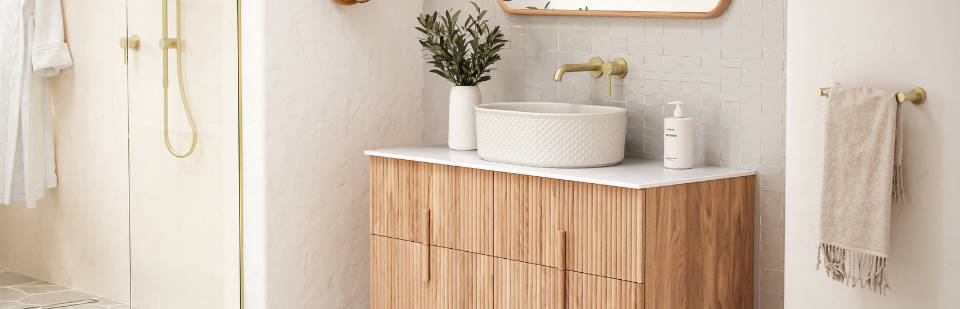


A framed bathroom mirror comes down to three things: what the frame is made of, how well the glass is protected at the edges, and how the mirror is fixed to the wall. The frame is the part that meets the steam, so the practical call is a frame in a material that tolerates moisture, such as powder-coated aluminium, stainless steel or a sealed painted finish, over copper-free glass. The sections below cover the frame materials in this collection, what moisture does to each, size, height, fixing, finish and care.
Both options work. Frameless mirrors suit modern, minimalist spaces, ornate frames suit traditional ones, and a simple frame only a few centimetres wide suits nearly any room. A frame adds a line around the glass and a finish that can match the tapware or the vanity. It also covers the edge of the glass, though the glass still needs to be properly made, and the sections below explain why. A frameless mirror reads as glass only, so the wall finish carries the room. For that option see frameless mirrors.
A bathroom is the hardest room in the house for a frame, and the material decides how it ages. Timber frames can swell and crack, MDF can delaminate, and metal frames can rust. Untreated timber needs regular sealing in a bathroom. Low-quality chrome plating peels and rusts under persistent humidity. Grade 304 stainless steel resists corrosion and needs only a wipe with a damp cloth, and powder-coated aluminium is the standard for frames. Avoid MDF or untreated timber near the shower.
The frames in this collection fit into that picture as follows:
The call: for a mirror near the shower or in a poorly ventilated ensuite, choose aluminium, stainless steel or a sealed painted frame over bare timber, and keep a timber frame for a powder room or a bathroom with a good exhaust fan. Timber is not wrong. It needs sealing and ventilation.
The frame gets the attention, but the glass fails first. Moisture gets into a mirror through the edges and through micro-scratches in the protective paint on the back. A standard mirror has a silver layer, a copper coat over it and paint layers. Once moisture reaches the silver, it oxidises, and the black spotting that results cannot be reversed. Look for mirrors with copper-free or edge sealed glass, which dramatically slow or stop that oxidation. Clear silicone around the perimeter is a temporary fix for edge spots on a mirror already in place.
Width follows the vanity. When the mirror is not the same width as the vanity, it should be 70 to 80 per cent as wide, so it looks smaller without looking shrunken, and 60 to 70 per cent when wall lights sit either side. A single wide mirror over a double vanity works, and so do two matching mirrors, one over each basin. A mirror 600 to 900mm tall suits most single vanities.
The collection has mirrors for every width. The Thermogroup Georgia round mirror is 600mm across, a versatile size for double basin vanities. The Thermogroup Carson rectangular is 750mm by 900mm, hangs upright or sideways, and has a black anodised aluminium frame and a 4mm mirror. The Timberline Halifax and Miami mirrors run from 600mm to 1500mm wide by 720mm, in widths including 750mm, 900mm and 1050mm. The Ingrain rectangular timber framed mirror is 600mm by 1000mm and hangs upright or sideways. If the shape and width is the main decision, wall mirrors shows the plain rectangles alongside.
Hang the mirror so its centre meets your eyes. Centre it at 1500 to 1650mm from the floor, leave 100 to 200mm between the tap or splashback and the base of the mirror, never less than 100mm, and keep the top edge at least 100mm below the ceiling. Average eye level runs from 1600 to 1750mm and households vary, so measure the people who use it. Keep 150 to 200mm clear above the mirror from cabinets or exhaust fans.
Frame and shape work together. Round mirrors suit pedestal basins and bathrooms with many hard surfaces. The collection has framed mirrors in every shape: round mirrors, oval mirrors, arched mirrors, pill shape mirrors, square mirrors and rectangular mirrors.
Frame finish is the last choice and the easiest to get right. Match it to the tapware or the vanity hardware and the wall reads as one scheme. The Thermogroup Georgia, Havana and Juno mirrors come in black, white or gold, so a black frame pairs with black taps, a gold frame with brushed brass taps, and a white frame suits a pale room where the frame should recede. Chrome fittings sit well with chrome taps and a slim black or white frame.
Searches for wooden bathroom mirrors, timber framed mirrors and custom timber mirrors come down to two routes in this collection. The first is the Ingrain timber framed range, with an ash-coloured timber finish and a soft rounded profile in round, rectangular and arch shapes, hung with screws and hangers. The second is the Timberline range, which is made to a choice of widths and painted in a standard finish. The Halifax and Miami come in widths from 600mm to 1500mm by 720mm, offer the frame in the full selection of Timberline finishes, and the Miami can be ordered in the colour of the matching vanity. The Halifax has an optional LED lighting kit.
The Timberline Miami Classic has a routed frame that suits shaker style vanities, and the Church and Jazz frames come in any standard painted finish but not woodgrain. If the vanity is painted, a painted Timberline mirror ordered to match is the more cohesive choice. If the vanity is woodgrain, the ash timber Ingrain mirror is the closer match to a natural look. For a similar look in a painted frame, see Timberline mirrors.
Some framed mirrors carry light. The Ingrain frontlit framed mirrors have a touch sensor, stepless dimming and a built-in demister. The Otti LED Newport and Noosa have a metal frame with acrylic and adjustable colour temperature. The Radiant mirrors have LEDs in the frame, four brightness levels and a defogger. IP44 is the minimum rating for a bathroom, with IP65 for wet rooms, and a CRI of 90 or more gives accurate colour. Demister pads typically draw 20 to 45 watts and LED strips are rated for 30,000 hours or more. The lit mirrors here are rated IP44. For the full lit range see LED mirrors.
The frame finish is what you see most. The collection runs through gold, black, white, brass, brushed nickel, woodgrain, chrome and bronze. Ordering the mirror in the same colour as the vanity gives a cohesive result, and the same logic works for tapware. For brushed nickel see brushed nickel tapware, for black black taps, for brass brushed brass taps, and for chrome chrome taps.
Four fixing systems are used across the range. The Ingrain mirrors use screws and hangers. The Timberline mirrors use an easy split batten, or a mounting cleat on the Miami. The Thermogroup mirrors mount with two brackets so the frame sits neatly against the wall. The Turner Hastings mirrors include concealed wall brackets. Lit framed mirrors add a power supply, covered on the hub page.
The simplest protection is air. Run the exhaust fan during the shower and for at least 15 minutes afterward, and wipe the mirror dry after steamy showers if there is no demister pad. That keeps moisture off the frame and away from the edges, which is where the damage starts.
For cleaning, use the manufacturer's care card first, because the right cleaner depends on the mirror. A pH-neutral glass cleaner on a microfibre cloth works on a plain framed mirror, sprayed onto the cloth and not onto the edges, and abrasive cleaners and scourers should stay in the cupboard. An LED demister mirror needs a soft microfibre or lint-free cloth rinsed in warm water and wrung out, with no glass cleaner, window cleaner or chemical agents, because they can damage the silver coating. Both methods use microfibre and keep liquid away from the edges. Stainless steel needs only a damp cloth.
The short version:
The final check is the same for every mirror: frame material against the room's moisture, glass against the product page, size against the vanity, and fixings against the wall. For the brands in this collection see Ingrain mirrors, Otti mirrors, Timberline mirrors, Turner Hastings mirrors, Thermogroup mirrors and Radiant LED mirrors.


