
*View accurate shipping rates and availability






4 Items

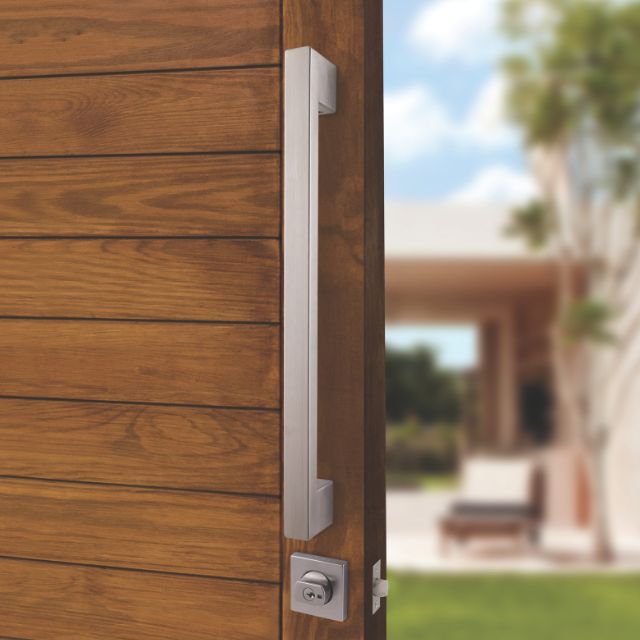


An entrance pull set is a long pull handle for the front door combined with a lock that takes a key. The handle is a fixed bar you grip and pull, and the lock sits in the door edge or beside the handle and is worked with a key from outside and a turn or lever from inside. This collection holds entrance pull sets in stainless steel and matte black from Lockwood, Nidus and Zanda, with single and double cylinder locks. This guide explains how an entrance pull set differs from a lever set, what is in the box, which door measurements decide fit, how the lock types work and how to choose between the sets. For bare pull handles with no lock, see pull handles, and for lever based locks, see entry door lock sets.
A lever entrance set suits a standard hinged door and a hand that is full of shopping, because pressing a lever down is easy. A pull set suits a door where the look of a long bar matters, such as a pivot door, a tall timber door or a glass entry. The bar is also a clear signal to a visitor of where to grip the door, which helps on a wide door with no visible hardware.
The practical point is the latch. On a pull set the bar does not turn, so the door is held shut by a deadlatch or a deadbolt, and you open it from inside with a lever, a thumb turn or a key, depending on the model. For a closer look at lever based locks, see entry door lock sets and exterior door levers.
The Lockwood Paradigm sets combine a stainless steel pull handle with a Paradigm lock. The outer handle is 600mm long and the inner handle is 500mm long, and the handle is 30mm wide. The handle is 304 grade stainless steel, in a brushed stainless finish or in matte black. These sets suit doors 32 to 48mm thick, and the single cylinder set needs a spacer on doors 32 to 36mm thick, which is included.
The locks use a five pin tumbler mechanism with a brass cylinder and brass barrel. The sets are supplied individually keyed with two keys per lock, with 78,000 key combinations. The backset is adjustable from 60 to 70mm on the deadbolt set and 60mm on the deadlatch set. The lock conforms to the security and durability requirements of Australian Standard AS 4145.2-2008.
The deadbolt has a stainless steel bolt that resists cutting, and DualSelect: one turn of the key sets safety mode and a further turn sets secure mode. The matte black set also lists bump and pick resistance, a counterbalance bolt that shares the load between the door and the frame and door magnets that hold the door in position when it is in passage mode. Screw fixings are concealed, which keeps the faces of the handle clean. See Lockwood for the wider range and deadbolts for separate locks.
A single cylinder lock takes a key on the outside and a turn or lever on the inside. A double cylinder lock takes a key on both sides. The Lockwood Paradigm sets come in both. The single cylinder deadlatch is a self-latching lock, which means the door latches by itself each time it closes. It suits semi-commercial and apartment buildings and meets fire rating requirements.
The choice comes down to how you want to leave the house. A key on both sides means you need the key to get out, which is more secure against someone reaching a thumb turn through broken glass but slower in an emergency. A single cylinder lets you leave without a key. For a home with children, older residents or a glazed door, think about this before you order, and choose the lock that matches how the door will be used day to day.
The Nidus ATZ is a stainless steel entrance set with an external thumblatch and an internal lever. It is a single cylinder deadbolt with key access from outside and a snib turn inside. The set is built from stainless steel for resistance to corrosion, and it includes four keys, which suits a household with several people or a spare kept elsewhere.
The design is sleek and sits well on modern architecture. A thumblatch gives you a pull handle that also releases the latch, which means the handle can be a neat compact shape and you do not need a separate lever on the outside. An installation sheet is linked from the product page. See Nidus door hardware for the rest of the range.
The Zanda Omega combination is built for glass, timber and aluminium doors. The pull handle is 600mm overall with 400mm centres, fixed back to back and sold as a pair. The handle is 316 stainless steel, which is the grade usually chosen where salt air or heavy cleaning is a factor.
The kit includes a round double turn lock and a 60 by 38mm floor mounted door stop, with three keys. A double turn lock throws the bolt with two turns of the key, which gives a deeper throw than a single turn. The handle is commonly used on hinged, pivot and sliding doors. See Zanda door hardware for matching pieces and door stops for other stop styles.
Four numbers decide whether a pull set suits a door: door thickness, backset, handle centres and the hole preparation. Thickness is the width of the door edge. The Lockwood sets suit doors 32 to 48mm thick. Backset is the distance from the door edge to the centre of the lock. The Lockwood backset is 60 to 70mm adjustable on the deadbolt and 60mm on the deadlatch, and 60mm is the backset most commonly used on Australian entrance doors.
Handle centres are the distance between the two fixing points on the handle. The Zanda centres are 400mm. Hole preparation is the set of holes the lock needs. A 54mm hole, a 16mm hole and a 25mm side bolt hole, and your door must have or take those holes before the lock goes in.
When you are replacing hardware, remove the old handle, check the bore, then measure backset, centres and thickness and compare each with the product page. When the door is new, give your door maker the product sheet so they prepare the holes before delivery.
A long pull handle looks right when it is in proportion to the door. The 600mm outer handles in this collection suit a door that is at least 900mm wide, where the bar can sit towards the lock edge without crowding the door. On a narrower door a shorter bar may look better, and the pull handle collection has shorter options. See pull handles.
Fit the handle so the grip sits at about the height of your hip or the middle of your forearm when your arm hangs naturally. The lock goes in the same line, usually a little below the handle midpoint. Your door maker will often set this out on the door before the holes are drilled.
For a front door, look for a standard, a bolt that resists cutting and a cylinder that resists picking and bumping. The Lockwood Paradigm meets AS 4145.2-2008, with a stainless bolt, bump and pick resistance and a counterbalance bolt. Those are claims that can be read on the product page and checked against the maker's sheet.
A lock is one part of door security. The door itself, the frame, the hinges and the strike plate matter as well. A strong lock in a weak frame does not give you a secure door. If you are replacing the lock only, look at the frame and the hinges at the same time. See hinges for door hinges.
A front door has more than a handle. The house number, the letterbox, the lights and the door furniture all sit in view. If you choose matte black, carry it through to the door stop and the hinges. If you choose stainless steel, match it to the rest of the stainless on the entry. See exterior door handles and hardware for other entry pieces.
A floor mounted stop, like the one in the Zanda kit, protects the wall behind the door. If your door does not come with one, add one so the handle does not hit the wall when the door swings open.
For a standard residential front door, choose a Lockwood Paradigm set in stainless steel or matte black, with a deadbolt when you want a key lock and a deadlatch when the door is in an apartment or a semi-commercial building. For a modern door with a thumblatch and an internal lever, choose the Nidus ATZ. For glass, pivot or sliding entries that want a long back to back bar, choose the Zanda Omega kit.
Measure first, decide your cylinder type, plan your keys and match the finish to the rest of the entry. Then the set will fit and work on the day it is fitted.
It is a pull handle for an external door supplied with a lock that takes a key. The bar is the handle and the lock holds the door shut.
These sets suit doors 32 to 48mm thick. On the single cylinder deadlatch set, doors 32 to 36mm thick need a spacer, which is included.
A single cylinder lock takes a key outside and a turn or lever inside. A double cylinder lock takes a key on both sides.
The Lockwood sets come with two keys per lock, the Nidus ATZ with four and the Zanda Omega kit with three.
Yes. A lever set has a handle that turns the latch. On a pull set the bar is fixed and the lock holds the door shut.


