
*View accurate shipping rates and availability






239 Items


Up to 70% off across the store, plus free towels and mirrors up for grabs on orders over $800*


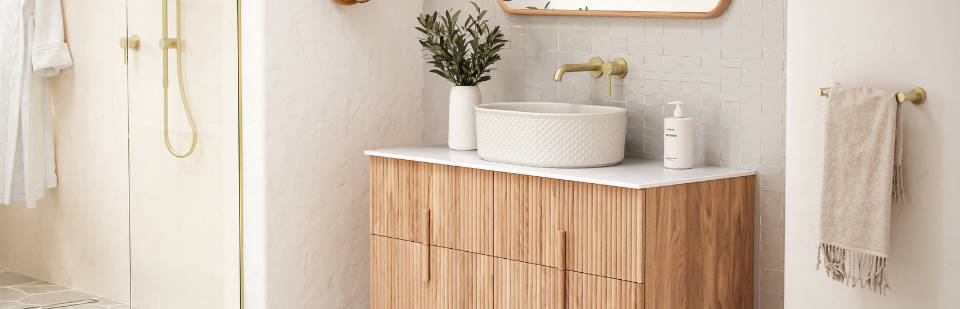


A toilet roll holder keeps the roll within easy reach of the pan, off the floor and in the finish that matches the rest of the room. This page covers wall-mounted toilet roll holders, also called toilet paper holders, across every type and finish we stock. Start here to choose the type, the position and the fixing. Then open the collection for your finish, your form or your tapware brand, where the ranges and measurements are laid out in detail.
The type matters more than the finish, because it decides how the holder is used. Six types cover almost every bathroom.
Nearly every holder here is wall mounted with screws and comes with a fixing kit or an install kit, and one Modern National holder is a stick-on design. Freestanding stands and recessed holders are not part of this collection.
For a residential bathroom, the holder usually sits about 660 to 760 mm above the finished floor, measured to the centre of the roll, and 200 to 300 mm forward of the front edge of the pan. Treat those figures as a starting point, not a rule. The test takes a minute: tape a spare roll to the wall at the planned position and sit down. Your arm should reach the roll without leaning or twisting.
Before you drill, check these:
For accessible, ambulant and commercial projects, the set-out follows AS 1428.1 and your project documents rather than a rule of thumb. For an accessible toilet, the requirement is that the outlet sits within 300 mm of the front of the pan, no higher than 700 mm above the floor, with the roll projecting no more than 150 mm from the wall. Confirm the set-out with your certifier before you fix anything.
Screw fixing is the stronger and longer-lasting choice, and it suits tiled walls and plasterboard when you use the right plug or anchor for the surface. Adhesive holders avoid drilling, but they work best on smooth, clean, non-porous surfaces and can lose their grip in a humid room. For a bathroom that is being renovated, a screw-fixed holder is the better match. When you drill into tile, confirm what is behind it first. Plasterboard needs a suitable anchor, a timber stud takes a screw directly, and a tiled wall needs fixings made for tile.
Swapping a holder starts with the old fixing holes: measure the distance between their centres, not the width of the old holder, and compare that figure with the new holder's fixing spread. Check whether the new holder is fixed facing one way or can be reversed, since some designs mount left-hand or right-hand. A holder with a round or square plate covers the wall around its fixings, which helps when the old holes are close to the new position. Before you mark the wall, hold a full roll in position to check the clearance.
Most of our holders are stainless steel, and the rest are brass or zinc alloy. Stainless steel comes in grades. Grade 304 suits a general home bathroom. Grade 316 and 316L resist salt better, so they are the grades to choose within reach of the coast. The grade is a separate decision from the colour, because a coloured finish is a coating on the metal underneath. See stainless steel toilet roll holders for the grades range by range.
Match the finish to the tapware and the rest of the accessories, because a holder in the same finish name as the tap sits in the same tone. Each finish has its own page with the ranges and measurements.
Brands name their finishes differently, so a search on one colour name misses ranges in the same colour. This table translates the main ones.
| Colour family | Names you will see |
|---|---|
| Gunmetal | Gunmetal or Gun Metal (Caroma, Nero, Fienza), Graphite (Nero Zen and Opal), Shadow (Meir), Brushed Carbon (Phoenix) |
| Brass tones | Brushed Brass (Caroma), Urban Brass (Fienza), Aged Brass (Nero York), Tiger Bronze (Meir) |
| Gold | Brushed Gold (Nero and Phoenix) |
| Bronze tones | Brushed Bronze (Caroma, Nero, Phoenix), Lustre Bronze (Meir), Brushed Copper (Fienza) |
| Black | Matte Black on most ranges, plain Black on the Caroma Luna and Urbane II Universal, Antique Black on the Phoenix Nostalgia |
Each colour is explained in its own collection above, and every name from one make appears together in the list further down. If you are matching an existing tap, find its finish name in the table, follow the link for that colour and compare ranges within the brand.
Three measurements matter on every holder. Projection is how far the holder stands out from the wall, and it decides how much clear wall you need beside the pan. Length or width is the footprint on the wall, which matters beside a vanity or a screen. Hanging length is the span the roll sits on. Double, shelf and spare holders are longer or deeper than singles, so allow for the extra before you mark the wall. Not every range gives all three figures on its product page, so open the page for the exact holder when a number is missing.
If you already have tapware from one brand, open the page for that brand, which sets out every design and finish together. Gold, brass and bronze names differ by brand, so matching by brand is the safest way to match a finish.
The Nero Mecca Care range is the one to look at for an accessible or assisted-living bathroom. It pairs a holder with a 450 mm grab rail rated at 150 kg, and 32 mm rails are approved for standard AS 1428.1 requirements in DDA bathrooms. It also includes a heavy duty holder, 25 mm toilet roll rails in 300 mm and 450 mm lengths and an add-on holder that fits any modular 32 mm grab rail. See grab rails for the rails themselves and assisted living for the wider range.
A holder is usually one piece of a set. Black bathroom accessories, chrome bathroom accessories, brushed nickel bathroom accessories and toilet brush holders carry the same finishes across towel rails, robe hooks and the rest of the accessories. The full range is on bathroom accessories.


