*View accurate shipping rates and availability






A 150 x 150mm tile is a square 15 centimetres on each side, small enough to read as a grid of its own and large enough to tile a wall quickly. This collection holds one tile: the Hartz Gloss White, a ceramic wall tile with a cushioned edge. This page explains that tile line by line, and then covers the questions people bring to the size itself: floor or wall, which grout joint, which layout and how to look after it.
For other small formats, see the small tiles collection, the 100mm x 100mm tiles collection and the mosaic tiles collection. For plain squares by shape, see the square tiles collection, and for white tiles in every size, the white tiles collection.
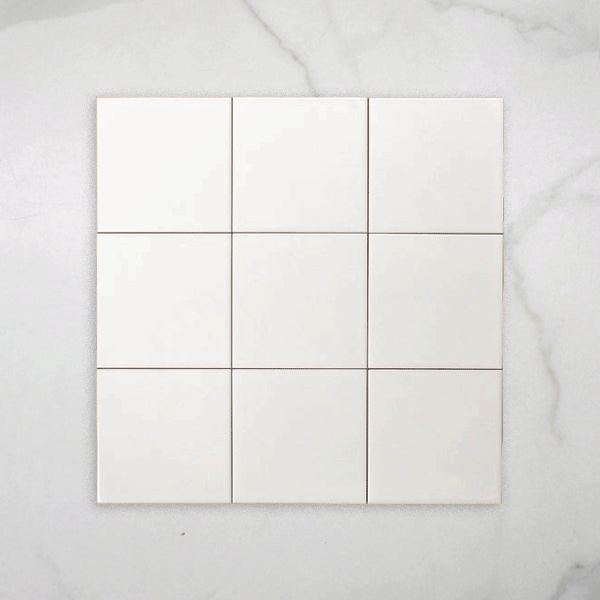
The Hartz Gloss White is white ceramic with a gloss finish, 150 x 150mm. The listing says the tiles installed will have a uniform overall appearance with minimal texture and colour variation, and the pattern line reads V1. The edge is cushioned and the tile is non-rectified. One box covers 1.53 square metres.
The most important line is the wall one. The listing says the tile is intended for wall applications only and not suitable for flooring, and the Wear Rating reads Wall Category 0. That settles the first question people ask about this size. This tile is for a wall, a splashback, a niche or a feature panel. It is not a floor tile, however small the squares look.
The listing also says installation must be carried out by a licensed tiler to the appropriate Australian standards. The white range page it belongs to is the white tiles collection, which holds the other formats of white.
A Sydney tile retailer notes that 150 x 150mm tiles are mostly recognised as mosaic style tiles used for bathroom and laundry walls and floors. It adds that small tiles can be flexible in wet areas and can give grip because there are more joints. That is the retailer's view. The deciding facts are on the listing: the Application line, the Wear Rating and the slip rating where one is printed.
An Australian size guide groups small floor tiles as up to 300 x 300mm, and says they suit detailed patterns or a pop of colour in smaller spaces such as a bathroom or laundry. It adds that they need more grout, so a continuous look is harder to get. The same guide says small wall tiles, up to 150 x 300mm, are good for decorative touches and mosaics. A 150 x 150mm tile sits at the small end of both.
If you want a floor in this size, choose a tile whose listing says Floors and prints a slip rating. The floor tiles collection explains slip and wear lines. For walls by size, see the wall tiles collection.
A tile manufacturer's size page describes 150 x 150mm as a classic square format that balances versatility and style, with proportions that suit interior spaces from kitchens and bathrooms to commercial interiors. It says a wide choice of colours, finishes and textures lets the size run from a subtle backdrop to a bold feature.
In a home, the common places are a bathroom wall, a shower recess, a kitchen splashback, a laundry splashback and a niche. A white gloss square suits all of them. The size gives enough joints to read as a deliberate grid, and the tile is large enough that a wall does not take long to tile. For rooms, see the bathroom tiles collection and the kitchen tiles collection.
A Perth retailer says white surfaces return more available light than darker colours, which can help a bathroom feel brighter, and that a gloss finish usually reflects light more strongly while a matte finish gives a softer, less reflective result. It adds that windows, mirrors, artificial lighting and surrounding finishes all change the effect, and that it would never promise that white tiles will make a room look larger.
A Sydney supplier's white splashback guide makes the same trade-off. Gloss catches light and keeps a splashback bright, which helps in kitchens with little natural light. It also shows water spots and fingerprints more readily, so it rewards a quick wipe. Matte sits back and reads calmer. The Hartz tile is gloss, so it follows the first pattern. The guide also says white is rarely just white, and that a sample against your benchtop and cabinetry in your own light is the quickest check.
The Hartz listing prints a cushioned edge and a non-rectified tile. The cushioned edge listings elsewhere in the store describe cushioned edge tiles as having natural irregular edges. An Australian styling blog explains the effect on the joint: rectified tiles with a square edge can have tight joints, while a tile with a cushion edge most likely needs a joint of 3 to 5mm.
The same blog gives a general rule that smaller joints are better, with ideal joints of 1 to 3mm, and says 1mm joints between wall tiles and 3mm joints between floor tiles are common. It notes that grout is the weakest part of a tiled surface and discolours over time, so larger joints mean more grout to clean and a greater chance of visible cracking. For a wall tile of this size, the listing does not print a gap, so ask your tiler to confirm the width before ordering.
The joint also changes the look. A narrow joint close to the tile colour makes the wall read as one smooth surface. A wider, contrasting joint makes the grid the feature. Because the tile is white, the grout colour carries most of the visual choice.
A flooring guide describes the straight lay, also called a grid or stack bond, as the simplest arrangement: tiles in aligned rows and columns so the joints form continuous straight lines. It says the layout suits square and rectangular tiles, and that smaller tiles create a textured, detailed look.
The same guide says matching grout minimises grout visibility for a continuous feel, while contrasting grout shows up the grid and adds graphic interest. A 150 x 150mm tile in a straight lay gives the grid its clearest form, because the square joints line up in both directions. That makes alignment matter. A Perth retailer notes that straight lines make poor alignment and uneven joints more visible, and that installation accuracy starts with a flat, properly prepared surface and a clear layout plan.
For a layout with more movement, a square tile can be set on the diagonal, which the diamond tiles collection explains. A diagonal needs more cuts, and the listing for this tile is for walls, so confirm the plan with your tiler.
The Perth retailer advises checking the complete wall width and the fixture positions before settling on a tile proportion. A format that looks balanced on a wide vanity wall can create awkward cuts in a narrow shower, it says, and corners, niches, tapware and shower fittings all affect where cuts fall. With a 150mm module the maths is simple: divide the wall width by 150 and look at the remainder.
A remainder under half a tile means thin cuts at the edge or the corner. Ask your tiler whether to shift the starting line so the cuts are even on both sides of a focal point such as the vanity or the niche. A flooring guide notes that smaller tiles suit a textured, detailed look, and that large rooms tolerate large tiles while small spaces benefit from sizes that avoid awkward cuts. Ask your tiler to mark the wall out dry before fixing.
The flooring guide gives one design idea for a grid: alternate tile colours every few rows to create bands. A white Hartz tile could take a band of a second colour at a chosen height, with the white above and below. A Sydney retailer says 150mm tiles can be combined with matte tiles in a visually pleasing way, and that small tiles can be mixed with other sizes, colours, shapes and materials to build a unique surface.
A simple version is a gloss white field with a matte tile in the same size at the base of the wall or around a niche. The size stays constant, so the joints line up, while the finish changes. Check the thickness of each tile before you plan it, since a 5mm tile beside an 8mm tile leaves a step at the join. A manufacturer's 150 x 150mm range lists thicknesses of 5, 6 and 8mm across different products, which shows the spread. The Hartz listing prints no thickness line, so ask the store for the figure.
The styling blog advises using a high quality grout, because better grouts have more polymer, which makes them stronger, more flexible and more resistant to water absorption, the main cause of grout discolouration. It also points out that grout comes in dozens of colours, from white and ivory to light and mid grey, black, brown and bright colours, and suggests asking to see a grout colour chart when you choose the tile.
On a white gloss wall, the choice is between a white or ivory grout for a continuous look and a grey for definition. The Sydney splashback guide says a white or off-white grout lets small tiles read as one soft surface, while a grey grout picks out every tile and plays up the grid. Decide before you order, and view the grout against the tile in the room's light.
A tile of this size creates more joints than a larger wall tile, which means more grout to keep clean. The Perth retailer says there is more grout to maintain with small formats, and that cement based grout and epoxy grout have different care needs. Some cement based products may need sealing, it says, while epoxy can offer stronger stain resistance in certain applications, and the grout manufacturer's instructions should decide.
The tile face is the easy part. A glazed ceramic face is usually straightforward to wipe with a non-abrasive cleaner, the same retailer says, and flat surfaces are generally easier to clean than rippled or heavily textured ones. A Sydney retailer's product page for a similar 150 x 150mm gloss ceramic tile lists sealing as not required, which is the usual position for glazed ceramic. A tile and grout system is only as easy to maintain as its grout, so plan the grout colour with cleaning in mind.
For a shower wall, the tile is only one layer. The Perth retailer says the tile, adhesive and grout sit over the waterproofed surface and do not replace the waterproofing itself, and that the National Construction Code sets out the relevant wet-area waterproofing requirements for bathrooms and showers. The product specification must also confirm that the tile suits the intended wall and wet-area use.
The Hartz listing is for walls, and a licensed tiler is required to install it. Ask your tiler and waterproofer to confirm the system for a shower recess. The tile itself will not tell you whether the wall behind it is sound.
This collection holds the Hartz white only. Other tiles of this size appear in other collections, because they are listed under a range name and a different size format. The Soluna Arc tiles, for example, are 150 x 150mm with a patterned arc design and plain colours, and they are wall tiles. You can find them in the patterned tiles collection, along with other small pattern ranges, and in the small tiles collection.
That split is worth knowing if you search by size alone. The size is a starting point, and the collections by look, colour and use show the rest of what the store holds at 150mm and nearby sizes such as 100 x 100mm and 200 x 200mm.
A 150 x 150mm tile gives more joints and a finer grid than a 300 x 300mm tile, and far more than a 600mm tile. The 300mm x 300mm tiles collection covers the next square up. A Sydney supplier's guide says large format tiles create a sleek, modern look with fewer grout lines, and that small tiles do the opposite: more detail, more grout and a more textured surface.
That is the trade-off to weigh. If the aim is a calm, continuous wall, a larger tile with a narrow joint is the quieter choice. If the aim is texture, a classic grid and a bright gloss, a 150 x 150mm tile gives it. The square shape is neutral, so the finish and the grout colour decide the mood.
The Sydney splashback guide recommends ordering a sample to check a white against the benchtop and cabinetry in your own light, and the Perth retailer makes the same point about samples laid flat and upright under ceiling light and natural light. Gloss changes with the angle of the light, so look at it in the morning and at night, from a standing height and from the side.
A white that looks cool beside a grey bench can look warm beside a timber vanity. Because gloss white is the one finish in this collection, the surroundings decide how it reads. Hold the sample next to the vanity, the benchtop and the paint before you commit.
The listing says one box covers 1.53 square metres. A 150 x 150mm tile covers 0.0225 square metres, so the box holds enough for a modest wall, and the coverage is the number to use when you plan quantities. Measure the wall, subtract the openings, and add an allowance for cuts around fixtures. The listings for other tiles in the store recommend ordering an extra 15 percent over the exact quantity, and that is a sensible starting point for a small tile with many edge cuts.
Order the full quantity in one go. Colour, size and texture can vary from batch to batch, and a later order may come from a different batch, which shows on a plain white wall more than on a pattern. Keep a few spare tiles for future repairs.
For a small bathroom wall, a kitchen splashback or a laundry splashback in white, the Hartz Gloss White is the tile in this collection. Check three things: the Application line says walls, the edge is cushioned and non-rectified, and the joint is agreed with your tiler. Order a sample and view it in the light of the room.
If you need a floor, a different pattern or a different finish, move out to the neighbouring collections. The tiles collection covers every shape and size in the store.