
*View accurate shipping rates and availability






8 Items




Up to 70% off across the store, plus free towels and mirrors up for grabs on orders over $800*


This page gathers lighting that is available now. It is a working selection, not a fixed catalogue, so what you see changes as items sell and new ones arrive. Right now it mixes four LED globes, a square oyster ceiling light, an indoor and outdoor wall light and two white Eglo Fremantle outdoor fittings. The guide below explains why availability matters when lighting is the last job on the list, then goes through each fitting so you can judge whether it suits the room before you commit.
In a renovation, lights go in late. An Australian guide to renovation trades gives the order as demolition, plumbing and electrical rough-in, waterproofing, tiling, cabinetry and then fit-off, with painting last, and it says the plumber and electrician return to install tapware, toilets, ovens and lights. Sources disagree about where the painter fits. One puts the electrician before the final coat. Other guides place the electrician's second fix after plastering and most of the decorating, and some renovators paint around the boxes first and finish the walls once the electrician has been.
The disagreement matters less than what the guides share. Fittings are among the last things to go on, so a fitting that is not ready when the electrician returns can hold up the finish of the whole room. One guide advises booking the second fix visit as soon as the first fix is confirmed, and another warns that decorators may need to repaint after late electrical changes. A selection that is available now takes some of that risk away. It does not replace choosing the right fitting for the room, which is what most of this guide is about.
All four globes are LED and all take an E27 base, the standard Edison screw size. One retailer's guide says E27 and B22 are the most common bases in Australian homes at 240V, so an E27 globe fits a large share of existing fittings, but check your socket before ordering.
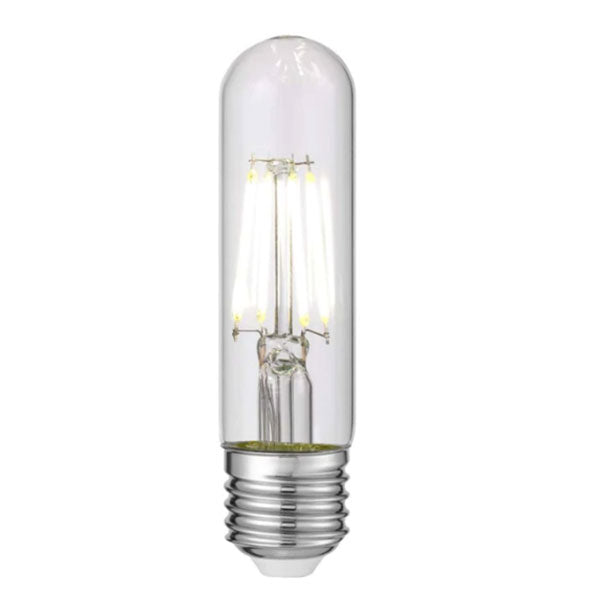
The Telbix classic A60 is a 5W globe giving 470 lumens at 4000K natural white. The pilot ST64 in clear glass is an 8W filament LED giving 800 lumens at 3000K warm white, and the same shape in amber glass is a 4W globe giving 360 lumens at 3000K. The T30 is a slim 5W tube, 30 mm across, giving 440 lumens at 4000K, and it is the only globe of the four listed as dimmable. Each carries a colour rendering figure of 80.
A consumer guide helps with reading those numbers. It rates about 420 lumens as the light of an old 40W incandescent and 800 lumens as a 60W, which makes the 8W clear pilot the brightest globe here. It calls 3000K warm and 4000K cool, and says most bulbs rate 80 to 90 for colour rendering, with 80 adequate. The T30's tube shape suits narrow fittings, as its listing says.
A retailer's globe guide suggests choosing in a fixed order: the base first, since a globe that does not fit the socket is no use, then the lumens for the job, then dimmer compatibility, then colour temperature. It groups 2700K to 3000K as warm, for living areas, 4000K for kitchens, bathrooms and offices, and 5000K to 6500K as daylight. By those bands the two 3000K pilots belong in living rooms and bedrooms, and the 4000K classic and T30 suit a kitchen, a laundry or a workspace.
The same guide describes shapes. The A60 is the general-purpose shape, and decorative shapes such as the pilot suit exposed fittings where the globe is on show, which is the case for the clear and amber pilots. The consumer guide adds that LED globes last far longer than the older types, citing 15,000 to 35,000 hours or more, and that small enclosed fittings trap heat and shorten the life of LED and compact fluorescent globes. A closed shade is a poor home for a hot, high-output globe, so stay within the fitting's stated wattage limit. The light bulbs and globes page covers bases, shapes and dimmer compatibility in more detail, including one retailer's warning that a non-dimmable LED on a dimmer can flicker, buzz or fail early.
Two more points from the globe guides apply to the T30, the only dimmable globe here. One retailer says LED globes should be used on LED-compatible dimmers, and that dimmers installed before about 2010 may need replacing. The same retailer tells buyers to look for the RCM mark, which refers to the Australian standard AS/NZS 4782, on globes. The listings for these four globes do not state an approval, so check the packaging if the mark matters to you.
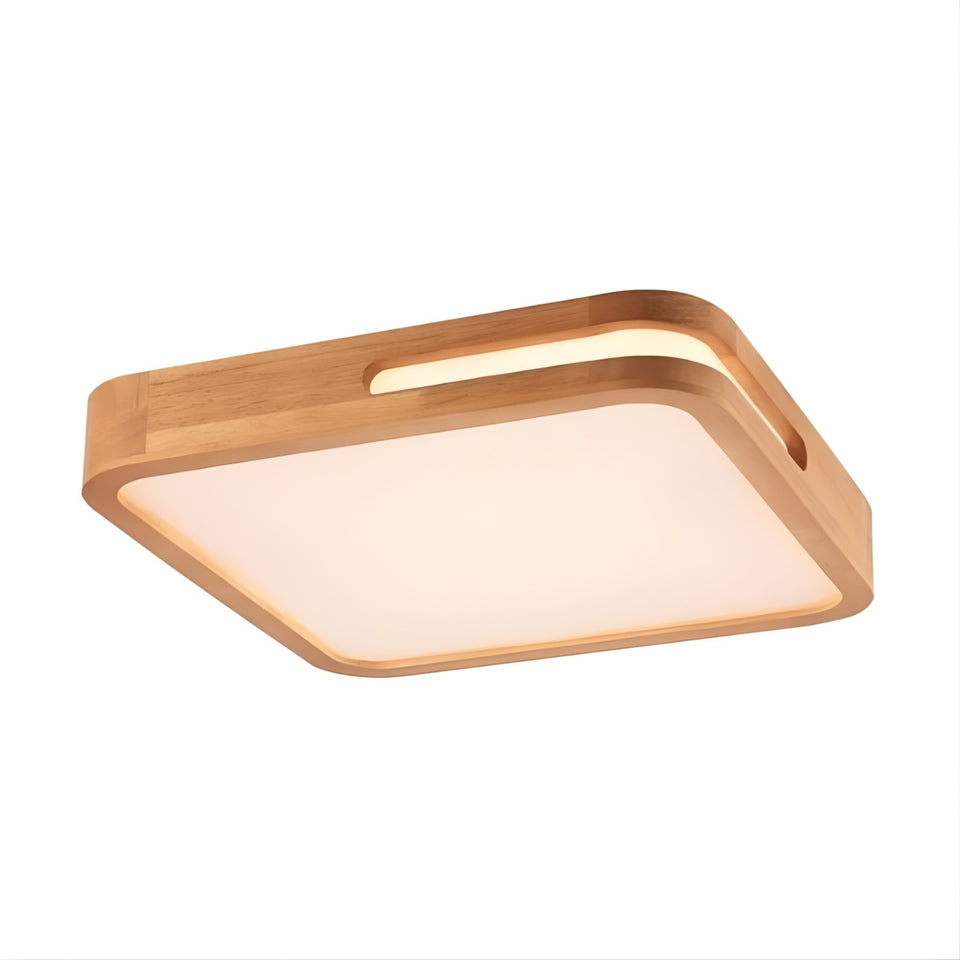
The Telbix Lyric is an oyster light with a square shape. It measures 40 cm by 40 cm and just 6 cm deep, weighs 1.9 kg and is built from wood and polycarbonate in a teak finish. The LED is integrated, rated at 24W and 1,575 lumens, and the listing calls the colour temperature adjustable across 3000K to 6000K. With an IP20 rating it is for dry indoor rooms only.
Read its dimming carefully. The listing says it dims in three steps by switch, to 100%, 50% and 20%. A guide to oyster lights explains how that differs from ordinary dimming. Step-dimming models are controlled from the wall switch, and one listing says such a fitting is not compatible with standard leading-edge, trailing-edge or TRIAC dimmers. Other oyster lights use a trailing-edge dimmer instead, and some do not dim at all. If the room already has a dimmer, ask the electrician whether it can stay, because a step-dimming fitting answers to the switch and not to the dimmer.
On size, a retailer guide for LED oysters says to measure the fitting you are replacing and match its diameter, or go one size up, so the new light covers any marks left on the ceiling. It sets a rough scale from a 250 mm fitting at 13W for small bedrooms, storage and hallways up to a 400 mm fitting at 24W for lounges and open-plan living, and notes that higher wattages give more brightness. At 400 mm and 24W, the Lyric sits at the large end. Australian listings for oyster lights as a category run from about 200 mm to 540 mm across. Some offer a selectable colour temperature of 3000K, 4000K or 5000K through a switch behind the diffuser, and typical lifetimes in those listings run from 30,000 to 50,000 hours.
The same listings mark IP20 oysters as indoor and dry-room only, while IP54 models are sold for bathrooms and covered outdoor areas. That answers where the Lyric can go: a bedroom, living room, hallway or study, and not a bathroom or a covered patio. An oyster is hardwired, and retailers tell buyers to use a licensed electrician. At 1.9 kg the Lyric is heavier than a plain disc, so ask the electrician to confirm the fixing before the day. The Telbix Lyric indoor lighting page covers the rest of the Lyric family, and ceiling lights covers ceiling fitting types and how to size them.
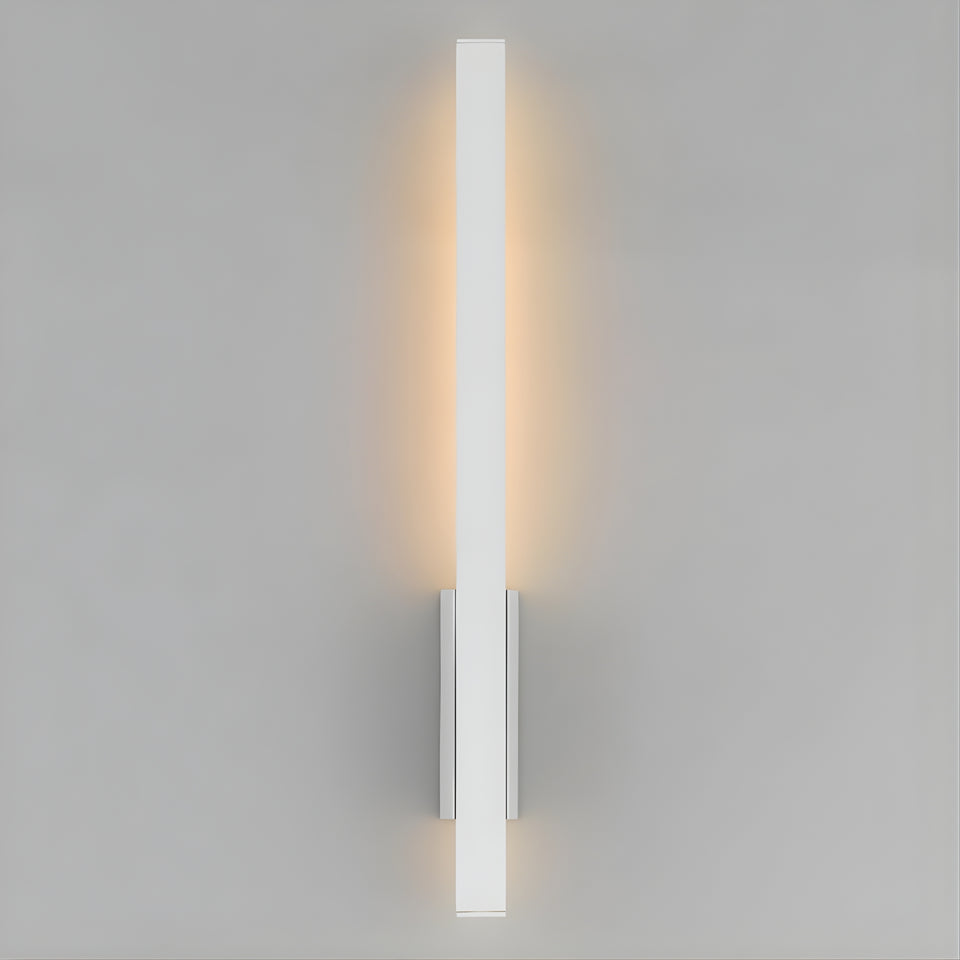
The Telbix Masto is a slim aluminium wall light in a white sand finish. It stands 50 cm high and about 5 cm wide, with an integrated LED rated at 8W and 360 lumens at 3000K. The listing says it suits indoor and outdoor use, gives IP54 and says it does not dim. The box holds the light, a fixing kit and installation instructions, and the listing restricts the electrical work to a licensed electrician.
IP54 sits between the ratings that Australian outdoor guides set by exposure. One gives IP44 as the minimum for a covered entry, porch, alfresco or eave, and IP65 for an exposed external wall, a driveway or a side passage. Another puts IP44 as the Australian benchmark for a covered deck and IP55 for a fully exposed position. On those figures the Masto suits a sheltered position, and a wall that faces the weather or gets hosed is better served by an IP65 fitting, such as the Fremantle pair below.
Mounting height varies between sources. One Australian retailer gives about 1.8 to 2.1 metres for entries and pathways, and a second guide from the same retailer gives 1500 to 1700 mm for a front door, with the fitting centred around the door. Because the Masto is 50 cm tall, the height you pick is the height of its centre and not its top. One guide says a wall light beside a standard door should be at least 25 to 35 cm tall, which the Masto clears easily. For more on this type of fitting, see exterior wall lights and outdoor lighting.
The Eglo Fremantle outdoor downlighter and the Fremantle up and down wall light are both white aluminium, rated IP65 and supplied with GU10 globes in the box. Each takes a 5W maximum and gives 400 lumens, with the colour temperature listed as adjustable, and neither dims. The downlighter is 7 cm wide and 11 cm high with one globe pointing down. The up and down light is 7 cm wide and 18 cm high, with one globe aimed up and one aimed down.
A guide to up and down lights says the pair of beams creates a layered effect on a facade and casts soft shadows on a textured wall, and a retailer guide calls downward lights useful near entrances and walkways. Both fittings are Class I, which the listings say requires an earth, so a licensed electrician makes the connection. The Eglo Fremantle outdoor lighting page covers the whole family, including the stainless steel and copper versions, the adjustable ceiling bars and the point about salt air, which the IP rating does not cover.
A manufacturer's outdoor guide builds a scheme in order. Entrances, paths and steps come first, then the garden, then architectural features and atmosphere, with wall lights for doors, entries and entertaining and warm 3000K light for atmosphere. The Masto and the two Fremantle fittings all belong to the first step, the entrance. A path, a set of steps or a garden bed needs bollards, step lights or spike lights, and none of those is on this page. The outdoor lighting page covers them and the rules for each.
Bathroom guides set zone ratings: IPX7 and a 12V supply inside the bath or shower, IPX4 above it and IPX4 again around the basin, with IP44 or higher recommended elsewhere in the room. One guide puts the zone above the bath at 2.25 metres and another at 2.5 metres. The four globes and the Lyric are IP20, which meets none of those figures, so they are for dry rooms. The Masto at IP54 and the Fremantle fittings at IP65 exceed the IP44 recommendation, but a licensed electrician working to AS/NZS 3000 decides where any fitting may go. The bathroom lighting page covers the zones in full.
Match the fitting to the job first, then to the room. For general light in a living area, the Lyric gives the most output on this page. The T30 or the clear pilot suits a fitting that already has an E27 socket, and the clear and amber pilots are the two to compare for a decorative filament look, with the amber giving the lower, warmer light. At the front door, the Masto suits a sheltered wall and the Fremantle pair suits a wall that takes the weather.
Keep colour temperature consistent in any one room. Lighting guides recommend 2700K to 3000K for living rooms and bedrooms and neutral white near 4000K for kitchens and bathrooms, and they advise against mixing temperatures in one space. The globes here split between 3000K and 4000K, so choose one and hold it. The Lyric's adjustable setting suits a room that serves two purposes.
A manufacturer's lighting guide describes the layers a room needs: ambient light from the ceiling, task light from lamps and adjustable wall lights, and accent light from sconces and spots. For a living room it suggests a ceiling or pendant light with floor or table lamps and wall lights, in warm white and with dimmers. On that plan the Lyric is the ambient layer for a room, and the filament globes belong in lamps and decorative fittings, where the glass is part of the look. The pendant lights page covers hanging fittings for the other layers.
Each product page shows the item's current status and a downloadable specification sheet where one exists. Read the sheet, since it is the guide to dimensions and ratings and a listing can lag behind it. If the fitting you want is not available, the wall lights, pendant lights and Telbix lighting pages cover the wider range, and the lighting page links every fitting type. Treat this selection as a quick route to a ready option, then confirm what matters to your room: base, rating, dimming and size.
The oyster, the wall light and the Fremantle fittings are all hardwired, and each listing says a licensed electrician installs them. Australian retailers give the same advice for any hardwired fitting: if it connects to the house wiring, a licensed electrician fits it. A globe is different. Changing a globe in an existing socket is simple with the power off, provided the new globe matches the base. Settle positions and heights before the electrician arrives, and read each installation sheet first.
Switch the power off and let any fitting cool before you clean it. Dust with a soft cloth, then use a cloth that is only lightly dampened, and avoid abrasive pads and harsh chemicals. The Masto and Fremantle fittings are outdoor rated and can collect salt near the coast, so rinse them more often there. One outdoor guide says to clean fixtures regularly because dirt reduces light output.
This page is a quick route to lighting that is ready now: four LED globes, a square oyster, an indoor and outdoor wall light and two white outdoor fittings. Check the base on the globes, the dimming type on the oyster and the IP rating on anything outside, since IP54 and IP65 suit different walls. Choose one colour temperature per room, book the electrician early and read the specification sheet for the fitting you pick.


