
*View accurate shipping rates and availability






3 Items
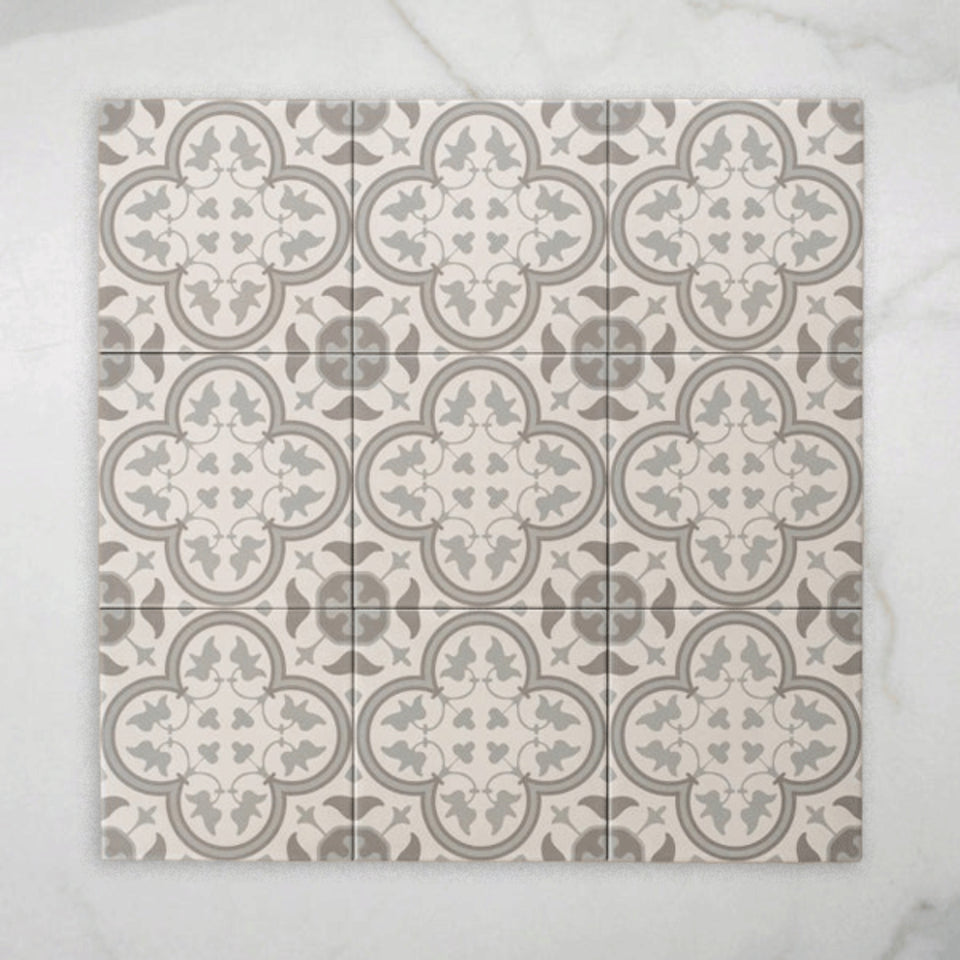


A 200 x 200mm tile is a square 20 centimetres on each side, a traditional small format for decorative floors and walls. This collection holds one range, Airlie: matte porcelain tiles, 8mm thick, in three colour mixes, light grey, mid blue and dark blue. Each box holds 25 tiles, and the listings print the same slip, wear and edge lines on all three.
The sections below explain the size, what the Airlie listings say, whether the tiles can go on a floor, and how to pair, lay and grout a small patterned tile. For other small formats, see the 150mm x 150mm tiles collection, the small tiles collection and the 300mm x 300mm tiles collection. For the wider set of pattern ranges, see the patterned tiles collection.
An Australian tile retailer's size guide puts small floor tiles at up to 300 x 300mm, medium at 300 x 600mm to 600 x 600mm and large above that. It says small floor tiles suit detailed patterns or a pop of colour in smaller spaces such as a bathroom or laundry, and that they need more grout, so a continuous look is harder to get. A 200 x 200mm tile sits well inside the small group.
A Sydney retailer describes 200 x 200mm as a traditional size that appears in many collections, and says patterns have strong decorative impact at this size when they are paired with bright, lively colours. It adds that traditional French and European ceramic patterns suit the format, that the most popular use is on bathroom and laundry floors, and that patterned 200mm decors are a recent choice for artistic walls.
A 200 x 200mm tile covers 0.04 square metres, so 25 tiles cover one square metre. That matches the box line on the Airlie listings, 25 pieces, which suggests one box covers about a square metre. Check the coverage on the product page before you measure, because a box line is the quickest way to get the quantity right.
The listings recommend ordering an extra 15 percent over the exact quantity, to cover breaks and offcuts. On a small tile with many edge cuts, that allowance is sensible. They add that colour, size and texture may vary from batch to batch, so order the whole job in one go, and keep a few spare tiles for future repairs.
Airlie is described on the listing as traditional patterned tiles that are simple and understated, in three modern colour mixes. All three are 200 x 200 x 8mm glazed porcelain with a matte finish, a Texture line of Low, flat and an Appearance of V1, a uniform pattern. The titles describe a cushioned edge, and the Edge line prints Non-rectified Tile.
The colours are light grey, mid blue and dark blue. The tags place them in encaustic look, Moroccan and patterned styles, with a Hamptons and a colourful tag on the blues. The light grey is also tagged for bathroom floors and walls. For other pattern looks, see the Moroccan tiles collection.
The tags use the term encaustic look, which refers to traditional cement tiles. A Melbourne retailer explains that encaustic tiles are made with steel stencils and wet, dyed cement that creates the pattern in contrasting colours, and that they need sealing before installation and resealing every couple of years. A Sydney importer says porcelain pattern tiles replicate the encaustic look but are fired at high temperatures, which makes them non-porous, so they need no sealing.
The Airlie tiles are the porcelain version. The pattern is part of the glaze, so the look of an old cement floor comes with the care of a porcelain one. For the cement version and its care, the retailers recommend specialist suppliers.
The Airlie listings print Application Wall and floor, a Wear Rating of 4, described as suitable for floors in normal use areas with a low risk of scratching, and a Slip Rating of P3, described as moderate slip risk. AS 4586 classifies the slip resistance of new pedestrian surface materials, and its wet pendulum test uses ratings from P0 to P5. The rating applies to floors people walk on, and does not matter for a feature wall.
A Perth retailer says bathroom floors are one of the best places to use patterned tiles, because the pattern gives the room interest at ground level and the walls can stay quieter. It says to choose tiles that suit wet area use and to check slip suitability before buying. A P3 tile is a moderate slip risk, so for a shower or a floor that is regularly wet, confirm with your builder or tiler what the area needs. The floor tiles collection explains slip and wear lines.
On a wall the wear and slip lines matter less, and a 200 x 200mm patterned tile is a good size for a feature panel. The Perth retailer says powder rooms can handle stronger pattern because people spend less time in them, and that a patterned wall behind the vanity makes the room feel finished without many accessories. It says splashbacks sit in a defined area, so the tile adds detail without taking over a room.
The Sydney retailer's note about patterned decors for walls fits the same idea. Because the tile is small, a panel of Airlie can be set at the height of a vanity, a niche or a splashback. For wall formats by size, see the wall tiles collection.
The Perth retailer says a small repeat can feel busy in a large area, while a large pattern can lose impact in a narrow space. It says scale is hard to judge from a single sample and suggests bringing room measurements to the store. A 200 x 200mm Airlie tile is a fine repeat. In a small bathroom, a laundry or an entry, it adds pattern without overwhelming the room.
An Australian retailer's patterned tile guide adds that smaller tiles create a sense of texture and visual interest, while larger tiles can make a room feel more spacious. Because a 200mm tile has many joints, the grout colour matters as much as the tile colour. Lay out a few tiles on the floor and stand back to see how the pattern reads from the door.
The Perth retailer says the easiest way to make patterned tiles work is to pair them with plain tiles that share one colour or tone, and to give the pattern one clear job. For an Airlie mid blue floor, that suggests a plain wall tile in the blue of the pattern or in the pale colour behind it. A US retailer's guide to patterned floors adds that keeping walls, cabinets and large furniture simple and neutral lets the floor be the star, and that pulling a secondary colour from the tile for a wall colour or an accent ties the room together.
It also suggests borders to define zones, a contrasting edge around a room or a change of pattern at a doorway. A border of plain tile around an Airlie field is a simple way to frame the pattern and to deal with the cut edges at the walls. For plain tiles in matching colours, see the grey tiles collection and the blue tiles collection.
The Perth retailer names entryways, hallway returns and small transition zones as places where patterned floor tiles work. The pattern creates a clear break between areas and can make a simple entry feel more considered, and it lets you use a stronger tile without committing it to the whole house. For these areas it suggests comparing pattern scale first, because a small repeat can feel busy in a large area and a large pattern can lose impact if the space is too narrow.
A 200 x 200mm Airlie tile suits a small entry or a laundry. The Sydney retailer says patterned 200mm tiles are popular on bathroom and laundry floors, and a laundry is a room where a practical floor and a bit of pattern go together. Check the wet area point again for a laundry floor: a P3 tile is a moderate slip risk, so ask the store and your tiler about the slip needs of the room.
The same retailer is candid about the limits. It advises care with strong patterns across very large open plan floors, in rooms that already have a detailed benchtop or colourful cabinetry, and in resale focused renovations. A pattern that looks right in a showroom bay can feel much stronger across a big area, it says. In a home you plan to keep, you can be more personal.
For Airlie, that points to a bathroom, a laundry, an entry or a feature wall, and away from a whole open plan floor. The light grey is the quietest of the three if you want pattern with less presence. The dark blue is the strongest, and it is best used in a small zone with calm surroundings.
The three Airlie colours sit in the cool half of the palette. The grey works with white, timber and chrome, and the blues bring colour. The US retailer says to look closely at a patterned floor and pull a secondary shade from it for a wall colour, a towel or an accent, so the room feels pulled together and not decorated in pieces.
An Australian retailer's colour guide says blue softens the energy of a room and feels at home in a bathroom, because blue is linked with water and open skies, and that it pairs with warm whites, natural stone and timber. That is the retailer's view, and the result depends on the light and the surroundings. A sample of each colour in your own room settles it.
The US retailer says a patterned tile does not have to stop at the floor. A hearth, a porch entry or a backsplash in a compact geometric layout can tie different parts of a home together, and using the same pattern language in more than one room creates flow. With a small tile such as Airlie, that could be a floor in the bathroom and a panel of the same tile in the laundry or entry.
A restrained version is better than a repeat. Use the pattern in two or three places that share a colour, and keep the plain tiles the same in every room. That keeps the pattern as a feature and not as the whole scheme.
The Airlie tiles are non-rectified. An Australian styling blog explains the effect on the joint: rectified tiles with a square edge can have tight joints, and a tile with a cushion edge most likely needs a joint of 3 to 5mm. The blog adds that smaller joints are generally better, with 1 to 3mm ideal, because grout discolours over time and is the weakest part of a tiled surface. The listings print no recommended gap, so ask your tiler for the width.
The US retailer says matching grout to the tile softens the pattern and creates a more continuous look, while contrasting grout outlines every shape and makes the pattern stand out. With a small tile the grout is a large part of the surface, so decide before you order, and view a physical grout sample beside the tile in your own light.
A flooring guide describes the straight lay, also called a grid or stack bond, as the simplest arrangement: tiles in aligned rows and columns so the joints form continuous straight lines. It says smaller tiles create a textured, detailed look and that matching grout reduces the visibility of the grid, while contrasting grout emphasises it. For a 200 x 200mm pattern tile, a straight lay shows the pattern most clearly.
The Airlie tags also show diamond and vertical stack layouts. A diagonal layout turns the same square 45 degrees, which the diamond tiles collection explains. A diagonal needs more cuts, so allow more tiles. Ask your tiler which layout suits the room, and to dry lay a section first.
A national retailer's DIY guide says to dry lay tiles once the centre lines are marked, to check the layout, plan the cuts and see how the tiles look together. It says the golden rule is to avoid small pieces of tile, or keep them hidden, and to start vertical lines from a centre line so cuts are even at both ends. For a floor, it says to assume the area is out of square, put full tiles at the doorway and keep cuts at the back.
With a pattern tile, the setting out also decides where the pattern starts. Ask your tiler to mark the room so the pattern is centred on a feature such as the door or the vanity, and the cut tiles fall at the edges. The same guide says movement joints are rarely needed through small residential tiling, apart from a perimeter allowance of at least 3mm filled with silicone and not grout.
The listings carry a note recommending the tiles be paired with underfloor heating for a warmer, drier, mould resistant bathroom. Check the heating maker's instructions and the adhesive data sheet with your installer. The Tile Collective's FAQ says most 200 x 200 tiles are low maintenance and easy to clean, and that a damp cloth or mop does the job, depending on the material.
Wipe spills promptly and sweep grit away so it does not scratch the glaze. The grout is the part to plan for. A 200mm tile has far more joints than a large tile, so there is more grout to keep clean. A grout close to the tile colour hides dirt better than a pale one, and the grout maker's instructions decide the cleaner.
The Perth retailer recommends laying samples both flat and upright, because tiles look different under ceiling light, natural light and shadow. With a pattern tile, lay several samples together as well, so you can see how the repeat reads across neighbouring tiles and where the colour meets the grout. A single tile hides the effect that a whole floor produces.
Start with the room. For a bathroom or laundry floor, the light grey is the quietest and the one tagged for bathroom floors and walls. For a stronger colour, the mid blue and the dark blue give the pattern more presence, and suit a feature floor or a wall behind a vanity. Then decide the grout and the layout, order a sample, and lay it flat in the room.
If you need a different pattern or a higher slip rating, look at the neighbouring collections. The tiles collection covers every shape and finish in the store.


