
*View accurate shipping rates and availability






11 Items


Up to 70% off across the store, plus free towels and mirrors up for grabs on orders over $800*


Indigo taps are plain wall mounted bathroom taps and a washing machine set, in chrome and matte black. This page holds the Indigo Savina and Indigo Alisa wall basin and bath mixers, bath and basin spouts, bath and shower mixers with a diverter, and the Elite X washing machine set. The guide below explains how the Indigo tapware is arranged, how the Savina and the Alisa differ, which reach suits a basin and which a bath, what to settle with the plumber before the wall is tiled, how the diverter and the washing machine set work, and how to look after the finish.
The range is small and made for the wall. There are two wall ranges, the Savina and the Alisa, and each has the same set of pieces: a wall basin and bath mixer, a bath and basin spout and a bath and shower mixer with a diverter. The Elite X is a pair of washing machine stops for the laundry. That is the whole range, so the choice is short: which wall range, which reach and which finish.
A short range has a benefit. Every piece in a range matches, so a bathroom can be fitted out with a mixer, a spout and a shower mixer from one range without a hunt for a missing part. For the other Indigo products, see Indigo, Indigo range and Indigo showers, and for the Savina on its own, see Savina range.
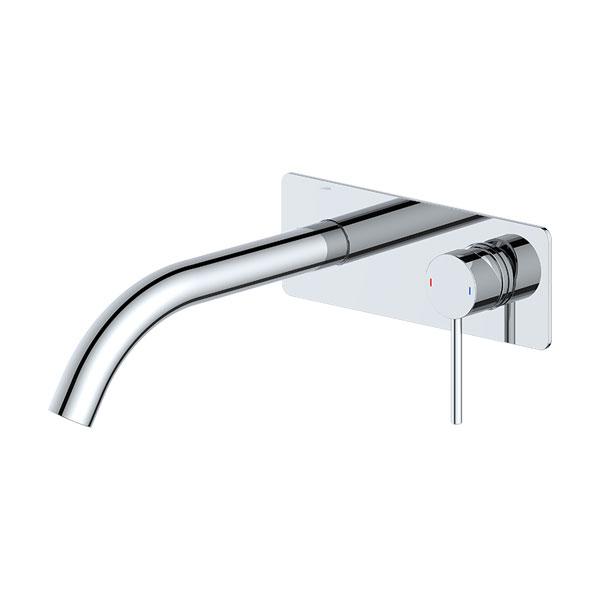
The two ranges are alike in function and different in shape. The Savina has a round plate, and the wall basin and bath mixer comes in reaches of 180mm and 225mm, in chrome and matte black. The Alisa has a rectangular back plate, a long, slim outlet and a reach of 270mm, in chrome. Choose by the shape of the room. A round plate suits curved fittings and a rectangular plate suits square tiles, a rectangular vanity and a straight line.
Keep the plate shape through the room, so the mixer, the shower plate and the spout match. A round plate on a wall with square fittings looks like a mistake, and the same is true the other way round. Do not mix the two ranges in one room unless the shapes are far enough apart to look deliberate.
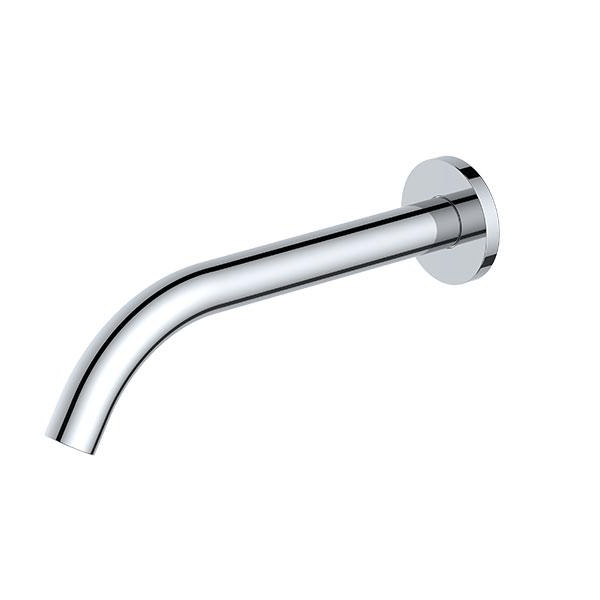
The reach is how far the outlet stands out from the wall, and it decides where the water lands. The 180mm reach is the shortest, and it suits a basin, where the water should land near the drain, and a small bath. The 225mm reach is longer, and it suits a larger basin or a standard bath. The 270mm reach of the Alisa is the longest, and it is made for a bath, where the water should land near the middle of the tub, over the plug, and for a wide freestanding bath beside a wall.
Measure before you decide. For a basin, measure from the wall to the drain, and for a bath, measure from the wall to the centre of the bath floor. A spout that is too short drops the water on the slope of the bowl, and one that is too long throws it over the far edge. A 270mm outlet over a small basin overshoots the drain, so use the long reach only where the place is long enough. See basin spouts and bath tub spouts for the full checks on length and height, and spouts for the group from every brand.
Both ranges have a wall basin and bath mixer, with a pin handle on a plain body. The Alisa set is supplied with the in-wall body, a rectangular back plate, the outlet, the handle and a fixing kit, so the parts needed are in the box. The body goes into the wall at the building stage, before the tiles go on, and the plate, the handle and the outlet go on at the end.
The outlet is fixed, so the water falls in the same place every time, and it cannot be moved after the wall is tiled. That makes the position the one decision to get right. See wall basin and bath mixer sets for the wider group from every brand.
Each range also sells its bath and basin spout on its own, in the same lengths. A spout on its own is used when the mixer is chosen separately, or when an existing outlet needs to be replaced. If you are replacing a spout, measure the projection of the old one, from the wall to the point the water falls, and choose a new one with the same reach. Check that the new spout connects to the wall outlet in the same way as the old one.
The bath and shower mixer has a slim lever, and the diverter version switches the water between a shower head and a bath spout with the same plate. A diverter is the right choice for a shower over a bath, where the bath fills first and the water is then sent to the shower head. The mixer has a body in the wall, so the plumber fits it at rough in. See shower mixers for the wider group.
Check the height of the mixer and the position of the plate. The mixer should be reachable from outside the spray, and the plate should cover the wall opening around the body. Ask the plumber to confirm the height of the spout and the shower outlet before the wall is lined.
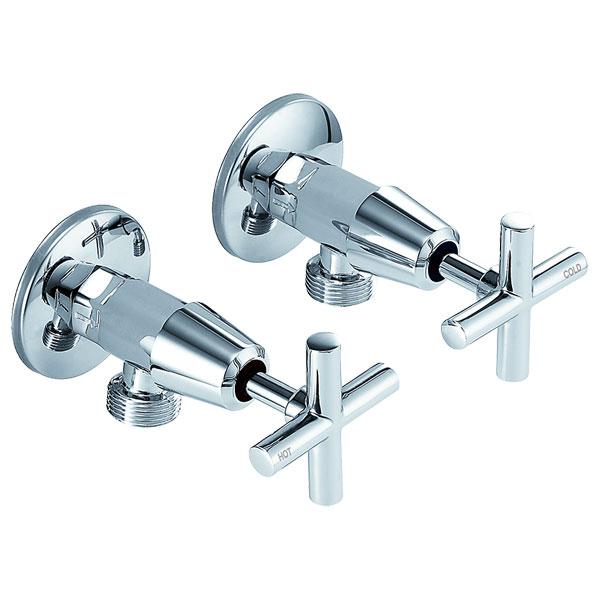
The Elite X is a set of wall stops for the hoses of a washing machine, in chrome. A washing machine tap is a stop tap with an outlet made for a hose, so it is not the same as a normal tap. It lets you close the supply to the machine without turning off the water to the house. Check the hose connection against the machine, and the pipe spacing against the set, and plan the stops with the other laundry taps. See washing machine sets for the checks.
Chrome is the standard finish, and most of the range is chrome. It is bright, easy to match to other fittings and simple to wipe clean, and it suits almost any bathroom or laundry. See chrome taps. Matte black is a flat, dark finish that suits a modern bathroom, and it stands out against white tiles and light walls. It needs a wipe from time to time to keep water spots off. See black taps. Keep the spout and the mixer in the same finish, because a chrome outlet with a black plate looks mismatched.
The wall is the one part of a bathroom that cannot be changed easily once the tiles are on. For an Indigo wall set, three things have to be decided at rough in: the position of the body, the height of the outlet above the basin or the bath, and the distance between the mixer and the outlet. The plumber sets the pipes from those three, and the tiler cuts the tile around the plate. Give both the range name, the plate shape and the finish before the wall is closed, and keep a written note of them with the house records.
The outlet does not set the flow. The flow depends on the supply pressure and the mixer that feeds it, so an outlet on a low pressure supply runs gently with any mixer. Taps sold in Australia carry a WELS rating for water efficiency, and it differs between models, so check the rating for the exact product. Plumbing work has to be done by a licensed plumber, who fits the body at rough in, tests it, and fits the trim after tiling. The installation sheet supplied with each product is the reference for the connection and the fixings.
Wipe the plate, the handle and the outlet with a soft, damp cloth and mild soap, and dry them with a soft cloth to prevent water marks. Do not use abrasive pads, bleach or strong cleaners, because they can damage a chrome or a black finish. Rinse bath oil and bubble bath off the outlet after use, since they leave a film, and rinse laundry products off the washing machine stops. A mixer that drips when it is shut, a handle that has become stiff or a temperature that is hard to control points to the cartridge, which a plumber can replace.
For the other Indigo products, see Indigo and Indigo kitchen mixers. For the taps from every brand, start at taps.


