
*View accurate shipping rates and availability






118 Items


Up to 70% off across the store, plus free towels and mirrors up for grabs on orders over $800*


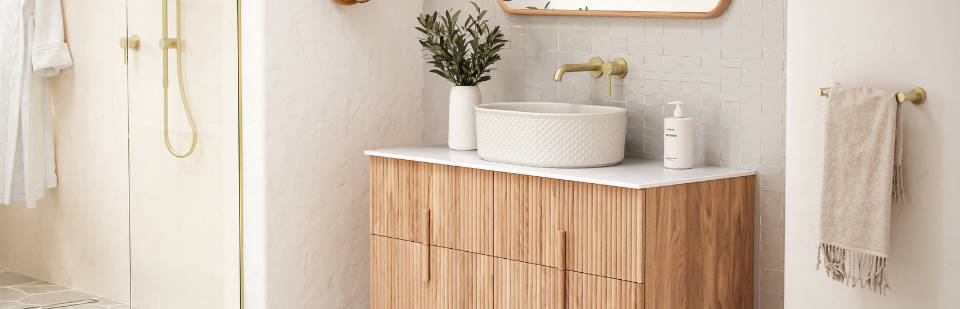


A shower mixer is the wall tap that controls your shower: one handle sets flow and temperature, and a diverter version also switches the water between the shower and the bath spout. This page holds wall shower mixers and bath and shower mixers with diverters, in chrome, matte black, brushed nickel, brushed brass, gold, gunmetal, bronze and champagne. The guide below explains how a shower mixer is built, what to check so the trim fits the body in your wall, how to replace one, and how to choose a finish and look after it.
A shower mixer is two parts. The body sits inside the wall and holds the cartridge and the pipe connections. The trim is what you see: the handle, the plate that covers the wall opening and sometimes a backplate. The body is fixed by the plumber before the wall is sheeted and tiled, and the trim goes on at the end. That is why a shower mixer is one of the first tapware decisions in a renovation, and why the trim you pick has to match the body in the wall.
Some mixers come as a complete set with the body, the handle and the plate. Others come as a trim kit only, sold to fit a universal body or the body from the same range. Check the box contents on the product page, because a trim kit without a body does nothing on its own.
A shower mixer controls one outlet, the shower. A bath and shower mixer has a diverter, so the same handle sends water to the shower or to the bath spout. Choose the one that matches your wall. If you have a shower only, a plain shower mixer is enough. If you have a bath with a shower over it, you need the diverter version, and a bath spout to take the other outlet. For bath outlets, see spouts and swivel bath spouts.
The trim plate has to cover the hole in the wall around the body. Plates are round or square, and they come in set sizes, so a plate that is too small leaves the opening showing. When you choose a trim, check the diameter of the plate against the opening in the tiles and the depth range the body allows, because the body has to sit within a set distance behind the finished tile. If the wall is already tiled, the depth range is the limit that matters most, so confirm it with the maker's installation sheet before you order.
The cartridges in these mixers are mostly 35mm ceramic discs, with some 25mm. A ceramic disc cartridge uses two ceramic plates to control the water, resists wear and shuts off cleanly for years. The handle is a lever or a paddle. A lever is easy to grip with wet hands and suits most households. A paddle handle is flat and slim, and it suits a modern bathroom. Some ranges use a progressive handle that starts on cold and warms as you turn, which saves hot water on a quick rinse.
Yes, and the job depends on what you change. Replacing the trim and the cartridge on a matching body is straightforward: turn off the water, remove the handle, the collar and the cartridge, then the plate, fit the new parts in reverse order and test. Many people do this in under an hour. Changing the body in the wall is a plumber's job, because it means opening the wall and working on the supply pipes. Before you order a new trim, identify the body behind your current one and check that the new trim is made to fit that family of body. If it is not, the new trim will not cover the opening or fit the cartridge.
Almost all of the mixers on this page are wall mounted with the body in the wall. A few are bench or hob mounted, which sit on a bath deck or a ledge. An exposed mixer on the surface of the wall is a different system, and it does not use an in-wall body. If you are replacing an old exposed set with an in-wall mixer, the wall needs to be opened, so ask a plumber what the wall can take.
Place the mixer so you can reach it from outside the spray. A common position is about waist to chest height on the wall beside the shower head, with the handle on the side of the door or screen opening. That lets you start the water and adjust it before you step in, and it keeps the first cold burst off you. Keep the mixer clear of the shower niche, the screen hinge and any tile joint, because the plate and handle need a flat surface and room to turn. Mark the position with your plumber and tiler before the wall is closed.
The mixer controls the water, and the head or rail shower delivers it. A fixed head on an arm, a rail shower with a hand piece or a hand shower on a hose can all run from one wall mixer, and a diverter mixer can also feed a bath spout. Match the finish of the mixer to the head, the arm and the rail, so the set reads as one. Check that the shower head suits your pressure, and that the outlet position on the wall suits the arm you choose.
A lever handle is the easiest to grip and to move with wet hands, so it suits children, older people and anyone with limited hand strength. A paddle handle is flat and slim, and it needs a firmer push. If you want a mixer with the clearest operation, choose a lever with a plate that has clear hot and cold marks, and consider the longer levers in accessible taps. A progressive mixer starts on cold, which limits the chance of a burst of hot water.
Most faults come from the cartridge or the seals. A mixer that drips from the shower head after it is off usually needs a new cartridge. A handle that feels stiff or gritty often has limescale in the cartridge, which a plumber can clean or replace. A mixer that leaks around the plate points to a loose seal behind the trim. Fixing these early saves water, and a replacement cartridge is usually easy to find for a current range.
WELS is the Australian water efficiency label, and shower mixers that carry a rating show it on the product page. A shower mixer itself is a control, and the shower head sets most of the flow, so the rating you want to watch is on the head. Mains pressure gives you the most choice. Low pressure and gravity fed systems need fittings rated for it, and a plumber can check the pressure at your shower before you choose a mixer and a head.
We recommend a solid brass body. The National Construction Code limits lead in plumbing products that touch drinking water to 0.25 percent from 1 May 2026, and some of these mixers are lead-free brass. Check WaterMark approval on the product page, because it affects legal installation in Australia. Use a licensed plumber to fit the body and to make the water connections.
Finish is the last decision, and it should match the shower head, the rail, the bath spout and the other metal in the room. The finish process differs by colour: chrome and matte black are mostly electroplated, while brushed nickel, brushed brass, gold, gunmetal and bronze are mostly PVD, which resists scratching and tarnish.
Keep one finish through the room, and limit it to two finishes with one leading.
Wipe the handle and the plate with a soft microfibre cloth and warm water after use, and add a little mild soap if needed. Dry them so water does not set on the surface, which matters most in hard water areas. Avoid bleach, harsh sprays and abrasive pads, which dull a finish and can strip a coating. If the handle feels loose or the mixer drips from the shower head after it is off, a new cartridge is the usual fix.
The contents depend on the product. A complete shower mixer comes with the mixer, a dress plate, a handle, an in-wall kit and installation instructions. A diverter version comes with the diverter mixer, a handle and a plate. A trim kit comes with the plate and handle, and the in-wall body may be sold separately. Read the product page for the exact list before you order.
The shower mixers on this page include Caroma taps, Phoenix taps, Meir taps, Fienza taps and Clark taps. Staying with one brand and range keeps the handle shape and finish consistent through the bathroom. See also shower and bath taps and the wider taps group.


