
*View accurate shipping rates and availability






45 Items


Up to 70% off across the store, plus free towels and mirrors up for grabs on orders over $800*





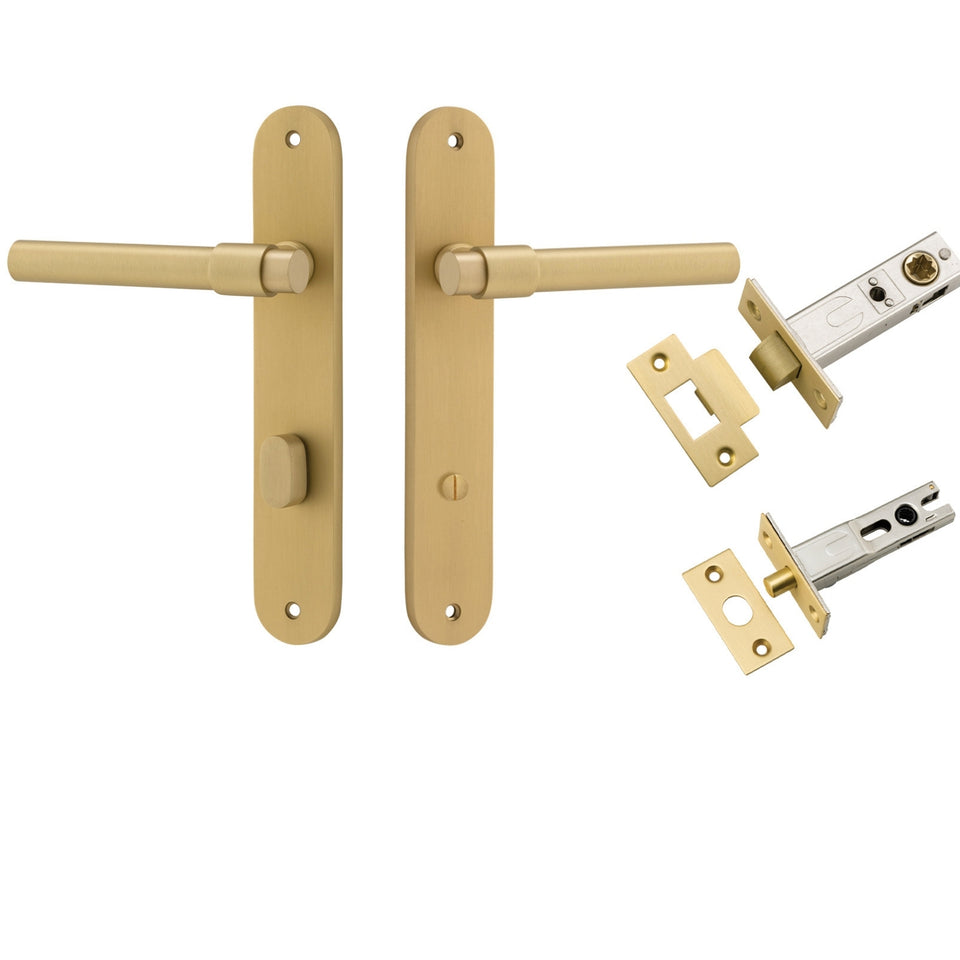




Helsinki is the structured lever in the Iver range: a straight, defined brass lever with clean lines, made for a modern house that wants a confident, architectural handle. It comes on a round rose, a rectangular backplate and an oval backplate, in passage, privacy and entrance kits, with an inbuilt privacy version for bathrooms. This guide covers the door parts only. It sets out the kits, the sizes that decide fit, the finishes and coatings, and how to choose and fit a Helsinki set. The brand overview is on Iver, the door ranges are compared on Iver door hardware, and the matching cabinet pulls are on Iver Helsinki cabinet handle.
The Helsinki lever is a straight bar with a defined end and no curve, so it reads as the most architectural of the Iver levers. On a round rose it is a slim, confident handle, and on a backplate it becomes a long, linear piece that suits a modern interior. It is made in solid brass, with a solid weight in the hand, and the finishes run from warm brass tones to cool nickel and matte black.
The three plates change the look. The round rose is 52mm across and leaves most of the door face clear. The rectangular backplate is 240mm long and 38mm wide, and the oval backplate has the same length with softer ends and is 40mm wide. A straight lever on a rectangular plate gives the strictest, most graphic look, and the oval plate softens it a little. The round rose is the lightest and suits a narrow stile.
Every kit is complete, with the latch or lock, the fixings and the instructions. There are four kit types.
The passage kit latches the door with no lock, and suits hallways, living areas and laundries. The privacy kit with a privacy turn adds a small turn on the inside so the door can be locked from within, for bathrooms, toilets and bedrooms. The inbuilt privacy version places the locking mechanism in the rose, so there is no separate turn. Its rose is 58mm wide and the lever is 141mm long. The entrance kit locks with a key. It uses a euro mortice lock with a 60mm backset, a key and thumb turn, and two keys in the box, and it comes on a backplate with the lock built in, or on a round rose with a separate high security lock.
For sets by function, see passage door handles, privacy door handles and entry door lock sets.
Every Helsinki kit suits doors 35 to 60mm thick, which covers most internal doors and many external ones. The backset is 60mm, the usual size on interior doors, so most replacements fit the existing hole. The kits use 85mm centre to centre spacing, which suits standard door preparations for euro and privacy locks, and the backplate fixing centres are 205mm.
The reach differs by plate. The lever on a round rose is 138mm long and projects 61mm, and on a backplate it projects 58mm. The Helsinki lever therefore sits further from the door than the Sarlat or Osaka, which gives a longer grip and needs more clear room beside a wall or a cabinet. If a door opens against a wall, fit a stop where the handle would meet it. See door stops.
On a panelled door, check the plate length against the stile. A 240mm backplate needs a clear run of that length, so measure the stile and the distance to the first moulding before you order. On a narrow stile, choose the round rose.
Helsinki kits are fixed with tie bolts, long bolts that pass through the door and pull the two sides of the handle together so the lever does not rock. Tie bolts are supplied to suit 55mm thick doors. The screws are solid brass, which lets the finish match as closely as possible and avoids rust in coastal areas. Brass screws are soft, so drill a pilot hole and finish the last turns by hand, and check that the bolts reach through a door thicker than 55mm.
The Helsinki is made in brushed brass, brushed gold, matte black, satin nickel and signature brass. Brushed brass and signature brass are warm tones, brushed gold is a lighter gold, satin nickel is cool, and matte black is neutral. The coating depends on the piece: brushed gold is a PVD coating, which is a hard layer applied in a vacuum chamber that resists wear, and the brass and nickel pieces are lacquered. A lacquered finish should be wiped with a soft damp cloth and never scoured, since scouring wears the lacquer.
A straight lever in matte black on a pale door gives the strongest contrast, and the same lever in satin nickel suits a house with stainless steel and chrome tapware. Brushed brass and signature brass suit timber and warm paint colours. See matte black, brushed brass and brushed nickel for the wider choice in those finishes.
The plate decides how the handle looks on the door. A round rose leaves the door face open and suits a panelled door or a narrow stile. A rectangular backplate hides the lock area and gives a strong vertical line, which suits a flat door and a minimal interior. An oval backplate softens the line. On an entrance kit, the backplate keeps the lever and the lock together on one plate, and the round rose entrance kit puts the lock on a separate item, which can look cleaner on a narrow door.
The round rose entrance kit pairs the Helsinki lever with a separate high security lock, so the lever and the lock work independently. The lever is 138mm long and projects 61mm. The lock is a euro mortice lock with a key and thumb turn, a 60mm backset and two keys in the box. Because the lock is set apart from the lever, the door carries a lever on a small round rose and a separate lock above or below it, which is a common and tidy arrangement on a front door.
This kit suits a door with a narrow stile, where a long backplate would not fit, and a door where the lock position needs to suit the frame. Mark the lock position with a level, cut the mortice pocket, and check that the strike lines up before you fit the lever. Fit the lock first, then the lever, so any adjustment to the lock does not disturb the handle.
The Helsinki suits flat and panelled doors in timber, MDF and painted finishes. Its straight line works best on a flat door or a door with simple, square panels, where the lever echoes the lines of the door. On a door with deep curved mouldings, a straight lever can look severe, and a rounder lever such as the Osaka or Baltimore may suit better. The range suits doors 35 to 60mm thick, so one range covers most internal and external doors, and if a door is thicker than 55mm the tie bolts need to reach through it.
On an external door, use the entrance kits and choose the finish with the exposure in mind. A covered porch is gentle on a lacquered finish, while a door that takes full weather wears faster, and a PVD finish is the hardest wearing.
In a hallway with several doors, consistency matters more than any single choice. Set every lever at the same height, use the same plate style and finish, and fit every privacy kit with its turn on the same side. A row of doors with handles at slightly different heights is noticeable, so mark the height once with a tape and a level, and carry it along the wall. The long straight line of the Helsinki makes small differences in height easy to see, so be exact.
Before you order for an existing door, check four things. The thickness of the door at the latch. The backset of the old latch, measured from the door edge to the centre of the spindle hole. The diameter of the hole in the face of the door. Whether the old latch is still in good order, since a worn latch is worth replacing while the handle is off. If all four agree with the Helsinki numbers, the set swaps in, and the old marks are the only thing to touch up. If the existing hole is a different size, check the specification before you drill, since a larger hole leaves a gap around the rose.
A rectangular or oval backplate is a good way to hide an old hole pattern. It covers the old screw marks and any damage around the lock area, so it is a useful choice when the door has had several generations of hardware.
Every internal door needs one of three things: free passage, privacy, or nothing at all. A passage kit is for doors that are never locked. A privacy kit is for doors that need to be locked from inside, and it must always have a release that works from outside. A door that needs no latch, such as a cupboard door, is better with a plain pull or knob, so choose from the cabinet range or the dummy range if you want it to match. See dummy levers for dummy options in other ranges.
The names follow a pattern. In Iver Helsinki Lever Oval Backplate Entrance Kit with High Security Lock Brushed Brass, the range is Helsinki, the handle is a lever, the plate is an oval backplate, the kit is an entrance kit with the lock on the plate, and the finish is brushed brass. A name with Round Rose Entrance Kit with Separate High Security Lock means the lock is a separate item. A name with Inbuilt Privacy means the lock sits within the rose.
The inbuilt privacy kit puts the lock button inside the rose, so the door carries only the lever and a single plate, with no separate fitting beside it. The rose is 58mm wide to hold the mechanism, which is wider than the 52mm rose on the other round rose kits. Choose it for a bathroom or bedroom where a clean plate matters. Choose the separate turn where you want to see at a glance whether the door is locked, or where small children need a release that is easy to find. Test the release from outside the day the lock is fitted, and keep the release tool where the household can reach it.
The entrance kits use a key and thumb turn cylinder. The key locks and unlocks the door from outside, and the thumb turn locks and unlocks it from inside, so anyone in the house can leave without a key. This is the usual choice for a front door and for most family homes, because the door can always be opened from inside in an emergency. Two keys come in the box, and extra keys can be cut from them. If the door has glass close to the thumb turn, a person outside could break the glass and reach the turn, so check the door before you choose.
Fit the latch first, then the spindle and the levers, then the plates. Check that the lever returns to level when released, since a lever that droops usually means a loose fixing. For an entrance set, cut the mortice pocket to the size of the lock body, fit the euro cylinder, and test the bolt from both sides before you close the job. A mortice lock needs more careful setting out than a tubular latch, so a joiner is the safe choice for a door that is already hung. For a privacy kit, fit the turn on the inside of the room, and test the release from outside.
List every door against its function before you order. The front door takes an entrance kit. Hallways, living areas, laundries and pantries take passage kits. Bedrooms, bathrooms and toilets take privacy kits. Write the door thickness beside each entry, and note any door that differs from the rest. Choose one plate style, one finish and one range, and order every set together so the finish agrees from the first door to the last, since a kit bought months later can differ slightly in tone.
The usual handle height is about 900 to 1100mm above the floor, and about 1050mm is common on new doors. In a hallway with several doors, set every lever at the same height and fit every privacy kit with its turn on the same side, so the run reads as one set.
If the kitchen or bathroom joinery uses Helsinki pulls, order them in the same finish as the door handles, so the doors and the cabinets agree. The Helsinki cabinet pulls share the straight line of the lever, so they read as part of the same design. See Iver cabinet hardware and cabinet handles for the wider choice.
Take off the old handle and check the spindle hole, the screw holes and the backset. A backplate hides old paint lines and screw marks, and a round rose leaves them showing, so decide before you fit. If the old lock was a mortice lock, a Helsinki entrance kit goes back into the same pocket, and a tubular latch kit does not. Photograph the old handle from both sides, and keep the old parts until the new set is fitted. Check how the door hangs before you fit new handles, since a door that drops at the latch edge makes any handle feel loose.
Wipe the levers with a soft damp cloth and dry them. Keep abrasive pads, polishes and acidic or bleach-based cleaners away from the finish. Tighten the fixings once a year, since timber moves with the seasons, and if a latch sticks, a drop of light oil on the latch tongue will free it. A brushed finish hides fingerprints better than a polished one, and matte black hides marks but needs a gentle wipe to keep the coating even.
Does the Helsinki come with a latch? Yes. Every kit includes its own latch or lock, the fixings and the instructions.
Can the Helsinki go on an external door? The entrance kits are made for front and rear doors, and the finish should be chosen with the exposure in mind. A covered porch is easy on the finish, while a door that takes full weather wears faster.
How does the Helsinki differ from the Osaka? Both use the same plates and the same fit numbers. The Helsinki is a straight lever with a longer reach, and the Osaka has a rounder line and a closer projection. Compare the two side by side if the shape matters.
Which plate suits a narrow door? The round rose, since it takes the least room on the stile.


