
*View accurate shipping rates and availability






6 Items



Up to 70% off across the store, plus free towels and mirrors up for grabs on orders over $800*

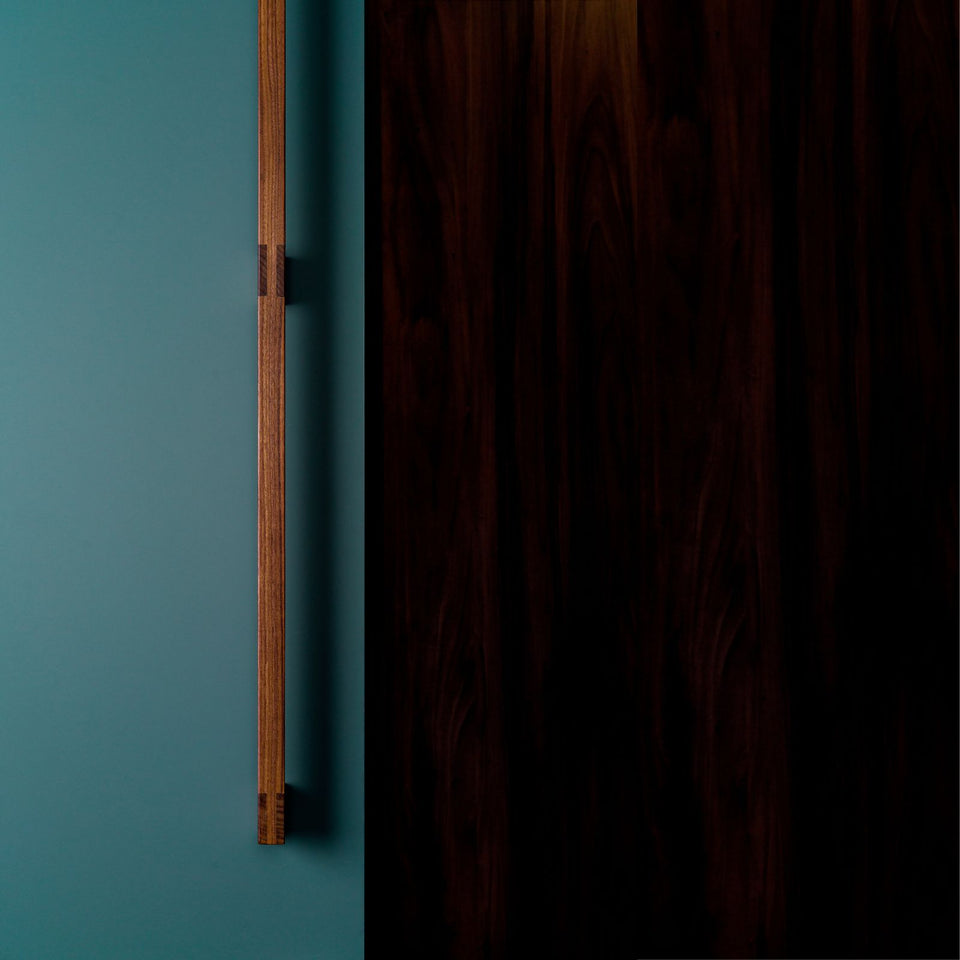
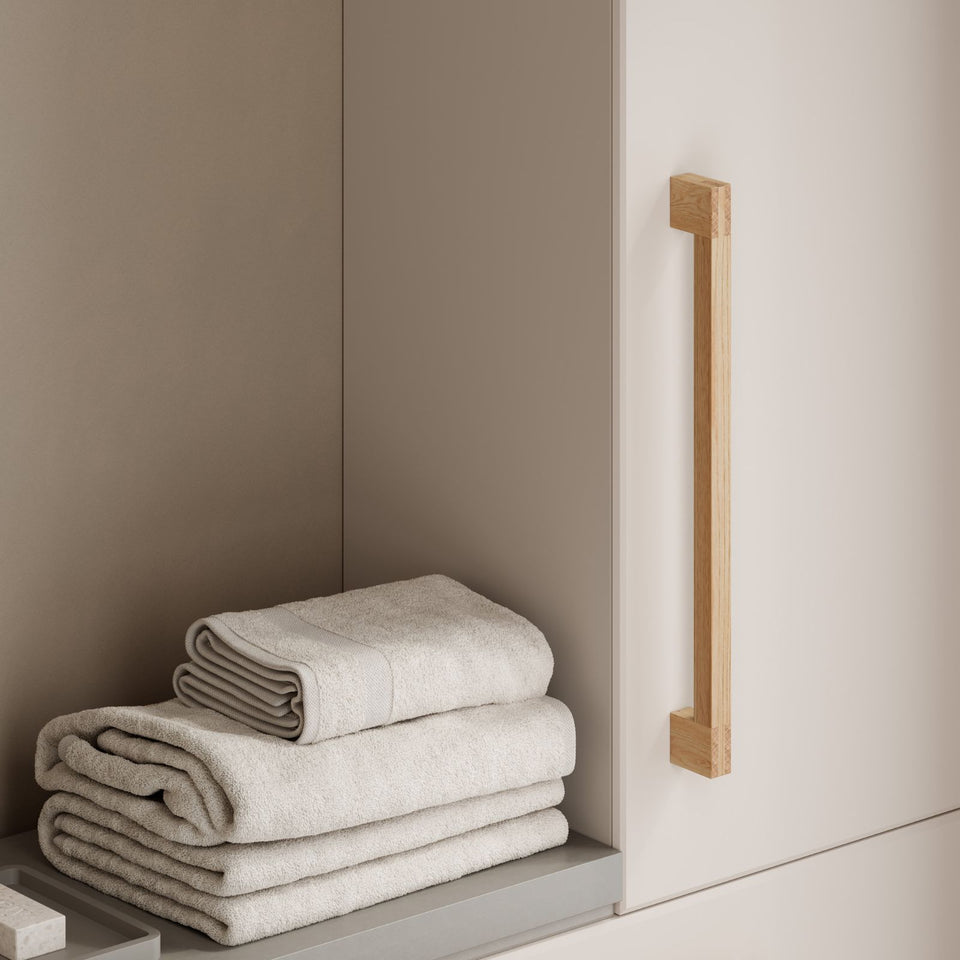
The Hako is a timber range from Momo Handles with a D handle, a larger Big handle and a 76mm T knob, in Walnut and Oak. The body is a square profile that joins its mounting bases without a visible seam, and the design is inspired by Japanese furniture. The join is imperceptible to the touch and is revealed subtly through the contrasting grain. The page covers what each piece measures, what walnut and oak look like and how a wooden handle is fitted. The page also explains how to size, place and look after the range. For the whole brand, start at Momo cabinet handles. For timber handles from other ranges, see timber cabinet handles.
The D handle is the everyday size, the Big handle is the long one, and the T knob is the small one. The Hako is a square-profile body that merges flush with its mounting base, and the square geometry suits flat-panel and Shaker doors and reinforces clean horizontal lines. See D shaped cabinet handles and cabinet knobs.
The Hako D handle has fixing distances of 160mm, 320mm and 480mm x 2, with overall lengths of 188mm, 348mm and 998mm. It is 14mm wide and projects 37mm. The fixing distance is the gap between the two screw holes, measured from centre to centre, so the 160mm and 320mm sizes run 28mm longer than their holes. The longest fixing distance is written as 480mm x 2 with no further detail, so check the product page for the hole layout before you drill.
The Big handle is on fixing distances of 480mm and 960mm, with overall lengths of 525mm and 1005mm. It is 24mm wide and projects 55mm. The T knob is 76mm long, 14mm wide and projects 37mm. Screws are not included. Screw length depends on the panel: 22mm for panels 16mm to 18mm thick, and 38mm for panels 32mm to 34mm thick. The screw must bite into the handle and stop short of the door face, which matters more in a wooden handle. The cabinet thickness is 16mm to 25mm.
When you replace a handle, measure the distance between the screw holes and match it to the fixing distance, not to the length of the old handle. A 128mm handle will not fit 160mm holes without new holes.
Mount these handles with a hand screwdriver and not a battery drill, to avoid over-tightening, and turn the last turns by hand. Tape a paper template to the door and mark the holes before you drill.
The timbers are Walnut and Oak, and the species are not given, so the descriptions below are of two common species and may not be the ones used. American black walnut has heartwood from golden to rich chocolate brown, with a creamy white sapwood, a fine and generally straight grain, a density of 615 kg/m3 seasoned and a moderately hard feel. American white oak has heartwood from pale yellow-brown to mid-brown, a mostly straight grain with medium to coarse texture and visible rays, and a density of 750 kg/m3 seasoned, hard and heavy.
Walnut has a denser, darker figure than oak and pairs with charcoal, deep navy and raw concrete palettes. Timber handles are warm, tactile and quiet against painted joinery, and they soften a kitchen in a way metal cannot. See walnut timber handles and American oak timber handles.
The finish is lacquer. A lacquered surface is a coated surface, so use the product recommended for the finish and keep bleach, ammonia, steel wool and scouring pads away. Ask us if the finish matters to you.
A sizing table helps. A standard drawer 450mm to 600mm wide takes a 128mm to 160mm centre, and a wide drawer of 600mm to 900mm takes 256mm to 320mm, or two 128mm pulls. A tall pantry door of 600mm and above takes two 256mm pulls. The one-third rule says a pull is about a third as long as the drawer front is wide, so near 200mm for a drawer 600mm across. The Hako D handle on a 160mm centre, 188mm overall, is the nearer size for that drawer, and the 320mm centre, 348mm overall, suits a drawer of about 1000mm.
The 480mm and 960mm Big handles are for wardrobes and full-height doors. Tall pantry doors suit long vertical pulls, which improve grip and weight balance. People look for big wardrobe handles, and the Big handle is the Hako piece for that. The 998mm D handle and the 1005mm Big handle are close in length, so compare the width and projection. The Big handle is 24mm wide and projects 55mm, while the D handle is 14mm wide and projects 37mm.
The T knob at 76mm is a long knob. Most cabinet knobs run roughly 25mm to 38mm across, so the 76mm T knob is about twice that length. It suits a small door or a narrow drawer where you want a longer grip. 76mm handles are also a size people look for.
A pull or knob sits 40mm to 60mm in from the edge that opens, near the bottom corner of an upper door and the top corner of a lower door. Pulls run horizontally on drawers and vertically on doors. To test a size before you buy, tape a strip cut to the handle's length onto the cabinet and live with it for a day. Use the same length throughout a kitchen, and put handles only on base cabinets and drawers for a less busy look.
Japandi and Scandi kitchens pair with timber and brushed nickel. Timber handles suit Japandi, coastal and Scandinavian interiors. Because the Hako is a timber handle, it sits outside the rule of two metals in a room, and it can sit beside metal tapware, though the colour of the timber should suit the other finishes. Choose the handle after the cabinet finish and benchtop are settled.
Handle types pair with kitchen styles. Contemporary and minimalist kitchens go with matte black or brushed nickel pulls, and Japandi and Scandi kitchens with timber and brushed nickel. Hamptons and coastal kitchens go with D-pulls or cup pulls in brushed nickel, brushed brass or chrome. Shaker kitchens go with cup pulls, bin pulls or knobs in brushed brass, antique bronze or matte black, industrial kitchens with gunmetal or matte black bar pulls, and heritage kitchens with antique bronze or aged brass and period knobs.
The Hako is a timber handle, so it sits closest to the Japandi and Scandi note, and timber suits Japandi, coastal and Scandinavian interiors. The square geometry suits flat-panel and Shaker doors. These matches are guidance and not rules.
A sizing table allows two pulls on a wide drawer in place of one long one. For a wardrobe door, a single Big handle gives one clean vertical line, and two shorter D handles give two grips at a convenient height. The choice is about the look you want and how the door is used. Pulls spread force on heavy drawers, which may reduce warping, and longer pulls spanning the drawer make a bolder statement. If you choose two D handles, keep them the same size and mount them the same distance in from each edge.
When you swap handles, match the fixing distance. A new D handle with the same distance drops into the old holes without drilling. Measure from the centre of one screw hole to the centre of the other. If the old holes are on another centre, you will need to fill them or drill new ones, and a filled hole shows unless the door is repainted. A T knob needs only one hole, so swapping a pull for a knob leaves one old hole unused and the other to fill.
Ventilate steam and keep humidity steady to look after timber. Bathrooms are more humid than kitchens. A timber handle on a well-ventilated vanity is a fair use, and one near an unventilated shower is the case to avoid. The cabinets these handles fit are at bathroom vanities and furniture.
Two search phrases lead to this range: bathroom furniture handles and big handles for wardrobes. For a wardrobe, the Big handle is the long option, and the D handle suits drawers inside a wardrobe unit. For bathroom furniture, fittings need wiping and drying more often than those elsewhere, because steam and moisture leave marks, and steam needs ventilating to look after timber. A timber handle on a vanity with an extraction fan is a fair use. Dry the handle after use and keep wet towels off the door.
Dust timber with a microfibre cloth, and use mild dish soap and warm water for high-touch areas. Spray the cloth and not the cabinet, wipe spills at once, and do not hang wet towels on doors. Limit strong sunlight. Handles are a high-touch area, so wipe them more often than the door, and dry them straight away.
Read the figures closely. Check the fixing distance, since the D handle is sold by its centre. Check the timber too, since the range is in Walnut and Oak, and check the screw line, since screws are not included. If a figure is missing or unclear, such as the finish, ask before you order and do not assume it. This page states only confirmed figures.
For the full brand, see Momo cabinet handles. For other types and materials, see cabinet handles, timber cabinet handles and cabinet knobs.


