
*View accurate shipping rates and availability






8 Items


Up to 70% off across the store, plus free towels and mirrors up for grabs on orders over $800*

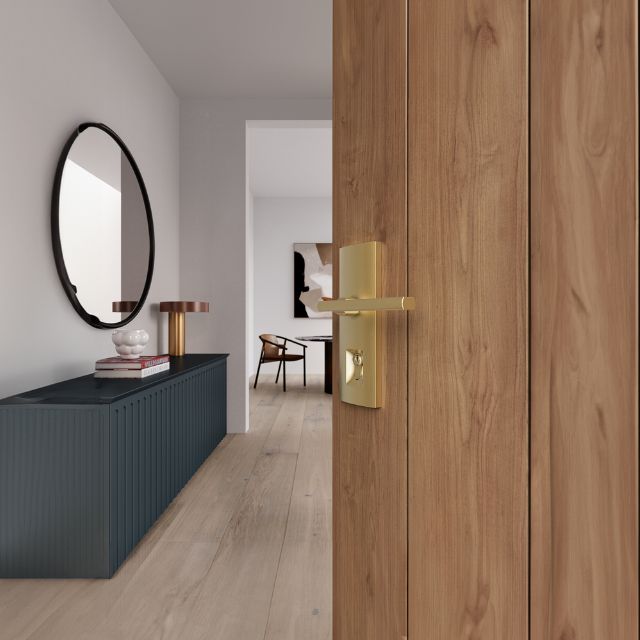

The Zanda Knox is a multi function entrance set: one lever lockset that works three ways. It has a key operated double cylinder deadbolt for when the house is empty, a privacy snib for when you are at home, and an unlocked mode that lets the set work as a passage set with free access in and out. This collection holds the Kent Knox and the Epic Knox in brushed nickel, graphite nickel, satin brass and matte black. Both are zinc alloy, electroplated, on a Euro mortice lock for doors 35 to 53mm thick with a 60mm backset. This guide explains how the three modes work, what a double cylinder deadbolt and a snib do, how the Knox differs from an ordinary entrance set, which measurements decide fit, how keys work, how to fit it and when it is the right choice. For other entrance options, see entry door lock sets, exterior door levers and entrance door hardware.
A standard entrance set locks with a key from outside and with a turn or a button from inside. A multi function set offers more than one way to lock. The Knox gives you three. In the first, you lock the door with the key and the deadbolt. In the second, you press a snib on the inside, and the door is locked from outside while still easy to leave. In the third, you leave everything unlocked, and the lever works like a passage set.
That flexibility suits a family home. During the day the door can be left unlocked for easy access. At night, the snib adds protection. When the house is empty, the key and deadbolt give full security. One set covers all three situations.
The Knox has a key operated double cylinder deadbolt with a robust 20mm throw. A deadbolt is a solid bolt that you throw with a key. A throw of 20mm means the bolt travels 20mm into the frame, which gives a firm hold. This gives extra security for when the home is unoccupied.
Double cylinder means the lock takes a key on both sides. When you lock the door with the deadbolt, you need a key to open it from inside as well as outside. Use this mode when you leave the house, and keep a key where you can reach it inside. Do not leave a key in a lock next to glass.
The snib is a button on the inside of the door. You lock the Knox by pressing the snib button on the inside, which ensures security from the outside while allowing safe exit in an emergency by simply turning the inside lever to unlock. In snib mode, the outside lever is locked and needs a key, and the inside lever still opens the door with a turn.
This is the mode you use when you are at home, in the evening or overnight. You get security from outside without needing a key to leave, so you can leave quickly in an emergency.
If you leave the lock unlocked, the Knox works as a passage set. The lever on each side withdraws the latch, and you can come and go freely. Leaving everything unlocked lets it operate as a passage set, allowing free access in and out. That suits a busy household in the daytime, when people come and go often.
Because the door still latches shut behind you, it keeps out draughts and is not left ajar. It is just not locked.
The collection has two Knox ranges. The Kent Knox has a modern rectangular lever with an arched radius at the pivot point. The Epic Knox is the matching lock in the Epic lever style. Both share the same mechanism, the same dimensions and the same four finishes. Look at the images on the product pages and choose the lever shape you prefer.
If the rest of the house uses Kent or Epic levers on the internal doors, choose the Knox in the same range so the levers match. See Zanda door hardware for the ranges.
The lock is a Euro mortice and the latch is tubular and bolt. A Euro mortice lock sits in a pocket in the door edge and takes a Euro cylinder, which a locksmith can change without replacing the whole lock. The tubular latch fits into a round hole in the edge. Together they give a strong, serviceable lock.
The door must be prepared for a mortice lock, with a pocket cut in the edge. A door that has an older mortice lock may already have the pocket, and a locksmith can confirm the fit.
The Knox suits doors 35 to 53mm thick and has a 60mm backset. That is a wide thickness range that covers most solid timber and solid core entrance doors. Measure the thickness of the door at the edge. The backset is the distance from the door edge to the centre of the lever spindle, and 60mm is the common figure on Australian entrance doors.
If your door has a different backset, check with the maker or a locksmith before you order. A lock with the wrong backset will not line up with the spindle.
The Knox is keyed different, which means each lock has its own key pattern and will not match another lock. Check the product page for the keys that come in the box. If you have more than one external door, ask a locksmith about keying them alike, so one key opens all.
Keep a spare key in a safe place you can reach if you are locked out, and give a spare to someone you trust.
The Knox comes in brushed nickel, graphite nickel, satin brass and matte black, all electroplated. Brushed nickel is a soft silver with a warm tone. Graphite nickel is a dark grey. Satin brass is a muted gold. Matte black is flat and strong. Choose the finish to match the hinges, the door stop and the house numbers at the entry, and the levers on the internal doors.
See hinges and door stops for pieces in matching finishes.
Choose the Knox for a front door where you want one lockset to cover day, night and away. It suits a family home, a rental where tenants need simple operation and a house where you want a deadbolt without adding a second lock. It is a good choice when you want the look of a single lever set rather than a lever plus a separate deadbolt.
It may not suit a door that is already prepared for a bored lock only, a door too thin for the mortice or a household that wants a smart lock.
A lever set with a separate deadbolt gives two locks on the door, which some people prefer for extra security. The Knox puts the deadbolt in the same unit, with one pocket and one set of plates, which looks neater and costs less cutting. If you want two independent locks, choose a lever set and a deadbolt. If you want one tidy set, choose the Knox. See deadbolts for separate deadbolts.
Read the installation instructions. Fit the lock body into the mortice pocket and fix it. Fit the cylinder, the plates and the levers, then fit the strike plate and box in the frame. Test the lever, the snib and the key from both sides with the door open. Test the deadbolt throw, and check that the bolt enters the frame cleanly and fully. Close the door and repeat.
If the door is not prepared for a mortice lock, ask a locksmith or a carpenter to cut the pocket. A cut in the wrong place cannot be undone.
The Knox suits solid timber and solid core doors that are 35 to 53mm thick and can take a mortice pocket. It suits a standard hinged entrance door, internal or external. It does not suit a sliding door, a glass door without a frame, a very thin door or a door that cannot be prepared for a mortice lock. Check the door before you order.
If the door is a security screen door, look at screen door locks, which are made for that job.
A strong lock needs a strong door and frame. Check the hinges, the strike and the frame when you fit the lock. Use long screws in the strike so it is fixed into the stud behind the frame. See entrance door hardware for the other parts of the entry.
For a front door that needs a deadbolt, a privacy snib and a passage mode in one lockset, choose the Zanda Knox, in the Kent or Epic lever to match the internal doors, and in the finish that suits the house. Check the thickness and the mortice, and plan the keying.
Then one lock will cover the whole day.
It is a lever lockset with a key operated deadbolt, an inside privacy snib and an unlocked passage mode.
It suits doors 35 to 53mm thick, with a 60mm backset.
The throw is 20mm.
Brushed nickel, graphite nickel, satin brass and matte black.
No. It is keyed different, so each lock has its own key.
Learn the three modes before you fit the lock. Turn the key and the snib through each mode with the door open, so you know what each position does and how to leave the door unlocked for family and locked when nobody is home. Show every adult in the house how the lock works, and keep a spare key where a trusted person can reach it.


