
*View accurate shipping rates and availability






36 Items






Ember Bronze is the warm, dark bronze finish in the Zanda range, applied by electroplating to levers, pull handles, lock kits, hinges, bolts, stops and sliding door hardware. This collection brings the Ember Bronze pieces together, so a door can be matched from the handle to the hinge to the stop in one finish. This guide explains what the finish looks like and how it behaves, what is made in it, which sizes decide fit for each part, and how to put a door together. Searches for Zanda Ember Bronze and Ember Bronze hardware lead here. The brand overview is on Zanda door hardware, and the bronze family across brands is on bronze door handles.
Ember Bronze is a deep, warm brown with a hint of red and a soft sheen, like aged bronze or a glowing ember. It is darker than brass and warmer than black, so it sits between the two and works with timber, stone and deep paint colours. On a pale door it reads as a strong, warm accent, and on a dark door it blends in with a gentle metallic glow. It is an electroplated finish, which means a thin metal layer is applied to the body to give the colour and a hard surface.
The finish suits modern country, Hamptons, traditional and contemporary interiors, and it pairs well with black window frames, brass lighting and warm timber. It is less common than brass or nickel, so a house in Ember Bronze has a distinct look.
Three lever designs are made in Ember Bronze. The Zanda Vertex is a slim stainless steel lever, 137mm long and 21mm wide, projecting 61mm, with 41mm fixing centres, and it comes as passage, privacy and dummy sets for doors 35 to 45mm thick with a 60mm backset. The Zanda Duke is a stainless steel lever, 116mm long, in passage, privacy and entrance sets. The Duke Return is a zinc alloy lever, 116.5mm long, with a 42.5mm projection, in passage and privacy sets, and it is the more restrained shape.
A passage set latches the door with no lock, and suits hallways and living areas. A privacy set adds a lock for bathrooms and bedrooms. A dummy set is a single lever for a cupboard or wardrobe. The Zanda Futura round separate privacy kit adds a turn and release to a door that already has a lever, and it suits doors 35 to 53mm thick with a 60mm backset. See passage lever sets, privacy door levers and dummy levers.
For a front door, Ember Bronze includes the Vertex entrance sets, which use a 70mm euro mortice lock with a double cylinder in key and key or key and turn versions, and the Duke entrance set, a 70mm key and turn set. The key and turn version locks from outside with a key and from inside with a turn, so anyone in the house can leave without a key. The key and key version needs a key on both sides, which adds security where there is glass beside the door.
The double turn lock kit on a round plate is a euro mortice lock with a single cylinder, 237mm long and 22mm wide, for doors 35 to 45mm thick with a 60mm backset. The round pull handle lock kit is a euro mortice lock with a roller bolt and a double cylinder, key and key, for doors 35 to 45mm thick. These pair with a pull handle to complete an entry set. The Stealth smart lock deadbolt has a 60mm backset and is keyed different. See entry door lock sets and smart door locks.
The Zanda Duke pull handle in Ember Bronze is a stainless steel bar 630mm long and 30mm wide, projecting 55mm, with fixing centres of 600mm, sold back to back. A long pull suits a front door, and a back to back pair clamps the door between the two handles for a firm fixing and the same look on both faces. A pull does not lock the door, so it pairs with a lock kit, such as the double turn kit or the round pull handle lock kit. Choose the length by the door: a long pull gives a strong vertical line on a tall door, and the centres must suit the door preparation. See pull handles.
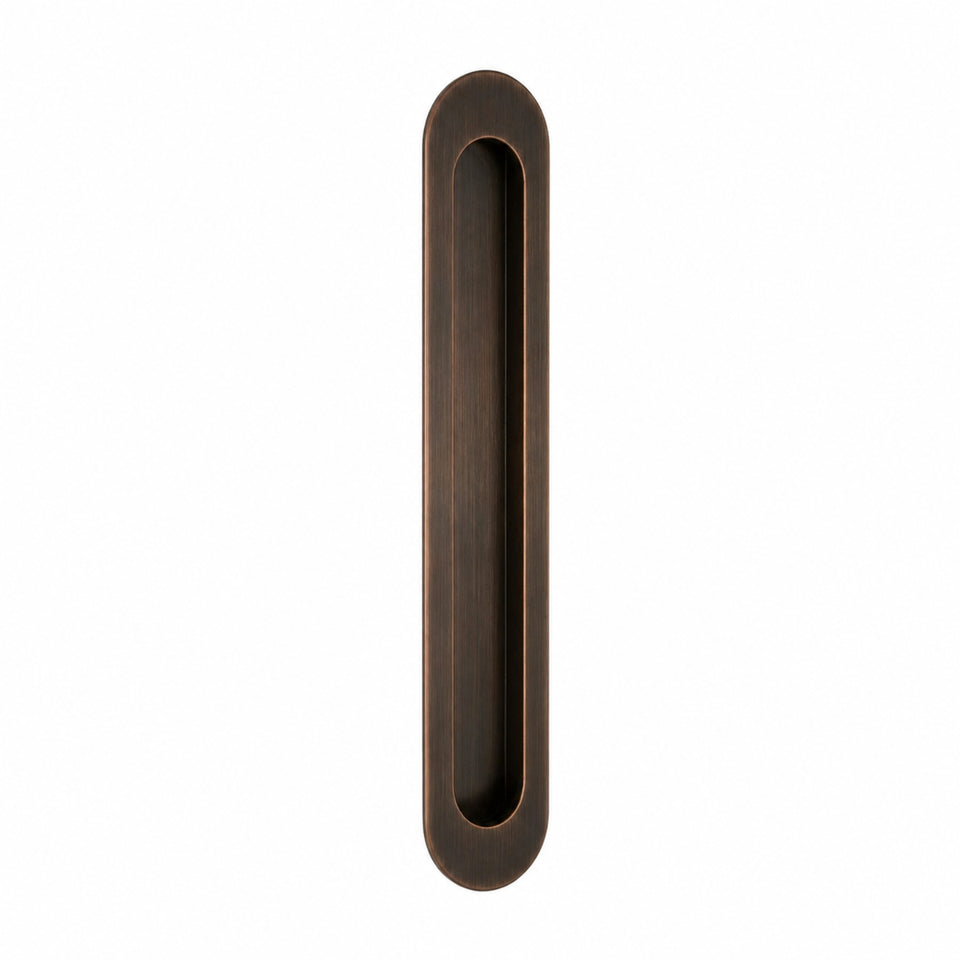
A door that slides into a wall cavity needs flush hardware. The Zanda Duke flush pull in Ember Bronze is 250mm by 40mm, projects 12mm and suits doors 35 to 45mm thick, and the Duke sliding door euro lock kit is the same size with a euro mortice lock and a double cylinder. The Zanda round cavity sliding passage and privacy handle kits are round plates 65mm across in stainless steel, for doors 35 to 45mm thick, with the privacy kit adding a lock with a claw latch. A rose adaptor kit, 65mm square, covers an existing hole. See cavity slider hardware and flush pulls.
Ember Bronze includes three hinges. The Zanda butt hinge with a loose pin is brass, 100mm by 75mm, and it lets the door be lifted off the frame once the pin is drawn, which suits internal doors. The Zanda butt hinge with a fixed pin is stainless steel, 100mm by 100mm with a 2.5mm leaf, and the pin cannot be tapped out, so it suits external doors. The Zanda bearing hinge with a fixed pin is brass, 100mm by 75mm by 2.5mm, with a bearing between the knuckles for a smoother swing. Match the size of the old hinge exactly, since the recess in the door is cut to a specific size, and replace every hinge on a door in one go. See hinges and Zanda hinges.
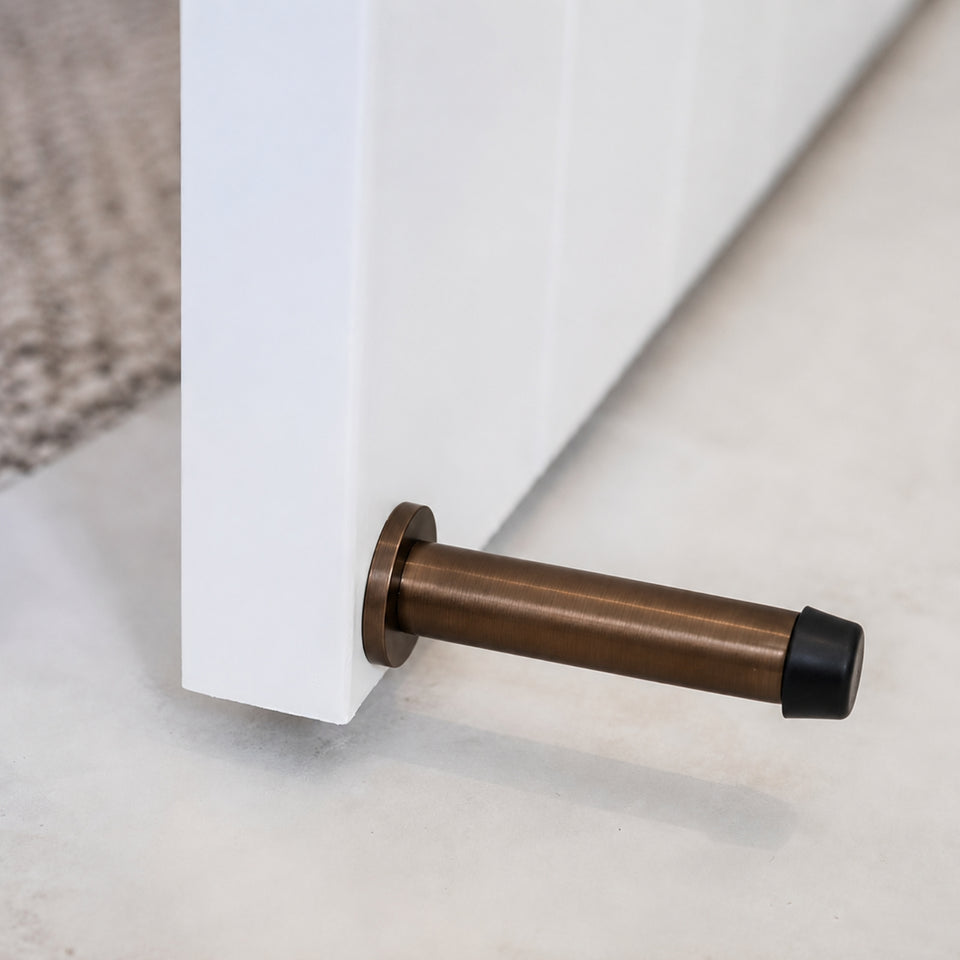
The 152mm flush bolt is brass, 19mm wide, and fits into the edge of a door for the inactive leaf of a pair of doors. The heavy duty barrel bolt is brass, 150mm by 31mm, with a 30mm throw, and slides across into a keeper on the frame. Three stops are made in Ember Bronze. The skirting fix stop is 85mm long and 32mm wide in zinc alloy and mounts to the skirting. The floor mounted stop is 38mm square in zinc alloy. The magnetic stop is 75mm long and 50mm wide, mounts to the floor or the wall, and holds the door open against a magnet. See flush bolts and barrel bolts and door stops.
The lever sets and lock kits suit doors 35 to 45mm thick, and the Futura kit and some entrance sets suit 35 to 53mm. The backset is 60mm, the usual size on interior doors, so most replacements fit the existing hole. The three numbers to check before you order are the door thickness, the backset and the diameter of the hole in the door. Measure the door edge with a tape, measure from the edge to the centre of the spindle hole, and measure the hole in the face. Photograph the old hardware from both sides with a tape beside it, and keep the old parts until the new set is fitted.
Electroplating applies a thin metal layer, and the layer is hard wearing under normal use. It can scratch if it is struck or scoured, and a scratch that goes through the layer shows the metal beneath. Handles that are touched all day will polish slightly at the contact points over the years, which is part of how a bronze finish ages and gives it character. If you want the finish to stay exactly as it arrives, handle it gently and clean it with a soft cloth.
Wipe the hardware with a soft damp cloth and dry it. Keep abrasive pads, metal polishes and acidic or bleach-based cleaners away from the surface. Near the coast, rinse handles with fresh water now and then so salt does not sit on the surface.
The three lever designs suit different houses. The Vertex is slim and long, with a clean straight line, and it suits a modern house with plain doors and square details. The Duke is a stainless steel lever with a slightly shorter reach, and it suits a wide range of doors, from flat modern doors to panelled ones. The Duke Return is a zinc alloy lever with a return at the end, so it curves back toward the door, which makes it more restrained and a little more traditional. Hold the range side by side if you can, since the difference is in the end of the lever and how it feels in the hand.
The reach matters beside a wall. The Vertex projects 61mm and the Duke Return 42.5mm, so the Duke Return leaves more room in a narrow hallway, and the Vertex needs a stop where the door opens against a wall.
A back to back pull handle is two handles fixed through the door with bolts, one on each face. The bolts pass through the door and pull the two handles together, so the pair clamps the door and the fixing is firm. The fixing centres, 600mm on the Duke pull, are the distance between the two bolts, and the holes must be drilled to match. If the door is new, give the door maker the centres and the grip height in writing so the holes are drilled in the workshop. If the door is already hung, mark the centres with a level and drill from the face where the handle will sit, so any break-out falls on the back. A pull does not lock the door, so fit it with a lock kit.
Is Ember Bronze the same as other bronze finishes? Finish names are not standardised, so Ember Bronze from Zanda can differ in tone from a bronze from another brand. Compare the pieces side by side before you mix them.
Can the Ember Bronze hardware go on an external door? The entrance sets, the fixed pin hinges and the pull handles are made for external doors, and an occasional rinse keeps salt and dust from sitting on the finish.
Which parts of a door are made in Ember Bronze? Levers, pull handles, lock kits, hinges, bolts, stops and sliding door hardware, so a whole door can match.


