
*View accurate shipping rates and availability






5 Items


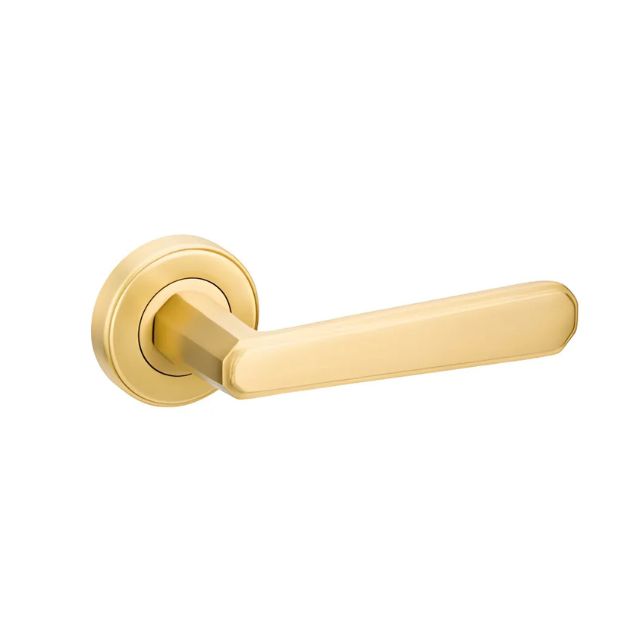


The Zanda Vienna is a classic art deco style door lever in solid brass with a satin brass finish. This collection holds the Vienna in five sets: a passage set for connecting doors, a privacy set for bathrooms and bedrooms, a dummy set for cupboards, and two entrance sets for external doors, one with a key on both sides and one with a key outside and a turn inside. Each is built around the same lever, with its distinctive shaped handle. This guide explains what art deco means in door hardware, what each Vienna set includes, which set suits which door, which measurements decide fit, how to handle the handing on the dummy lever, how to plan a house or an entry in Vienna and how to fit and look after it. For the wider range, see Zanda door hardware, interior door levers and entry door lock sets.
Art deco is a design style of the 1920s and 1930s, known for geometric forms, bold lines and a sense of glamour. In door hardware, it shows up as levers with a stepped or angular shape, a strong, symmetrical outline and a feel of quality metal. The Vienna has a classic art deco style door lever and an art deco style shaped handle.
The result is a lever with more character than a plain bar. It suits a house with period charm, a renovated apartment with deco touches or a modern interior that wants a bit of drama. It also looks good against timber panelled doors and in rooms with brass accents.
The Vienna is made from solid brass. It is constructed from solid brass and manufactured in Italy. Solid brass is heavy, strong and takes a finish well, and a brass lever has a substantial feel in the hand. It resists corrosion and wears gracefully.
The finish in this collection is satin brass, electroplated over the brass. Satin brass is a muted gold with a soft shine, less bright than polished brass and warmer than nickel. It is the popular choice for current interiors with timber and black fittings. A satin finish hides fingerprints better than a mirror finish.
The passage set is for internal connecting doors such as living rooms and laundry rooms, where privacy is not required. It latches the door shut and does not lock. It includes the 1172 latch and gives a rose size of 53mm. The box holds two Vienna levers and the latch.
Use the passage set for hallways, living rooms, kitchens, laundries and any door that closes but never locks. See passage lever sets for passage levers from other makers.
The privacy set is for doors that need a lock from inside, such as bathrooms and master bedrooms. It includes the 1172 latch and a separate lock kit, with two Vienna levers. The lock is a separate part from the lever, so the lever shape stays clean and the lock sits on the plate.
A separate lock kit means you fit the passage-style lever and latch first, then add the privacy lock. Choose it for rooms where someone expects to be alone. See privacy door levers for more privacy options.
The dummy set is for cupboards, closets and pantries where only opening and closing of the door is required. It includes a half leverset with a dummy fixing spindle, so it is one lever for one face of the door. Handing must be specified. The Vienna lever has a direction, so you must say whether it is for a left hand or a right hand door.
Check the way each cupboard door swings before you order, and order a dummy lever for each face that needs one. See dummy levers for dummy levers from other makers.
The entrance sets are for external doors that lock with a key. Each includes Vienna levers in a pair, a mortice lock, matching escutcheons and a 60mm cylinder. One has a double cylinder (key/key), with a key on both sides, and one is key/turn, with a key outside and a turn inside. Both use a Euro mortice lock with a tubular and bolt latch, for doors 35 to 53mm thick with a 60mm backset, and both are keyed different.
Choose key/turn for a door where you want to leave quickly, and key/key where there is glass close to the inside turn. The set includes matching escutcheons, so the keyhole is neatly finished.
The entrance sets suit doors 35 to 53mm thick and have a 60mm backset. The passage and privacy sets use the 1172 latch, which is a 60mm backset latch for standard internal doors. Measure the thickness of the door at the edge. Most internal doors fall within the range. A very thin hollow core door may not.
The backset is the distance from the door edge to the centre of the lever spindle, and 60mm is the common figure on Australian doors.
A Euro mortice lock sits in a pocket in the door edge and takes a Euro cylinder, a standard shape that a locksmith can change without replacing the lock. The entrance set includes the lock, the cylinder and matching escutcheons, which are plates around the cylinder on the door face. The door must be prepared for a mortice lock, with a pocket in the edge. A joiner or locksmith can cut it.
The entrance sets are keyed different, which means each lock has its own key pattern. Check the product page for the number of keys. If you have more than one external door, ask a locksmith about keying them alike. Keep a spare key in a safe place.
Some Vienna pieces are handed, and the dummy handing must be specified. A handed lever has a direction: the lever points one way when at rest. For a pair of levers on a door, the hand is set by the swing of the door. Check which way each door swings, and specify left or right when you order.
If you are unsure, stand facing the door from the side where the hinges are on your left. That is a left hand door, and where the hinges are on your right, a right hand door.
The Vienna lever has a shaped, stepped outline that reads as a deco detail. In the hand, it is a lever, pressed down to open. A shaped lever can feel different from a plain bar, so if you can, hold one before you order a whole house. Think about the people who use the doors, and whether the shape suits their hands. A lever with a clear end to press is easy for most.
The 53mm rose on the passage set is a neat round plate that sits close to the door and does not catch.
The front door is where the Vienna makes its biggest statement. The entrance set gives a brass deco lever on the outside with a Euro mortice lock, a cylinder and matching escutcheons. The matching escutcheon ties the keyhole to the lever. On a timber door painted a deep colour, satin brass looks rich. On a natural timber door it looks warm.
Choose between key/key and key/turn by thinking about glass and emergencies. Add a deadbolt if you want a second lock. See deadbolts for deadbolts to match.
A satin brass lever looks best with satin brass hinges, door stops and cabinet handles. A mismatched finish stands out on a decorative lever. See hinges and door stops for pieces in matching finishes.
Read the instructions. For a passage or privacy set, fit the latch into the door edge, pass the spindle through and fit the levers and roses, tightening evenly. For a privacy set, fit the separate lock kit. For an entrance set, fit the mortice lock into its pocket, then the cylinder, escutcheons and levers. Fit the strike on the frame, and test every function from both sides.
For a dummy lever, fit the lever and the dummy spindle through the door, and check the handing.
Wipe with a soft damp cloth and dry. Avoid abrasive pads, polishes and strong chemical cleaners, which can mark a satin finish. The stepped shape collects a little dust, so brush it lightly. Check the fixings now and then. Satin brass develops a soft character over time.
The first mistake is ordering a dummy lever without specifying the handing. The second is using a passage set where a lock is needed. The third is ordering an entrance set for a door not prepared for a mortice lock. The fourth is mixing finishes with the hinges. The fifth is ignoring the thickness range. The sixth is forgetting the key plan on entrance sets.
A short list avoids all six: handing, function, mortice, finish, thickness and keys.
For a house or a room that wants a deco style lever in warm brass, choose the Zanda Vienna in satin brass and order by function: passage for connecting doors, privacy for bathrooms and bedrooms, dummy for cupboards and entrance for external doors. Match the hinges and stops, and plan the handing and the keys.
Measure the doors, check the numbers and fit with the instructions. Then the levers will give each door a clear character.
A classic art deco style door lever in solid brass, made in Italy, in satin brass.
Passage, privacy, dummy and two entrance sets, one key/key and one key/turn.
It suits doors 35 to 53mm thick, with a 60mm backset.
Yes, on the dummy set. Handing must be specified.
Yes. They include a mortice lock, a 60mm cylinder and matching escutcheons.


