
*View accurate shipping rates and availability






5 Items


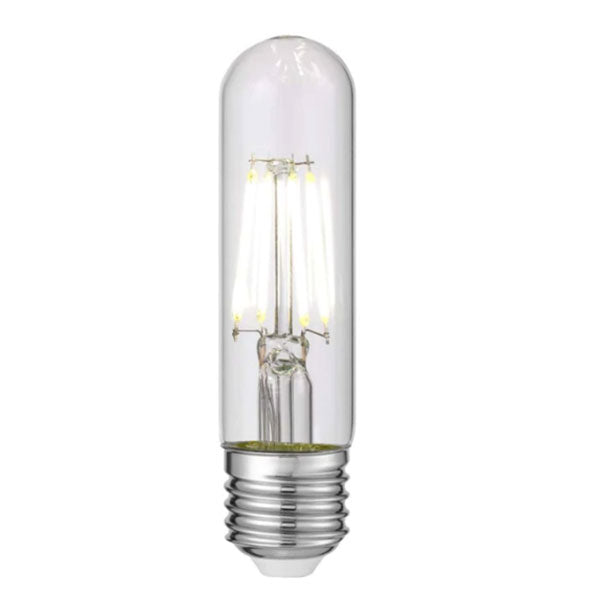

The globe decides how a light fitting looks, how bright it is and what colour the light is. This page holds LED globes in a classic A60 shape, two decorative pilot shapes, a slim tube and a dimmable GU10. Below you will find how to match a globe to a fitting, how brightness is measured, which colour temperature suits which room, what dimming asks of a globe and how long LED globes last. It also says plainly what the range does not include.
The base is how the globe fits the socket, and it is the first thing to check. Edison screw bases, written E, screw in clockwise, and E27 is the standard size, with E14 the smaller candle size. Bayonet bases, written B, push in and twist to lock, and B22 is the Australian bayonet standard. Pin bases, including GU10, push into the socket and are common in spotlights and downlights. B22 and E27 are the most common residential bases at 240V, and GU10 is also 240V. G9 pins appear in decorative fittings.
One pairing needs care. MR16 globes look like GU10 globes but run on 12V and need a compatible transformer, and confusing the two can damage the globe and the transformer. Bayonet and Edison screw globes perform the same, so the choice between them is about the fitting, not the light.
Every globe here is an LED, and each states its base, wattage, lumens, colour temperature, colour rendering figure and whether it dims.
The range does not include rechargeable or battery globes, blue or colour-changing globes, or smart globes. An amber filament globe is the one coloured option.
Shape does not change brightness, but it changes the way the light leaves the globe. Many LEDs emit mostly from the top and end, which suits downlights. G95 and ST64 shapes suit exposed globes where the filament shows. A60 is the standard general-purpose shape, and it suits globes hidden behind a shade or frosted cover because it gives even light. GU10 reflectors give directional light aimed at one spot, where the beam angle matters. Candle and decorative shapes suit exposed fittings.
That is how the range here splits. The A60 is for fittings with a shade or a diffuser. The two pilot ST64 globes have a decorative glass envelope around the filament that shows off the warm glow of the filament LEDs, so they are made to be seen in open fittings. The T30 is a slim tube that suits narrow fittings. The GU10 suits a recessed or track fitting.
Watts measure the power a globe uses, and lumens measure the light it gives out. Brightness is best judged by lumens and not by watts or incandescent equivalent claims. About 420 lumens matches an old 40W incandescent, which an LED produces from about 6W, and suits table and floor lamps. About 800 lumens matches 60W, from about 8 to 10W of LED, for small rooms. About 930 lumens matches 75W, from about 10.5W, for medium rooms, and about 1,300 lumens matches 100W, from about 13W, for large rooms or work areas.
Set against those figures, the globes here are small sources. The 8W clear pilot at 800 lumens matches an old 60W bulb. The A60 and T30 at 470 and 440 lumens are closer to a 40W bulb, and the amber pilot at 360 lumens and the GU10 at about 300 lumens are accent sources. Because a fitting often holds several globes, add the lumens of every globe in the fitting, and check the maximum wattage the fitting allows.
Colour temperature is measured in kelvins and describes how warm or cool the light looks. There are three colour bands: warm white at 3000K is cosy and suits living areas and bedrooms, cool white at 4000K is whiter and suits offices, kitchens and bathrooms, and daylight at 5000K and above is blue-white, like outdoor daylight. Warm white runs 2700K to 3000K and cool white 4000K and above, with a super warm band of 2200K to 2700K for bedrooms. Tri-colour globes let you switch between settings at the fitting.
The globes here fall into two groups. The pilot ST64 globes and the Eglo GU10 are 3000K, which suits a living room or a bedroom. The A60 and the T30 are 4000K and suit task lighting in a kitchen or bathroom. Do not mix colour temperatures within one room, because the difference shows on the walls, and a warm metal fitting looks best with a warm globe. For a bathroom, see bathroom lighting, where a neutral to warm white at the mirror and a colour rendering figure of 90 or above suit makeup.
Dimming depends on both the globe and the dimmer. Use dimmable LEDs only on LED compatible dimmers, because a non-dimmable LED on a dimmer can flicker, buzz or fail early. Dimmers installed before about 2010 may need replacing before an LED upgrade. Trailing-edge dimmers suit most dimmable LED globes, and the dimmer rating should comfortably exceed the total wattage on the circuit.
On this page, only the T30 and the GU10 are dimmable. The A60 and the two pilot globes are not. A fitting on a dimmer needs a globe from the dimmable lines, and a non-dimmable globe on a dimmer is a common mistake. For more on dimming systems, see the lighting guide.
Small enclosed fittings trap heat, which shortens the life of LEDs and CFLs, so a fitting with a closed glass shade needs a globe that suits it. LED lifespans run 15,000 to 35,000 hours or more, roughly 8 to 19 years at typical use, against 6,000 to 15,000 hours for CFLs and 1 to 2 years for halogen and incandescent globes. A typical LED lasts 25,000 to 50,000 hours. LEDs fade over time and the rated life depends on conditions.
LEDs use far less energy than the older types: a 60W incandescent gives about the light of an 8W LED, and incandescent globes are mostly phased out. LEDs turn on instantly and contain no mercury, while CFLs contain mercury and should go to council recycling, and LEDs are e-waste that can also be recycled there.
Every fitting has a limit on the globe it can take, and it is printed on the fitting or given in the specification. The holder caps the maximum globe wattage, so check it on the fitting, for example on a batten fix light. The Cafe Lighting Cloud takes E14 globes of up to 60W, and the Zara and Le Mans take E27 globes of up to 40W. G9 lampholders take a maximum of 5W of LED each. LEDs draw far less than those limits, so an LED globe sits comfortably inside them, but a multi-light fitting multiplies the load, and the dimmer has to cope with the total.
When a fitting has several lamps, match the globes across it. Mixed brightness or colour shows quickly in a row of lamps, and mixing colour temperatures is a common mistake.
The same errors come up again and again. Choosing by watts instead of lumens is the first. Ignoring colour temperature is the second, and mixing colour temperatures in one space is the third. Using a non-dimmable globe on a dimmer switch is the fourth, and making every room maximum brightness is the fifth. MR16 and GU10 look alike and run on different voltages, and small enclosed fittings trap heat. Reading the base, the lumens, the colour temperature and the dimmable line avoids almost all of them.
Changing a globe is a job a householder can do with care. Replacing a globe is fine with the power off, as long as the new globe matches the fitting. Changing globes is one of the exceptions to the rule that work on fixed 240V wiring needs a licensed electrician. Switch the light off at the wall, let the old globe cool, check the base type and the maximum wattage printed on the fitting, and fit the new one. A new holder, or a fitting that is hardwired, is electrician work.
Match the globe to the fitting by working through the same steps. Find the base first, then the shape that suits the shade, then the lumens, then the dimmer, then the colour temperature. For the fittings that take these globes, see pendant lights for E27 pendants, ceiling lights for B22 batten fix fittings, and wall lights for E27 and G9 wall lights. For an amber filament look, see amber glass lighting.
The old globe or the fitting gives the base. The shade gives the shape: A60 behind a shade, ST64 or tube where the globe shows, GU10 for a spot. The room gives the lumens, with 800 lumens as a 60W reference and every globe in a multi-light fitting added up. Use 3000K for living areas and bedrooms and 4000K for task areas, and keep one temperature in a room. A dimmable globe is needed only on a dimmer circuit, and the colour rendering figure matters if the light is at a mirror.
For a maker whose fittings take these globes, see Eglo lighting.


