
*View accurate shipping rates and availability






16 Items


Up to 70% off across the store, plus free towels and mirrors up for grabs on orders over $800*


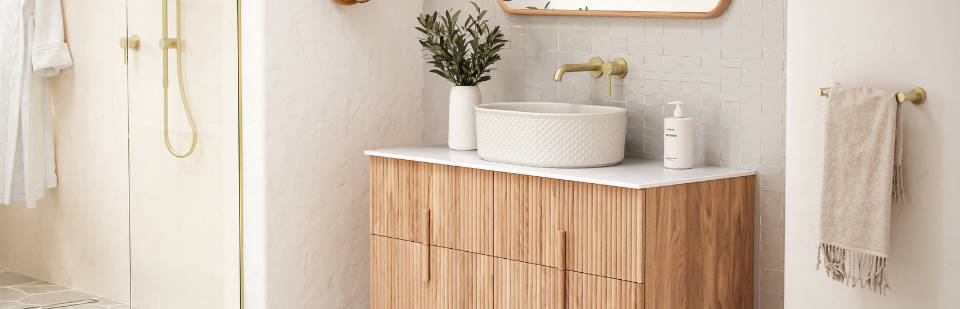


Marquis mirrors are shaped glass: frameless, polished at the edge, 25mm deep in most ranges, and cut into round, arched, capsule, geometric and semicircular forms. The range is built around the shape, so the first decision is which outline suits the wall. After that comes the width against the vanity, the height on the wall and the fixing. The sections below take each step, with the source for each figure named in the text.
The collection sorts into six families. The round mirrors are the Orbit, in 600mm, 750mm, 900mm and 1200mm diameters, and the Solar, whose listing describes soft curves in 500mm, 600mm, 750mm and 900mm diameters. The rectangles are the Base, a soft curved rectangle 600mm high in widths of 600mm, 750mm, 900mm and 1200mm, and the Flynn, 720mm high in widths from 600mm to 1500mm. The arches are the Arco, 550mm by 800mm, and the Pane, a squashed arch 750mm high in widths from 600mm to 1200mm.
The elongated shapes are the Capsule at 550mm by 900mm, the Luna at 456mm by 1000mm, the Alta at 400mm by 1200mm with rounded corners, and the Culare, a horizontal capsule at 1200mm by 650mm. The Oval is 600mm to 1200mm. The geometric group is the Deco, a decagon in 600mm to 1200mm, the Hexa, a hexagon at 445mm by 1000mm, and the Otto, an octagon at 500mm by 900mm. The Palmer is a semicircle at 1200mm by 800mm, and the Kyka is a curved shape in 750mm, 900mm and 1200mm widths.
The soft shapes do different jobs. A round mirror is the same in every direction and suits a small wall or a pair over a double vanity. Houzz says round mirrors suit pedestal basins and bathrooms with many hard surfaces. A designer quoted by Homes and Gardens says a circular mirror adds softness and contrasts with the crisp angles of the vanity and the shower screen. An oval or capsule gives the curve more length, and the Luna and the Capsule are listed with soft edges to create a soft-looking space.
An arch adds height. The Arco listing says arch mirrors can soften the look of any space, and the Pane's arch is gentle, a squashed curve on top of a wide mirror. The geometric Deco, Hexa and Otto sit at the other end: they break up the curves of a room that already has round basins and soft shapes. For the shape groups see round mirrors, oval mirrors, arched mirrors and rectangular mirrors.
The listings carry the same fields in the same order. Start with the overall width and height, then the depth, which is 25mm on most of the range, 22mm to 27mm on the newer frameless mirrors, and 136mm on the Flynn with its shelf. Next read the orientation line, then the wall mounting line, which names the bracket. For the newer mirrors read the lighting line, which describes the optional 3000K upgrade. Finally download the specification sheet, which every listing offers, and read it before you choose the fixings.
Every Marquis mirror in this collection is a single sheet of glass with a finished edge. The listings describe a polished edge, and the Marquis Oval listing names it a frameless polished edge mirror. The Orbit, Base, Solar, Deco and Oval list 25mm of depth. The newer frameless group, the Kyka, Culare, Palmer, Pane and Alta, lists 22mm to 27mm of depth and a clear, no-tint mirror surface for accurate reflection.
A glass fabricator's guide says a frameless mirror is a single sheet of glass with polished or bevelled edges, mounted directly to the wall. It adds that the cut edges are exposed to humidity, so a cleanly polished edge resists moisture for much longer than a rough one. The same guide notes that a frame protects an edge from knocks, so a frameless mirror asks for more care when it is fixed and cleaned. For the group see frameless mirrors.
The Flynn is the one Marquis mirror with a storage shelf, and its listing gives 720mm in height and 136mm in depth. The listing describes a frameless polished edge mirror with a shelf in a choice of cabinet finishes: White Gloss, White Matte, Tranquil Retreat Matte and Duragrain. The widths are 600mm, 750mm, 900mm, 1200mm and 1500mm, so the mirror can match a vanity width. The shelf takes small items near the basin, so check the base of the shelf against the tap before you fix the mirror.
Houzz gives the clearest width rule: when the mirror is not the same width as the vanity, make it 70 to 80 per cent as wide, and 60 to 70 per cent when sconces share the wall. On a 600mm vanity that is a mirror about 420mm to 480mm wide. On a 900mm vanity it is about 630mm to 720mm, and on a 1200mm vanity about 840mm to 960mm. Homes and Gardens gives a second rule: choose a width just shy, by 1 to 2 inches, of the vanity countertop.
The Marquis widths let you test the rule. A 600mm mirror suits a vanity about 750mm to 855mm wide, a 750mm mirror suits one about 940mm to 1070mm, and a 900mm mirror suits one about 1125mm to 1285mm. A 1200mm mirror suits a vanity about 1500mm to 1715mm, and a 1500mm Flynn suits one about 1875mm to 2145mm. A 456mm Luna suits a vanity about 570mm to 650mm, and a 550mm Capsule suits one about 690mm to 785mm. Treat these as starting points, mark the outline on the wall with masking tape, and look at it from the doorway before you decide.
The Deco, Hexa and Otto are the most distinctive Marquis shapes. The Deco is a decagon, a ten-sided shape close to a circle, and comes in 600mm, 750mm, 900mm and 1200mm. The Hexa is a hexagon at 445mm by 1000mm, and the Otto is an octagon at 500mm by 900mm. The Hexa and Otto are tall and narrow, and the Deco is the one to choose when a round mirror feels too soft for the room. All three are 25mm deep, and the sizing and height rules above apply to them in the same way.
The Orbit is a plain circle. The Solar is also listed as a circle in diameters from 500mm to 900mm, with soft curves that give it an organic and modern look in its own description. The Orbit goes larger, to 1200mm, while the Solar goes smaller, to 500mm, so the choice often follows the size: a 500mm Solar for a narrow wall, and a 1200mm Orbit for a wide one. Between 600mm and 900mm the two overlap, and the decision comes down to the look you prefer.
A shaped mirror takes less wall than a wide rectangle, so the space beside it matters more. Houzz counts sconces as part of the mirror's footprint, which is why its percentage drops from 70 to 80 per cent to 60 to 70 per cent when lights share the wall. The Australian height guide asks for the top edge to sit at least 100mm below the ceiling and the base 100mm to 200mm above the tap. Add a switch, a towel rail or a shelf to the same wall and the usable width shrinks again, so mark every item on the wall before you fix a bracket.
The Orbit and Solar give a size for most walls. At 70 to 80 per cent of the vanity width, a 500mm Solar suits a vanity about 625mm to 715mm wide, and a 600mm round suits one about 750mm to 855mm. A 750mm round suits a vanity about 940mm to 1070mm, a 900mm round suits one about 1125mm to 1285mm, and the 1200mm Orbit suits one about 1500mm to 1715mm. A round mirror is as tall as it is wide, so a 900mm round also reaches 900mm up the wall, which matters under a low ceiling or above a tall tap.
The Culare, Palmer, Kyka and Pane suit a wide vanity because they hang horizontally. The Culare is a 1200mm by 650mm capsule with softly rounded ends. The Palmer is a semicircle at 1200mm by 800mm, with a straight base and a curved top. The Kyka at 1200mm is 900mm high and the Pane at 1200mm is 750mm high. The listings describe the Culare and Palmer as suited to medium and large vanities, and as designed for horizontal installation. A wide mirror at 1200mm suits a vanity about 1500mm to 1715mm wide under the Houzz rule, and covers a 1200mm double vanity almost edge to edge.
A double vanity gives you the choice between one wide mirror and two. Homes and Gardens says to hang a mirror over each sink on a double vanity for balance. Houzz says several tall, skinny mirrors give a vertical look, which suits high ceilings. The Australian height guide asks for at least 100mm between two mirrors hung side by side.
The narrow Marquis shapes suit this layout. The Alta at 400mm, the Hexa at 445mm, the Luna at 456mm and the Otto at 500mm are narrow enough to pair over two basins without crowding. Centre each mirror on its basin, check the gap, and plan the fixings for both.
Hang the mirror so its centre meets your eyes. An Australian height guide puts the centre at 1500mm to 1650mm from the floor, with 100mm to 200mm between the tap and the base of the mirror and the top edge at least 100mm below the ceiling. Houzz says a mirror needs to reach about 30cm above and below the eye line of its users.
Work it through for common sizes. A 720mm tall Flynn centred at 1550mm covers 1190mm to 1910mm, which clears a tap and reaches above the eye line of most adults. A 1000mm tall Luna centred at 1600mm covers 1100mm to 2100mm and leaves 300mm under a 2400mm ceiling. A 1200mm tall Alta centred at 1600mm covers 1000mm to 2200mm, which leaves 200mm below the ceiling, so check the base against the tap. The height guide notes that average eye level runs from 1600mm to 1750mm, so measure the people who use the basin.
The Australian height guide gives a worked example: on an 850mm vanity with a 175mm basin mixer, the base of the mirror falls between 1125mm and 1225mm from the floor, and with a taller 305mm mixer between 1255mm and 1355mm. A 720mm Flynn with its base at 1125mm reaches 1845mm, and a 1000mm Luna reaches 2125mm. Both clear a 2400mm ceiling by more than the 100mm the guide requires. A 1200mm tall Alta with its base at 1125mm reaches 2325mm, which leaves only 75mm, and at a base of 1225mm it reaches 2425mm, which is over the ceiling. The Alta needs a lower base, or a higher ceiling, than the shorter shapes.
A humidity guide says a mirror 600mm to 900mm tall suits most single vanities, and suggests keeping 150mm to 200mm clear above a mirror from cabinets or exhaust fans. The Orbit and Solar at 600mm, the Arco at 800mm and the Capsule at 900mm all fall inside that range. Houzz says several tall, skinny mirrors can emphasise the height of a space, which suits a small room with a high ceiling. Allow for wall lights: when sconces share the wall, the width falls to 60 to 70 per cent of the vanity, so a narrow shape leaves room beside it for the light.
The listings say which way each mirror hangs. The Kyka is portrait in 750mm and 900mm and horizontal in 1200mm. The Pane is portrait in 600mm and horizontal in 750mm, 900mm and 1200mm. The Culare and Palmer are horizontal, and the Alta is vertical. A mirror hung sideways changes which wall it suits, so settle the direction before the vanity is ordered, and check the orientation line on the listing.
The Kyka, Culare, Palmer, Pane and Alta list an optional 3000K warm white LED lighting upgrade for visibility and ambience. A bathroom lighting guide recommends light at the sides of the mirror and not only overhead, because overhead light alone casts shadows on the face. Warm light suits a room where the mirror is for a glance, and a stronger task light suits grooming. For mirrors that arrive lit and complete, see LED mirrors, and for the whole group mirrors.
The newer Marquis mirrors list a wall-mounting bracket already attached to the mirror, which keeps the fixing simple. The fixing carries the whole load, because nothing frames the glass, so choose the screws and plugs for the weight of the mirror and the wall behind it. A hanging guide says studs are the most secure fixing and cavity anchors suit plasterboard without a stud. It advises avoiding wiring, plumbing and areas of high heat or moisture. It also warns that a dropped frameless mirror shatters. A mirror over 100cm should be lifted by two people, which covers the 1200mm and 1500mm sizes.
An architecture publication's humidity guide says moisture gets into a mirror through the edges and through tiny scratches in the paint on the back, and that copper-free or edge-sealed glass slows the oxidation that causes black spots. The fabricator's guide says that a mirror glued tight to a damp splashback deteriorates faster, and that good ventilation, including running the exhaust fan, protects any mirror. Leave a small gap between the glass and the benchtop or splashback, and check the fixings once a year.
A stockist's care sheet for an LED demister mirror says to clean with a soft microfibre or lint-free cloth rinsed in warm water and wrung out, then wipe gently with a soft dry cloth. It advises against glass cleaner, window cleaner and chemical agents, because they can damage the silver coating. Keep liquid off the edges, and wipe the corners where dust collects.
The final check is the same for every mirror: shape against the wall, width against the vanity, height against the eye line, and fixings against the weight. For other brands see Thermogroup mirrors and Timberline mirrors, or browse wall mirrors.


