
*View accurate shipping rates and availability






3 Items


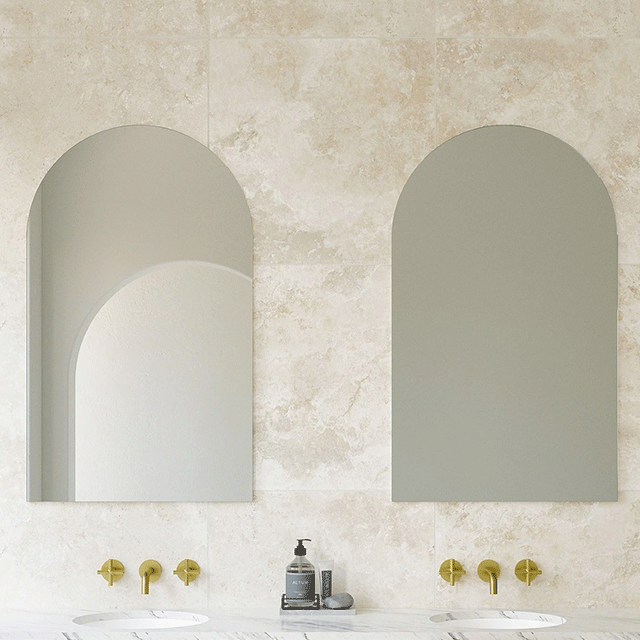
An arch mirror is a rectangle with a curved top, and the curve is the reason to choose it. It softens a bathroom built from straight lines, it draws the eye upward, and it suits a single vanity or two matching mirrors over a double. The practical call: choose an arch no wider than the vanity, hang it so the centre sits at eye level, and add light to the glass only if the room needs it. The sections below cover what the shape does, width, height, hanging, lit and unlit versions, frames, floor standing options and care, with the source for each figure named in the text.
Most bathrooms are made of right angles: tiles, vanity edges, shower screens, door frames. A mirror retailer's comparison of arch and rectangle mirrors says a rectangle reinforces those lines and reads as structured, while an arch adds a curve and carries a softer visual weight. It adds that the curved top draws the eye upward, so an arch can make a room feel taller, and it recommends an arch for rooms with 2.4m ceilings, where a rectangle can feel boxed in against the ceiling.
The same comparison is honest about the trade-offs. A rectangle is the standard choice above a vanity because it lines up with the vanity top and the wall edges. An arch needs enough wall height above the vanity, and if it sits too close to the ceiling the curve gets lost. A rectangle also has slightly more reflective area at the same overall height, because the curved top of an arch mostly reflects the ceiling. So the call depends on the room: an arch for a bathroom with room to spare above the vanity and straight lines to soften, a rectangle where the wall is short or you want every centimetre of glass in front of your face.
The wording people search with varies, from arched mirror and arch bathroom mirror to curved bathroom mirror and arch vanity mirror, and all of them mean the same product. The collection covers arch mirrors in plain glass, framed in aluminium or timber, frameless, and lit.
Width follows the vanity. An Australian mirror retailer's FAQ gives the simplest rule: choose the largest width that is no wider than the vanity. A Houzz Australia guide is a little tighter. When the mirror is not the same width as the vanity, it says to make it 70 to 80 per cent as wide, so it looks smaller than the vanity without looking shrunken. Both rules agree on the direction: do not overhang the vanity.
The arches in this collection are narrow and tall, which suits the shape. Widths run from about 430mm to 750mm for the standard arches, with heights from 800mm to about 1030mm. The Timberline Church mirror comes in 430mm by 830mm and 630mm by 1030mm. The Marquis Arco is 550mm by 800mm. The Thermogroup Church polished edge mirror comes in 500mm by 800mm and 750mm by 1000mm, and the Ingrain timber framed arch is 600mm by 1000mm. The Timberline Melody is a half-moon at 1200mm by 800mm, and the Radiant Ark runs from 1000mm to 1800mm.
A narrow arch over a wide vanity looks small, and a double vanity asks for a different layout. The Thermogroup listing for its gold arch mirror says the narrow shape suits two mirrors over a double bowl vanity. That is the usual answer: two matched arches, one over each basin, centred on the basin and not on the vanity as a whole. For a single vanity of 600mm to 900mm, one arch a little narrower than the vanity keeps the proportions in balance.
Hang the mirror so its centre meets your eyes. Heights guides differ a little, and the range is worth knowing. One Australian guide puts the centre at about 150 to 160cm from the floor and suggests leaving 15 to 25cm between furniture and the bottom of the mirror. An Australian mirror retailer's guide says to leave 100 to 200mm between the tap or splashback and the base of the mirror, and never less than 100mm. A Houzz guide on bathroom heights puts average eye level at 1600 to 1750mm and notes that households vary, so measure the people who will use it.
With an arch the top matters as well. The curve needs clear wall above it, so check that the top edge still sits well below the ceiling after you fix the centre at eye level. If a tall person and a short person share the bathroom, choose an arch tall enough to cover both rather than hanging it higher. The tall arches here, at 1000mm and above, give more room to adjust than the 800mm versions.
Most arch mirrors are portrait only, with the arch at the top, and the listings here say so. The exceptions are shaped differently. The Marquis Palmer is a semicircular frameless mirror designed for horizontal installation over a vanity, and the Timberline Melody is a half-moon at 1200mm by 800mm. If you want a mirror that sits wide and low over a long vanity, those are the shapes to look at.
The arch is one of several soft shapes, and the others do different jobs. The Houzz guide notes that round mirrors suit pedestal basins and bathrooms with many hard surfaces, and that they leave more empty wall at the corners than a rectangle does. An arch keeps a flat bottom edge that sits parallel to the vanity and curves only at the top. A pill shape has two curved ends, and an oval is curved all round. The alternatives are on round mirrors, oval mirrors and pill shape mirrors.
A double vanity gives you two choices: one wide mirror or two. A height and placement guide from an Australian mirror retailer says to leave at least 100mm between two mirrors over a double vanity. Two arches suit the shape, because each is narrow enough to centre over its basin, and the gap between them becomes part of the design. Measure the centre of each basin, centre each mirror on that line, and check the gap against the 100mm minimum. The Thermogroup Juno listing says its narrow arch is made for this layout, and the Thermogroup Ablaze backlit arch is listed as the right size for either a single vanity or two mirrors over a double. If the lit arches go in pairs, plan the supply for both before the wall is closed.
The arch's curve is the first thing to disappear if the mirror is hung too high. The same height guide says the top edge should sit at least 100mm below the ceiling or cornice, with 100 to 150mm as a comfortable guide. It gives standard ceiling height as about 2400mm and high ceilings as about 2700mm. Start from the eye-level centre, add half the mirror's height to find the top edge, and compare it with the ceiling. A 1000mm arch centred at 1600mm tops out at 2100mm, which leaves a clear 300mm under a 2400mm ceiling. A taller arch, such as the 1030mm Timberline Church, needs the same check. If the numbers do not work, lower the mirror a little or choose a shorter arch.
Fixing is the part most buyers skip. A hanging guide for arch mirrors gives the basics. Fixings are not usually supplied, so buy ones rated for the wall and the weight. Solid walls take heavy-duty wall plugs and high-load screws, plasterboard takes heavy-duty cavity anchors or toggle bolts, and stud walls are best fixed into the studs where possible. A stud finder will also detect pipes and cables behind the wall. To find the load each fixing must carry, divide the mirror's weight by the number of fixing points, then fit anchors rated well above that figure.
Because an arch's hanging point sits lower on the back than a rectangle's, the top of the mirror stands slightly away from the wall, according to the comparison above. Allow for that when you align it. For any mirror over 100cm tall, the hanging guide recommends two people to lift it. The listings here describe screws and hangers, split battens or built-in brackets, depending on the model. The Timberline listings call the split batten an easy mounting system, and the Thermogroup Juno listing says its frame sits the mirror 20mm out from the wall and mounts with two brackets.
A lit arch mirror puts light and a demister into the glass. LED Mirror World's comparison of frontlit and backlit mirrors explains the difference. A frontlit mirror sends light toward the face and is usually stronger at reducing shadows on the cheeks, jaw, eyes and neck. A backlit mirror places the LEDs behind the glass, so the light reflects off the wall first and reads as an ambient glow. The guide suggests frontlit for shaving, skincare and windowless vanities, and backlit for atmosphere and guest bathrooms.
The collection holds both. The Ingrain frontlit arch mirrors, 500mm by 900mm in brushed nickel, matt black or brushed gold, and in a frameless version, are listed for makeup and shaving, with a touch sensor, stepless dimming and a built-in demister, at 6500K. The Ingrain frameless backlit arch is 500mm by 900mm with backlit LED for ambient light. The Thermogroup Ablaze backlit arch is 500mm by 800mm with a choice of warm or cool white light and an integrated demister that comes on with the light. The Radiant Ark is a frameless LED mirror with touch sensors, four brightness levels, three colour settings and a defogger.
Power is the main constraint. The Ingrain lit listings say they require hardwired installation by a licensed electrician, and the Thermogroup Ablaze arch is listed as hardwired only, with a separate switch needed. The Radiant Ark is hardwired with the wiring concealed behind the mirror. A bathroom lighting guide calls bathroom lighting licensed work in Australia, and says an electrician confirms the wet-zone boundaries on site. The lit listings carry an IP44 rating, which that guide treats as the common bathroom benchmark. Decide the light before the wall is closed, so the supply can be placed behind the mirror. For the whole lit group, see Ingrain LED mirrors or LED mirrors.
The listings give more construction detail than most shoppers read. The Thermogroup Juno arch has a safety backing film and copper-free glass, and its frame wraps 7mm around the front of the mirror. The Thermogroup Church polished edge mirror is 5mm thick with a commercial-strength vinyl backing and comes with metal hangers, with a glue-to-wall option available on request. The Marquis Palmer has a polished edge that the listing says catches the light. The Timberline listings give a copper-free mirror, and the Church frame is finished in a two-pack polyurethane described as durable and easy to clean. Depths in the listings run from 18mm on the slim Timberline frame to 25mm on the Marquis mirrors and 31mm to 38mm on the Ingrain arches.
Not every arch needs light. If the room has good side lighting, plain glass keeps the choice simple. The unlit arches here are framed in aluminium, timber or paint, or are frameless with a polished edge. The Ingrain framed arch comes in brushed nickel, matt black and brushed gold, and the Ingrain timber framed arch has an ash timber finish with a soft rounded frame profile, listed as suiting Ingrain vanities. Timberline's church frame can be painted in a standard painted finish, and Thermogroup's Juno arch has a slim frame in gold, black or white.
The Houzz guide pairs frameless mirrors with modern, minimalist spaces and says a simple frame only a few centimetres wide suits nearly any room. Frames add a line and a colour that can echo the tapware, and a frameless polished edge reads as glass only. See framed mirrors and frameless mirrors to compare, and Ingrain timber framed mirrors for the timber option. The glass in the Ingrain and Timberline listings is copper-free, which the listings give as the reason it resists corrosion in a damp room.
Some searches ask for an arched floor mirror or an arched full length mirror. The Ingrain full length arch mirror is 600mm by 1500mm and its listing says it can be wall hung or used as a floor standing mirror, in brushed nickel, brushed gold or matt black. It comes with screw fixing for the wall and brackets for floor standing. A full length arch suits a hallway, a bedroom or a dressing area more than a bathroom vanity wall, and it is a different job from the vanity arches above. The full range is on full length mirrors.
If you are comparing it with a rectangle for the same space, the same trade-off applies as above: the arch softens the room and draws the eye up, and the rectangle gives slightly more reflective area at the same height.
Arch mirrors come in brushed nickel, matt black, brushed gold, gold, black, white, painted finishes and ash timber in this collection. The Houzz guide suggests choosing the frame to suit the style of the room, ornate for traditional, simple and slim for almost any room. A frame finish that matches the tapware ties the vanity wall together, so choose the mirror and the tapware on the same day. For brushed nickel see brushed nickel tapware, for black black taps, for brass brushed brass taps, and for chrome chrome taps.
A stockist's care sheet for an LED demister mirror says to clean with a soft microfibre or lint-free cloth rinsed in warm water and wrung out well, then to wipe gently with a soft dry cloth. It advises against glass cleaner, window cleaner and chemical agents, because they can damage the silver coating and leave brown marks. Wipe the surface rather than spraying it so liquid does not run into the edges, and keep cleaner away from the touch sensor on lit mirrors.
A short route through the decisions:
The final check is the same for every arch: width against the vanity, height against the eye line, the top edge against the ceiling and the fixings against the wall. For the other shapes see round mirrors, pill shape mirrors and wall mirrors, or return to mirrors.


