*View accurate shipping rates and availability






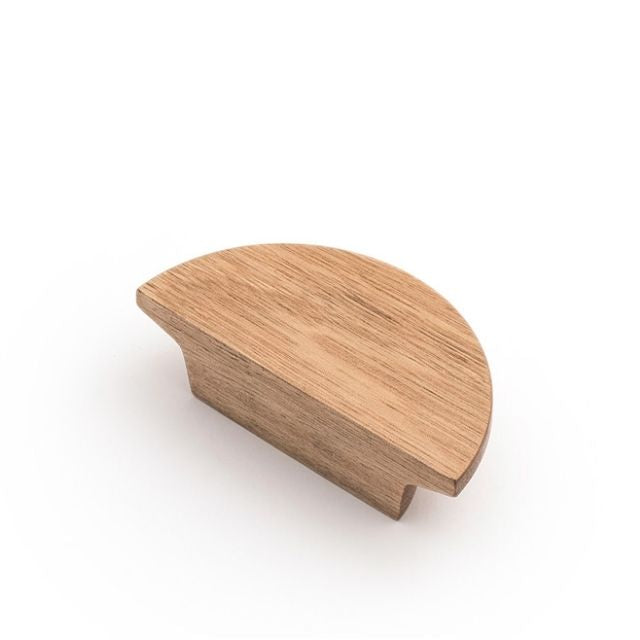
The Tullah is a timber lip pull from Castella, in a semi-circle shape and a round shape, each in 90mm and 140mm sizes. The TBS listings say it is made from reclaimed Tasmanian oak (Hydrowood) in a natural wood finish, mounted from the rear with screws included. Below you will find what a lip pull is, what Tasmanian oak and Hydrowood are, what each size measures and how the 24mm fixing distance works. The page also covers how to size, fit and look after a timber pull. For the whole brand, start at Castella cabinet handles. For timber handles from other ranges, see timber cabinet handles.
Touch Handles, an Australian handle seller, describes a lip pull as a U-shaped handle fixed to the top or side of a door, with one side shorter than the other so that a small lip forms for the fingers to hook under. It is also sold as a finger pull or an edge pull, and a retailer's guide treats the three names as one family that sits flush against the cabinet edge. Yorkshire Ironmongery, a UK hardware supplier, separates these from recessed finger pulls, which are channels cut into the panel and normally routed during manufacture. The Tullah is the surface-mounted kind. It screws on, so it can go onto existing joinery or a new run. For the whole family, see lip pull handles.
A retailer's cabinet handle guide says lip pulls suit handleless and near-handleless designs, such as fluted, Shaker and contemporary profiles. The Tullah's half-circle shape is a variation on the same idea, with a rounded profile that sits against the edge of the door.
The TBS listings give a specification for the Tullah. The material is wood in a natural wood finish. The overall length is 90mm or 140mm, the overall width is 43mm or 68mm, and the projection is 25mm. The fixing distance is 24mm, the gap between the two screw holes, measured from centre to centre. Two 22mm M4 screws are included, and the pull is rear-mounted.
The listing text calls the sizes 90mm and 140mm diameter options in both round and semi-circle shapes. The listed widths of 43mm and 68mm are about half of the lengths, which fits a semi-circle, so the semi-circle is the shape those widths describe. The listings give no separate width for the round pull, so check the product page for the shape you order.
The fixing distance is short, only 24mm, and that matters for replacement. A handle with a long fixing distance will not use the same holes, so a Tullah on an old door means new holes. The TBS placement and sizing guide notes that a handle will not fit holes on a different centre without new holes, and that applies in full here.
Wikipedia says Tasmanian oak is the trade name for three eucalypts: Eucalyptus regnans, messmate (E. obliqua) and E. delegatensis. Early settlers gave the name because they likened the wood's strength to that of English oak, and the article is clear that the name does not mean a close botanical relationship. The timber is a very pale blonde. The article lists furniture, flooring, panelling, veneer and window frames among its uses, and notes that the wood tends to collapse on drying, so it needs steam reconditioning for high-value work.
Business Queensland describes the three species as almost identical. The heartwood is pale brown to white-brown and often pink-tinted, the grain is moderately open to coarse but even and straight, and the density is 675 to 770 kg/m3 at 12 per cent moisture. It calls the timber firm to moderately hard, and says it accepts stain, polish and paint. For a handle, that means a pale, even grain that a finish can darken or leave natural. The Tullah is listed in a natural wood finish, so expect a light timber tone.
The listing names Hydrowood. Hydrowood is a supplier of reclaimed Tasmanian timber, and its site says every log is responsibly recovered from beneath Tasmania's hydro lakes and then milled. It lists species such as myrtle, blackwood, Huon pine and what it calls Hydrowood Oak, and it says its chain of custody is certified by PEFC and Responsible Wood. The site promotes the timber for distinctive grain and colour and for traceable provenance. The Hydrowood page uses the name Hydrowood Oak and not Tasmanian oak, while the TBS listing says Tasmanian oak (Hydrowood), so rely on the listing wording for this product.
The sourcing statement belongs to the listing and to Hydrowood. Nothing in the listing sets out the process on the Castella side, so this page makes no further claim on it.
The semi-circle is the classic lip pull shape: a flat edge against the door and a rounded outline that the fingers curve under. The round pull is a full circle, so it sits on the face of the door and the fingers meet the rim from below. The two shapes read differently on a door. The page for round-shaped handles collects the full circles, and the half-moon page collects the half circles. See round shaped cabinet handles and half-moon cabinet handles.
A practical way to choose is to hold both against the door. A guide says plainly that a lip pull is less comfortable on a heavy drawer or a large door that is opened often, because it gives a smaller hold than a bar. The 140mm size gives more to hold than the 90mm, and it suits a wider front.
A common rule says a pull should be about a third as long as the drawer front is wide. For a drawer 600mm across that gives about 200mm, so the 140mm Tullah is the nearer size, and the 90mm suits a narrower drawer or a small door. ITFitz, a furniture supplier, says drawers up to about 400mm take a knob, a short pull or a compact T-bar. That points the 90mm Tullah at small drawers and the 140mm at fronts of 450mm to 700mm. The rule is a guide and not a strict rule.
A pull or knob sits 40mm to 60mm in from the edge that opens, near the bottom corner of an upper door and the top corner of a lower door. A lip pull goes on an edge, so on a drawer it sits on the top edge of the front, and on a wall cabinet on the bottom or side edge. To test a size before you buy, tape a card cut to the pull's shape onto the cabinet and live with it for a day.
The Tullah fixes from the back, with the two M4 screws included. The listing says the pull is rear-mounted and that screws are included. A hardware supplier gives a screw rule that depends on the panel: 22mm for panels 16mm to 18mm thick, and 38mm for panels 32mm to 34mm thick. The supplied 22mm screws fit the first case, and a thicker front needs longer screws. The screw must bite into the handle and stop short of the door face.
Mark the positions with masking tape or a card template before you drill.
Entry Point, a handle retailer, describes timber handles as warm, tactile and quiet against painted joinery, and says they soften a kitchen in a way metal cannot. A light oak pull stands out most on a dark door and blends in on a white one. The same retailer pairs timber with matt black, polished chrome or satin brass in other ranges, and the rule for a room is one dominant finish with at most two metals.
Choose the pull after the benchtop and cabinet finish are settled. Timber ages and darkens with light, so hold the sample against the actual door and benchtop in the room's own light.
Wardrobes, bathroom vanities and kitchen drawers suit the lip pull shape. Wood and Co, a cabinet maintenance writer, advises ventilating steam and keeping humidity steady to look after timber. A retailer's guide says bathrooms are more humid than kitchens. A timber pull in a well-ventilated vanity is a fair use, and one near an unventilated shower is the case to avoid. The cabinets these handles fit are at bathroom vanities and furniture.
Wood and Co advises dusting with a microfibre cloth, and using mild dish soap and warm water for high-touch areas. Keep bleach, ammonia, steel wool and scouring pads away. Spray the cloth and not the cabinet, wipe spills at once, and do not hang wet towels on doors. The same source says to limit strong sunlight and to use the maker's product for the finish. The Tullah listing does not name a finish product, so ask the supplier before you apply oil or wax, and test on an unseen spot first.
Hardware guides place lip pulls along the top edge of base units and along the side or bottom edge of wall units, so the hand reaches the lip from the direction it already approaches. They suit wardrobes, bathroom vanities and small drawers as a discreet alternative to a knob. The face of the door stays clear, and nothing stands off the surface to catch a sleeve. The Tullah projects 25mm, so it stands slightly proud of the edge, and the semi-circle shape rounds that off.
The weak point is grip. A lip pull gives a smaller hold than a bar, and a guide notes it can be less comfortable on a heavy drawer or a large door that is opened often. For a pan drawer or a pantry door, a bar from cabinet pull handles gives a firmer hold, and an appliance panel wants an appliance pull made for the job.
Both give a handle-free face, but they work differently. Push-to-open uses a mechanism inside the cabinet and has no hold to grip, while a lip pull is a real handle that you grip and pull. A hardware guide says a handleless kitchen with correctly sized pulls works as well every day as one with conventional handles, which is why the size of the pull matters more here than it would on a bar.
Wikipedia notes that Tasmanian oak tends to collapse on drying and needs steam reconditioning for high-value uses. That is a reason the grade of timber behind a handle matters, though the Tullah listings say nothing about how the timber was dried or finished, so this page makes no claim about it. Business Queensland lists furniture, linings, joinery and turnery among the uses of the same three eucalypts, and a small turned or cut handle is a modest use of the same timber. The timber's pale colour is what the listing's natural wood finish will show.
Wood changes with its surroundings. Wood and Co advises keeping humidity steady and limiting strong sunlight to look after timber furniture. A pull in a bathroom with an extraction fan, or on a wardrobe away from a sunny window, sits in a steadier environment than one in direct light or in steam. This is general timber care and not a statement about the Tullah finish, which the listing does not describe.
Entry Point recommends timber handles for Japandi, coastal and Scandinavian interiors. A retailer's cabinet handle guide pairs Japandi and Scandi kitchens with timber and brushed nickel, and contemporary and minimalist kitchens with matte black or brushed nickel pulls and lip pulls. Hamptons and coastal kitchens go with D-pulls or cup pulls in brushed nickel, brushed brass or chrome, and Shaker kitchens with cup pulls, bin pulls or knobs in brushed brass, antique bronze or matte black. A timber lip pull is a different choice from all of those, and it sits closest to the Japandi, Scandinavian and coastal group.
Because timber is a material and not a metal finish, it also sits outside the two-metals rule for a room. A retailer's guide advises one dominant finish for the handles through a kitchen and at most two metals. A timber pull can sit beside metal tapware without counting as a third metal, though the colour of the timber should still suit the other finishes in the room.
The same guide matches each handle type to a job. Bar pulls and D-pulls fix at two points, run from 96mm to well over 500mm, and suit drawers, overhead cabinets, pantry doors and appliance panels. Cup or bin pulls suit Shaker, farmhouse and mid-century kitchens, and cabinet knobs fix at one point and work better on doors than on drawers. Recessed edge and finger pulls are common in European-style handleless kitchens and suit sliding doors. Appliance pulls are typically 600mm and above for fridge panels and full-height pantry doors. A lip pull is the right call when the door is flat, fluted or Shaker and you want a clean face. See cabinet knobs for the one-fixing alternative.
The TBS listings carry the figures, so read them closely. Check the size, since the pull comes in 90mm and 140mm. Check the shape too, since the range has a semi-circle and a round, and check the screw line, since two 22mm M4 screws are included. If a figure is missing, such as a width for the round pull, ask before you order and do not assume it. This page states only what a source stated.
A sample answers most of the remaining doubt. Hold the pull against the door, check where the fingers land, and check that the 25mm projection clears the neighbouring door when both open. A retailer's guide also suggests taping a strip cut to the handle's length onto the cabinet for a day to judge scale.
When you replace a handle, match what is already on the door. A retailer's guide stresses that centre-to-centre spacing, and not overall length, is the number to order by. The Tullah's 24mm centre is unusual among handles, so a swap from a conventional bar or knob almost always means filling the old holes and drilling new ones. A filled hole shows unless the door is repainted, so decide the position carefully before you drill.
The guides name a few. Ordering by overall length when the fixing distance is what counts comes first, and on a pull with a 24mm centre the distinction is large. Buying without seeing the timber in the room's own light comes second, since colours shift on screen and grain varies by piece. Fitting undersized pulls on wide drawers comes third, and choosing hardware before the cabinet finish and benchtop are settled comes last. A pull is touched every day, and these choices decide whether it stays pleasant to use.
For the full brand, see Castella cabinet handles. For other types and materials, see cabinet handles, timber cabinet handles and lip pull handles.