
*View accurate shipping rates and availability






9 Items


Up to 70% off across the store, plus free towels and mirrors up for grabs on orders over $800*


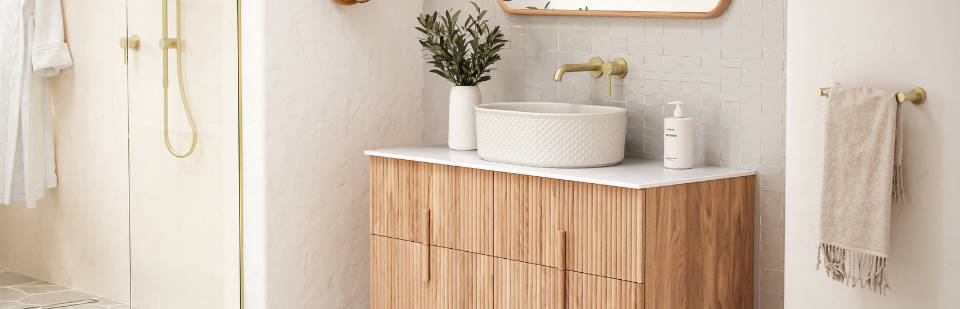
A brushed gold mirror gives a bathroom a warm metal line without the glare of polished brass. Every Ingrain mirror here has a slim brushed gold aluminium frame around 5mm copper-free glass, and the range runs from round and pill to arch, rectangle and a full length arch, with three lit versions. The practical call is to start with the tapware, because the finish is the hardest part to match, then choose the shape and size for the wall. The sections below cover the finish, matching, the nine mirrors, size, height, fixing and care, with the source for each rule named in the text.
Brushed gold is a satin metal finish with a soft, warm glow, rather than a mirror shine. A retailer's copy describes brushed gold as warm and the frames as durable and resistant to corrosion and tarnish in humid bathrooms. The names are not fixed. One retailer's finish pages use brushed gold, brushed brass, brass gold, aged brass, antique brass and vintage brass for related tones, so a gold mirror and a gold tap from different ranges may not match exactly.
That makes the first rule a practical one: put a sample, or the tap itself, beside the frame before you order. The listings call this range brushed gold and say the frame is aluminium. Under strong natural light, small differences in undertone show, so check the match in the room's own light.
A UK bathroom retailer's guide says brushed brass and gold match brass taps and accessories and contrast with black fittings. It says black cuts through pale tiles and matches black brassware, and that chrome suits traditional and modern bathrooms alike. It also says to match the mirror finish to taps and accessories for a cohesive look, or contrast on purpose. For the matching route see brushed brass taps, and for a contrast with black see black taps.
A design guide on mixed metals gives the numbers. In a small en suite use one or two finishes, and in a larger room no more than three. Choose a dominant finish first, and with three finishes use a 60-30-10 split between dominant, secondary and accent. Avoid very similar shades, because close-but-not-identical metals can look accidental, and keep items in a group in the same finish, such as all taps in one finish and handles and hooks in another. A gold mirror over a gold tap is the dominant pairing, and a black towel rail is a clear accent.
The Ingrain Round Brushed Gold Framed Mirror comes in 600mm and 800mm diameters, 38mm deep. The Ingrain Arch Shaped Brushed Gold Framed Mirror is 500mm by 900mm and the Ingrain Pill Shaped Brushed Gold Framed Mirror is 460mm by 910mm, both 38mm deep and portrait only. The Ingrain Rectangle Brushed Gold Framed Mirror is 750mm by 900mm, 38mm deep, and hangs portrait or horizontal. The Brushed Gold Arch Shaped Full Length Mirror is 1500mm by 600mm.
Three lit versions sit alongside them. The Ingrain Arch Shaped Brushed Gold Framed Frontlit LED Mirror is 500mm by 900mm, 35mm deep, at 60W. The Ingrain Round Brushed Gold Framed Frontlit LED Mirror comes in 600mm and 800mm at 34W or 45W. The Ingrain Rectangle Brushed Gold Framed Backlit LED Mirror is 600mm by 800mm, 43mm deep, at 66W. All nine list screws and hangers for mounting, and a specification sheet and an installation and owner guide for download.
The mixed-metals guide says to choose light fixtures that complement the chosen brassware and hardware, and that textured hardware, such as knurling, fluting or hammering, can be used alongside or instead of mixed metals. A gold mirror frame is a smooth, brushed surface, so a fluted tap handle or a hammered soap dish adds texture without adding a second metal. Keep the wall light, the towel rail and the hooks to the same finish group so the mirror does not stand alone.
The frame does a job as well as a look. A retailer's guide says a frame adds a protective layer to the glass edges, which is why it suggests a framed mirror for a home with children or pets. The listings give 5mm copper-free glass for corrosion resistance. An architecture publication's humidity guide says moisture gets into a mirror through the edges and through tiny scratches in the protective paint on the back, and that copper-free or edge-sealed glass slows the oxidation that causes black spots. The Ingrain guide adds that keeping the edges dry matters, because moisture left on them can cause damage known as black edge.
A round mirror is the same in every direction and suits a small wall or a pair over a double vanity. Houzz says round mirrors suit pedestal basins and bathrooms with many hard surfaces. The arch and pill add height, and the Ingrain pill is a rounded capsule at 460mm by 910mm, narrower than most. The rectangle is the plain choice over a straight vanity, and at 750mm by 900mm it can hang either way. For the shapes see round mirrors, arched mirrors, pill shape mirrors and rectangular mirrors.
For the framed choice across all finishes, see framed mirrors. For the rest of the range, see Ingrain mirrors.
An Australian style guide describes each shape. Round is a soft circle that contrasts with straight lines in a modern bathroom, with large rounds working as focal points and smaller ones working in pairs above a double vanity. The pill is an elongated oval that works horizontally or vertically above a vanity, with a curve that contrasts with angular fixtures and tiles. The arch softens hard lines and adds height and depth, and the rectangle is the classic, versatile choice for modern and traditional bathrooms alike.
The same guide says full length mirrors suit bathrooms with more space, or a room where a larger, more open feel is wanted. In a gold finish, the frame is the feature, so pick the shape that leaves the frame visible: a round or pill shows the whole outline, while a large rectangle shows mostly its sides.
The Brushed Gold Arch Shaped Full Length Mirror is 1500mm by 600mm, 38mm deep, portrait only. The listing says it can be wall hung or used as a floor standing mirror, with brackets for the floor version, and suggests propping it against a wall at the end of a hallway. It is the one mirror here that is not for a vanity. For the full length group see full length mirrors.
The lit mirrors add touch sensor operation with stepless dimming and a built-in demister. The listings say they need hardwired installation by a licensed electrician, and give 6500K light, IP44 and 220 to 240V. The Ingrain guide says the demister heats fully in 3 to 5 minutes and turns off automatically after 60 minutes. A short press on the touch sensor turns the light on, a press and hold gives stepless dimming, and a long press while the sensor is blue turns off the button light. For the whole lit group see Ingrain LED mirrors.
Houzz gives the clearest width rule: when the mirror is not the same width as the vanity, make it 70 to 80 per cent as wide, and 60 to 70 per cent when sconces share the wall. On a 600mm vanity that is a mirror about 420mm to 480mm wide. On a 900mm vanity it is about 630mm to 720mm, and on a 1200mm vanity about 840mm to 960mm.
Turn the rule around for the Ingrain widths. A 460mm pill suits a vanity about 575mm to 655mm wide, and a 500mm arch suits one about 625mm to 715mm. A 600mm round suits one about 750mm to 855mm, an 800mm round suits one about 1000mm to 1145mm, and a 900mm wide rectangle suits one about 1125mm to 1285mm. Mark the outline on the wall with masking tape and look at it from the doorway before you decide.
Hang the mirror so its centre meets your eyes. An Australian height guide puts the centre at 1500mm to 1650mm from the floor, with 100mm to 200mm between the tap and the base of the mirror and the top edge at least 100mm below the ceiling. Houzz says a mirror needs to reach about 30cm above and below the eye line of its users.
Work it through. A 910mm tall pill centred at 1600mm covers 1145mm to 2055mm, which clears a tap and leaves 345mm under a 2400mm ceiling. A 750mm tall rectangle hung horizontally and centred at the same height covers 1225mm to 1975mm. An 800mm round covers 1200mm to 2000mm. The height guide notes that average eye level runs from 1600mm to 1750mm, so measure the people who use the basin.
The Australian height guide gives a worked example: on an 850mm vanity with a 175mm basin mixer, the base of the mirror falls between 1125mm and 1225mm from the floor, and with a taller 305mm mixer between 1255mm and 1355mm. A 910mm pill with its base at 1125mm reaches 2035mm, and with its base at 1355mm it reaches 2265mm. Both clear a 2400mm ceiling by more than the 100mm the guide requires. A 900mm arch reaches 2025mm to 2255mm. A taller mixer lifts the base, so check the top edge as well.
A humidity guide says a mirror 600mm to 900mm tall suits most single vanities, and suggests keeping 150mm to 200mm clear above a mirror from cabinets or exhaust fans. A 500mm arch or a 600mm round fits a compact vanity without crowding the corners, and Houzz says several tall, skinny mirrors can emphasise the height of a space. In a small room, the mixed-metals guide says to use one or two finishes, so a gold mirror and gold tap, with perhaps one other accent, is enough.
A glass fabricator's guide says wood and MDF frames can swell, warp or peel in poorly ventilated bathrooms, especially near showers, and that metal, sealed or composite frames hold up far better. The Ingrain frames are aluminium. The same guide says good ventilation protects either kind of mirror, including running the exhaust fan after a shower, and that a mirror glued tight to a damp splashback deteriorates faster than one with a small gap behind it. A screw-fixed mirror on hangers keeps that gap.
The listings say which way each mirror hangs. The arch, pill and full length mirrors are portrait only. The rectangle at 750mm by 900mm can hang portrait or horizontal. The round mirrors have no direction. Among the lit mirrors, the brushed gold rectangle hangs portrait or horizontal. Check the orientation line before you buy, because the fixing points change with the direction.
The three lit mirrors in this collection differ by how they light. The frontlit round and arch send light toward the face, and a guide from a mirror seller says a frontlit mirror brightens the cheeks, jaw, eyes and neck and helps reduce shadows. The backlit rectangle lights the wall behind the glass, and another guide says that gives a halo glow and suits modern and minimalist rooms. The guides add that no LED mirror replaces the ceiling light, and that mirror light does not reach showers or baths. For the type decision see Ingrain frontlit mirrors with demister and Ingrain backlit mirrors with demister.
The listings carry the same fields in the same order. Start with the overall width and height, then the depth, which on this collection is 38mm on the framed mirrors, 35mm on the frontlit arch and 43mm on the backlit rectangle. Next read the orientation line, then the wall mounting line, which says screws and hangers. For lit mirrors read the wattage, the colour temperature line, the IP rating and the installation line. Finally download the specification sheet and the installation and owner guide, and read both before you choose the fixings.
A double vanity gives you the choice between one wide mirror and two. Homes and Gardens says to hang a mirror over each sink on a double vanity for balance, and Houzz says several tall, skinny mirrors give a vertical look. The Australian height guide asks for at least 100mm between two mirrors. The 460mm pill and 500mm arch are narrow enough to pair, and two identical gold frames over two gold taps make a strong, symmetrical line.
The listings give screws and hangers. The Ingrain guide says to mark two screw positions on the wall aligned with the mirror's mounting plate holes, using a tape and a spirit level. Then drill, insert wall plugs and screw in the screws provided, leaving 4 to 5mm exposed to hang the mirror. The guide notes that the plugs provided suit stone or brick walls but not wooden walls, and that the wall should be of suitable strength and construction. Where possible, screw into studs or other suitable anchors, and use suitable anchors in hollow walls.
A hanging guide adds that studs are the most secure fixing, cavity anchors suit plasterboard without a stud, and a mirror over 100cm should be lifted by two people, which covers the 1500mm full length arch.
The Ingrain guide lists a few more rules for the three lit mirrors. They are for indoor use only, at an ambient temperature of 25 degrees. They must be earthed, must have a means of disconnection from the supply in the fixed wiring, and must be installed and tested by a qualified electrician. Any timer or switch has to sit in the right zone for its IP rating. The guide also says not to stare at the operating light source for long periods. The plain mirrors need none of this, and they hang on screws and hangers like any other framed mirror.
The Ingrain guide gives the routine: clean, warm water and a soft lint-free cloth, wrung out before wiping, then dry the mirror at once with a dry lint-free cloth. Avoid acid or alkali-based cleaners, never use abrasive cleaners, and do not use commercial mirror cleaners that contain ammonia or vinegar. Do not spray cleaner directly onto the mirror: apply it to the cloth, which keeps it off the edges. Wipe the frame the same way, and check the fixings once a year, as the humidity guide advises.
The final check is the same for every mirror: finish against the tapware, width against the vanity, height against the eye line and fixings against the weight. For the general guide see mirrors, and for the wall browse wall mirrors.


