
*View accurate shipping rates and availability






184 Items


Up to 70% off across the store, plus free towels and mirrors up for grabs on orders over $800*


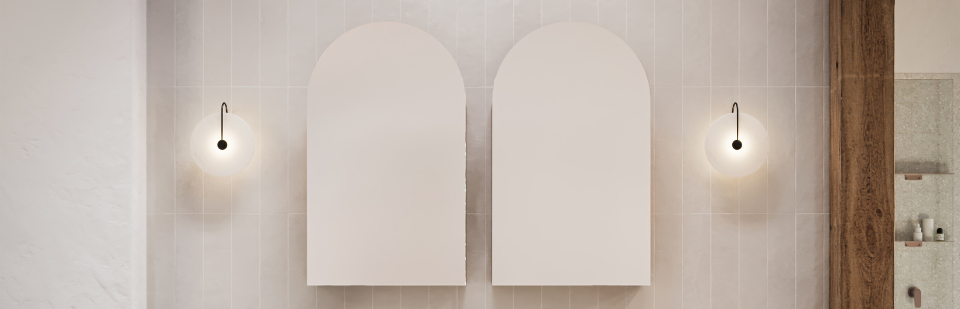
Good lighting is planned in layers, chosen for the room, and fitted to the supply behind it. This page is the starting point for lighting in our range: wall lights and vanity bars, pendants, ceiling lights and oysters, bathroom and outdoor fittings, and the globes that go in them. The guide below covers how to plan a room with more than one light, how ceiling height narrows the choice and how to read a globe. It also covers what the LED and its driver decide, how dimming works, and where each type of fitting is covered in more detail.
Australian retailers and manufacturers agree on the basic idea. A room needs more than one source of light, and each source does a different job. One retailer's kitchen guide names four layers. Ambient light is the base, and it comes from recessed downlights, ceiling fixtures or track lighting. Task light is focused over high-use areas such as islands, benches and sinks, and placing it directly over the work surface reduces shadows. Accent light picks out architectural features or open shelving. Decorative light, from pendants, wall sconces or chandeliers, adds style and a focal point.
A manufacturer's design guide gives a similar split in three layers and says designers rarely rely on a single ceiling light. They use several sources at different heights, which gives depth and balance. A single ceiling light, the guide adds, is the first of the common lighting mistakes, ahead of undersized fittings, ignoring dimmers and forgetting about mood.
The right plan depends on how the room is used. A design guide gives a short summary room by room.
A living room should feel warm, flexible and inviting, and the guide suggests a ceiling light or pendant for ambient light, floor or table lamps for softer evening light, and wall lights or spotlights for artwork and shelves, with warm white bulbs and dimmers. A kitchen needs bright overhead light, task light over benches and cooktops, and decorative pendants over the island or table. A bedroom suits soft, layered light from bedside lamps, wall-mounted reading lights and warm ambient light, and another retailer notes that a single floor lamp can light a bedroom adequately without any overhead light if you choose one suited to the job. A bathroom needs ceiling light for brightness, wall lights beside the mirror for even light on the face, and accents in niches or under the vanity.
For open-plan spaces, a retailer's layering guide suggests starting with the features of the room: the dining table, the shelving, the entertainment unit, the wall for artwork and the reading chair. Lighting those creates pockets of light, so the space feels purposeful instead of evenly bright. It calls wall lights the most versatile option for layering in large spaces, with uplighters, lamps and angled surface downlights or track lights as supporting layers.
Each type of fitting has its own page, where the choices are covered in more detail.
An Australian lighting retailer says to measure the ceiling before choosing anything hanging. Most homes built since the 1990s sit at 2.4 metres, older homes and many newer builds at 2.7 metres, and entries and voids go to 3 metres and up. At 2.4 metres, hanging fittings are a problem, and the retailer suggests slim oysters, flush mounts, surface or recessed downlights and spot bars. At 2.7 metres you can add semi-flush fittings and short-drop pendants over a table or island, but not over a walkway. From 3 metres, long-drop pendants and chandeliers start to make sense, and the room needs more lumens because the light has further to travel.
The retailer's kitchen figures give one more piece of the picture. For island pendants, it gives 600 to 750mm between them, at least 200mm from the bench edge and 750 to 900mm above the benchtop, so the fitting sits out of your direct line of sight.
A fitting that takes a globe leaves the brightness, colour and shape to you. The same retailer's globe guide breaks the choice into five steps. First, identify the base. Edison screw bases, written as E, are common in modern pendants. Bayonet bases, written as B, push in and twist to lock. Pin bases, including GU10, push into the socket and are common in spotlights and downlights. The retailer says B22 is the Australian bayonet standard, and the listings here use E27, E14, B22, G9 and GU10 bases.
Second, choose the technology, and the guide recommends LED for its efficiency, durability and lifespan. Third, choose brightness by lumens. Watts measure the power a lamp uses, and lumens measure the light it gives out, so modern LEDs can give more light than older incandescent or halogen globes for much less power. A manufacturer guide gives a reference point: about 800 lumens matches an old 60W bulb, which an LED produces from roughly 8 to 10W.
Fourth, choose the colour temperature. The retailer puts super warm light at 2200K to 2700K as intimate and suited to bedrooms, warm white at 2700K to 3000K as cosy and suited to living areas, and cool white at 4000K and above as clean and focused, for offices, laundries and garages. The manufacturer guide places neutral 4000K in kitchens and bathrooms. Fifth, match the shape to the fitting: G95 or ST64 for exposed globes where the filament shows, A60 for globes hidden behind a shade, and GU10 reflectors for directional light aimed at one spot.
Some fittings have the LED built in, and others take a globe. A manufacturer guide says integrated LED allows slimmer designs and better light distribution. The same guide gives a typical LED life of 25,000 to 50,000 hours, and says LEDs use up to 75 to 85 percent less electricity than incandescent or halogen light, which are the guide's own figures and not a promise for any one fitting.
Behind every LED sits a driver. Its driver guide explains that Australian mains power is 240V, but most LED chips need a steady low voltage supply, typically 12V or 24V, and the driver provides it. Fittings that take a 240V LED bulb already include a driver, and so do fixtures with an integrated driver, so both can be wired straight to the mains. Low voltage 12V or 24V fittings, such as many outdoor and garden lights, and fixtures with a remote driver installed separately, need a driver, and the specification may say driver required, meaning the fitting is sold bare. The same guide says to run a driver at 20 to 80 percent of its rated wattage, and to use a driver with a higher IP rating outdoors and in bathrooms.
The fittings in this range run on 240V mains where the listing gives a voltage, and the specification names the globe type or says the LED is integrated.
Dimming controls the current or voltage reaching a light, which lowers its output. The retailer's dimming guide lists the benefits as adjustable brightness for tasks or mood, longer globe life and modest energy savings. It lists the pitfalls too: technical complexity, the need for a qualified electrician, and older dimmers that may not suit LEDs well.
Phase dimming is the common home system. Leading-edge dimmers are the older method, with a range of about 40 percent, and suit halogen and incandescent globes. Trailing-edge dimmers are newer, dim up to 100 percent and work with most dimmable LED globes. Mains voltage LEDs can be phase dimmed without a separate driver, and low voltage LEDs always need a driver. Commercial and larger systems use 1-10V, 0-10V and DALI, which need compatible drivers and a control cable. The guide says rotary dimmers are the most popular in Australia, that the dimmer rating should comfortably exceed the total wattage on the circuit, and that you should match the fitting, light source and dimming technology before ordering. Not every fitting is dimmable, so read the dimmable line on each listing.
The IP rating tells you where a fitting can safely go. The first digit covers solid objects and the second covers water. The listings here fall into three groups. IP20 fittings are for dry rooms such as bedrooms, living rooms and hallways. IP44 fittings are the common rating for bathrooms, and guides recommend IP44 or higher in a humid room. IP65 fittings are for outdoor walls and ceilings where rain can reach the light. Zones and exposure rules differ by place, and the sources disagree on some figures, so use the detail on the bathroom and outdoor pages and ask a licensed electrician to confirm the rating for your position.
The same few errors turn up across the guides. Choosing by watts instead of lumens is the first. Ignoring colour temperature, or mixing colour temperatures in one space, is the second, because the difference shows on the walls. Using a non-dimmable globe on a dimmer switch is the third, and it can cause flicker or reduced performance. A manufacturer guide adds relying on one ceiling light, choosing fittings that are too small for the room, leaving out dimmers, and setting every room to maximum brightness. Another retailer adds a planning error: leaving the lighting until after the fitout, when some features are hard to add.
A kitchen design magazine adds a point about switching. Put different sources on separate switches, so the pendants, the downlights and the wall lights can be used on their own. That gives the layers a practical use, because you can run only the one you need.
An LED guide adds a detail that hardly appears on a listing: LEDs are directional, so less light is wasted, and the beam angle sets where it lands. Narrow beams suit focused lighting such as spotlights and artwork, and wide beams suit general room lighting. A fitting with a shade does that job differently, because the shade spreads the light. Textured or ribbed glass softens and diffuses light, and the shade or diffuser decides how the same globe feels in two different fittings.
Transition spaces ask for a different approach. A retailer notes that a hallway run of two or three matching fittings looks more considered than a single oyster, and another suggests spacing wall lights about 2 to 2.5 metres apart along a hallway. A manufacturer guide places statement pendants in an entry or over a stair void, where the height allows. In a stairwell, a retailer says the fittings follow the rise of the stairs, and an electrician should check height and spacing against the pitch.
Style guides from manufacturers offer a few clear pointers. For a Hamptons look, choose white, clear or soft neutral fittings, with glass shades that spread the light and keep the room airy, and large pendants over islands, dining tables and stair voids. For an organic look, choose curved and rounded shapes, natural stone and timber, woven and ribbed materials and earthy neutrals, and start with one or two pieces instead of redesigning the room. For a sculptural fitting, the guide says scale, materials and craftsmanship make it a statement piece, where a plain downlight is meant to disappear. A retailer's guide notes the common influences: coastal, industrial, mid-century and eclectic styles each have their own guide.
An outdoor lighting guide recommends layers outdoors as well. Light the entrances, paths, steps and places where visibility matters first. Add garden lighting next, then pick out architectural features with wall and in-ground lights, and finish with warm light of about 3000K for atmosphere. Guides tie the IP rating to exposure, and one points out that an IP rating does not measure salt resistance, so coastal homes should look at the material as well. The outdoor pages cover the figures in full.
A hardwired light in Australia needs a licensed electrician. Another retailer says anything tied into fixed 240V wiring is licensed electrical work, including swapping one oyster for another, and the exceptions are a batten fix shade over an existing holder, plug-in fittings and changing globes. A dimming guide advises consulting a certified electrician before buying, and the Telbix specifications carry an electrical protection line that reads by licensed electrician only. Another retailer advises planning before the fitout, because some features are hard to add later, and says to tell the builder early so the cabinetry, power points and plumbing allow for them.
One retailer advises dusting and cleaning fittings regularly to keep them bright, and checking bulbs and fittings for wear, especially on outdoor fixtures exposed to the weather. Another retailer notes that mood matters as much as brightness: bright, cool light tends to support alertness, and warm, soft light a calmer atmosphere.
Natural light is part of the plan too. A kitchen design magazine notes that skylights, clerestory windows and glass splashbacks bring in daylight and reduce how much artificial light a room needs during the day, so the fittings can be chosen for evening use.
The range comes from three makers, and each has its own collection. Telbix lighting is the largest. The company page says Telbix was founded in 1990 in Ascot Vale, Victoria, with its head office in Broadmeadows, and that it is a wholesaler of domestic lighting in contemporary and modern styles. Eglo lighting comes from a company that directories describe as founded in Austria in 1969 with its roots in Tyrol, and with an Australian subsidiary. Cafe lighting supplies multi-light pendants, and its listings describe handmade frosted glass shades.
Finishes run through black, gold, brass, white, chrome, stainless steel and copper in this range, with opal, amber, clear and smoked glass. Compare them at black lighting, gold and brass lighting, white lighting, chrome lighting and stainless steel lighting, and for glass at opal glass lights, amber glass lighting and smoked glass lights. A US guide suggests that lights need not match exactly, and that repeating one finish across two or three fittings in a space gives a thread of continuity.
List the rooms, then the layers each one needs. Check the ceiling height before you choose anything that hangs. Choose each fitting from its type page, and read the specification for the IP rating, the globe line, the dimmable line and the electrical protection line. Choose a colour temperature for each room and keep it the same within the room. Settle the wiring and any dimmer with a licensed electrician before you buy.


