
*View accurate shipping rates and availability






13 Items


Up to 70% off across the store, plus free towels and mirrors up for grabs on orders over $800*


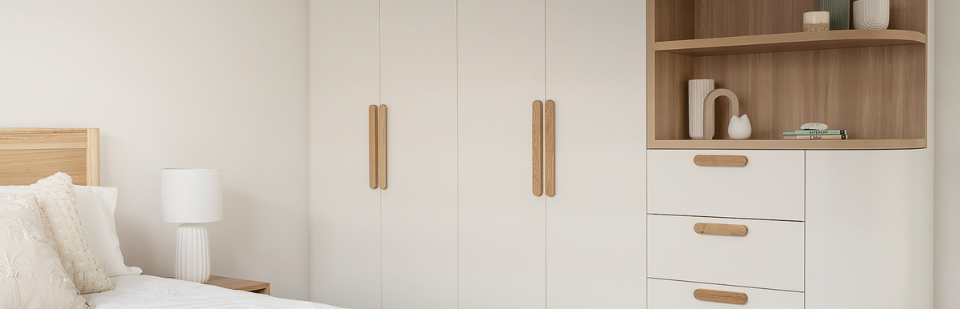


The Arpa is an aluminium range from Momo Handles with a D handle, a 70mm T knob and a 22mm round knob, plus versions with a backplate. Its symmetrical, straight-lined look is reminiscent of the Art Deco movement of the 1920s, with fine vertical lines. It comes in Brushed Dark Brass, Brushed Nickel, Brushed Black and Antique Brass. Below you will find what Art Deco means in a handle, what each piece measures, and what aluminium and an electroplated finish do. The page also explains what a backplate is for and how to size, fit and clean the range. For the whole brand, start at Momo cabinet handles.
The Arpa D handle comes on three hole centres: 192mm, 320mm and 1178mm. The overall lengths pair with them in order, at 214mm, 342mm and 1200mm, and the projection is 35mm. The hole centre, also called the fixing distance, is the gap between the two screw holes, measured from centre to centre. The 192mm antique brass handle is 8mm wide, and the range comes in four sizes up to 1200mm.
The shortest size is on a 192mm hole centre, 214mm overall, and this page uses 192mm. If your holes are on 160mm centres, confirm the size before you order, since this page cannot confirm a 160mm size.
The D handle with a backplate is 230mm overall, 25mm wide and projects 37mm. When you replace a handle, measure the distance between the screw holes and match it to the fixing distance, not to the length of the old handle.
The T knob is 70mm long and projects 35mm. The T knob with a backplate is 50mm overall and 25mm wide, with a 37mm projection. The round knob is 22mm across and projects 31mm. The 70mm T knob and the round knob in antique brass have a section of 9mm, so measure a sample if the gap between doors is tight.
Screws are not included. Screw length depends on the panel: 22mm for panels 16mm to 18mm thick, and 38mm for panels 32mm to 34mm thick. The screw must bite into the handle and stop short of the door face. Order screws to suit your panel with the handle.
The backplate versions pair the handle or knob with a flat plate that sits against the door, and optional backplates are also available. The plate is longer than the handle it carries, 230mm against 214mm for the 192mm D handle, so it needs more room on the door. Lay the plate against the door before you drill. The plate sets are 230mm overall for the D handle and 50mm overall for the T knob.
Aluminium has a density of 2.70 g/cm3, about a third that of steel, and a thin oxide layer protects the metal from further corrosion by oxygen, water or dilute acid. Corrosion resistance drops with aqueous salts and dissolved chlorides. Aluminium is the lightest option, significantly lighter than brass and zamac, which suits long slim profiles.
Coastal use needs a straight answer. Aluminium's oxide layer protects it from moisture, but pitting can still start in splash zones and in windy, humid air near the water, where brass or 316 stainless steel is the safer call. Indoors, in a coastal house, an aluminium handle is a normal choice, while in a splash zone or outdoors by the sea the stronger materials are the safer call. See aluminium cabinet handles for the material in full.
The Arpa finish is electroplated. This page makes no claim about its thickness or what lies under it. The closest related process is anodizing, which thickens the natural oxide layer. Anodic films are harder than bare aluminium but have low to moderate wear resistance, and they can crack but will not peel. Painted handles can wear off, while electroplated finishes cannot be removed or scratched. Those are statements about the finishes in general and not about the Arpa, so treat the finish as a surface to wipe and not to scrub.
Both Brushed Nickel and Dull Brushed Nickel are used for the nickel finish, so read the finish name on the exact product page. Brushed finishes hide fingerprints better than polished ones, and the rule for mixing is to keep a room to two metals and repeat each at least twice so it reads as a decision.
A common rule says a pull should be about a third as long as the drawer front is wide. For a drawer 600mm across that gives about 200mm, which is close to the 214mm Arpa D handle on a 192mm centre. Drawers 450mm to 600mm wide take 128mm to 160mm centres, so a 192mm centre is a long pull for that band, and wider drawers take 256mm to 320mm. The 320mm centre therefore suits a wide drawer of 600mm to 900mm. A tall pantry door of 600mm and above takes two 256mm pulls, or a long vertical pull, and the 1178mm handle is for a full-height run such as a pantry or wardrobe door or a long drawer front.
A pull or knob sits 40mm to 60mm in from the edge that opens, near the bottom corner of an upper door and the top corner of a lower door. Pulls run horizontally on drawers and vertically on doors. To test a size before you buy, tape a strip cut to the handle's length onto the cabinet and live with it for a day.
Knobs take the fingers and a single screw and suit small doors and drawers, while pulls take the whole hand. A pull is gripped with three or four fingers, which makes it the better choice for heavy drawers and for children and older people. Most cabinet knobs run roughly 25mm to 38mm across, so the 22mm round knob is smaller than that common range and the 70mm T knob is longer than a round one. The 22mm knob is a light accent for a small door, and the T knob gives a longer grip. See cabinet knobs and D shaped cabinet handles.
The Arpa D handle is a straight bar, so it sits easily in the contemporary and coastal groups in Brushed Nickel, and in the heritage group in Antique Brass. The Brushed Black suits the contemporary note, and the Brushed Dark Brass sits between the Shaker and heritage notes. A period shape on a plain flat door shows off the vertical lines, while a busy door competes with them.
The 1178mm D handle is a long bar that runs the height of a tall door. Tall pantry doors suit long vertical pulls, which improve grip and weight balance. Appliance pulls are typically 600mm and above for fridge panels, full-height pantry doors and oven cabinetry, and the Arpa's longest size sits in that territory. For the doors of a wardrobe or a pantry, one long bar replaces the two shorter pulls the sizing table would suggest. Mount it vertically, 40mm to 60mm in from the edge that opens.
Measure the door before you order a size this long. The overall length is 1200mm on a 1178mm centre, so the screws sit only 11mm from each end of the bar, which leaves little margin if the door is slightly short. Check the door height against the overall length, and confirm the screw positions against the door's edge and not the bar's centre.
When you swap handles, match the fixing distance. A new D handle with the same distance drops into the old holes without drilling. Measure from the centre of one screw hole to the centre of the other. A 128mm handle will not fit 160mm holes without new holes, so an Arpa on 192mm centres will not use holes cut for another size. If the old holes are on another centre, you will need to fill them or drill new ones, and a filled hole shows unless the door is repainted. A backplate can cover marks, but do not rely on it to hide a large hole.
Gold, brass and bronze tones pair with navy, charcoal, blue or green cabinetry and matt black works against light cabinetry as a contrast. In a bathroom, fittings need wiping and drying more often than those elsewhere, because steam and moisture leave marks. The cabinets these handles fit are at bathroom vanities and furniture. Choose the handle finish after the tapware and appliance finishes are settled.
Aluminium needs only simple cleaning. For coated finishes, use a soft microfibre cloth with mild soap and warm water if needed, dried promptly, and keep abrasive pads, powdered cleansers, ammonia, bleach and alcohol-based disinfectants away. Put the cleaner on the cloth and not on the hardware, and dry the handle straight away so water marks do not form. A coating wears first where the hand lands, so wipe the grip area more often than the rest of the handle.
For the full brand, see Momo cabinet handles. For other types and materials, see cabinet handles, aluminium cabinet handles and cabinet knobs.


