
*View accurate shipping rates and availability






2 Items
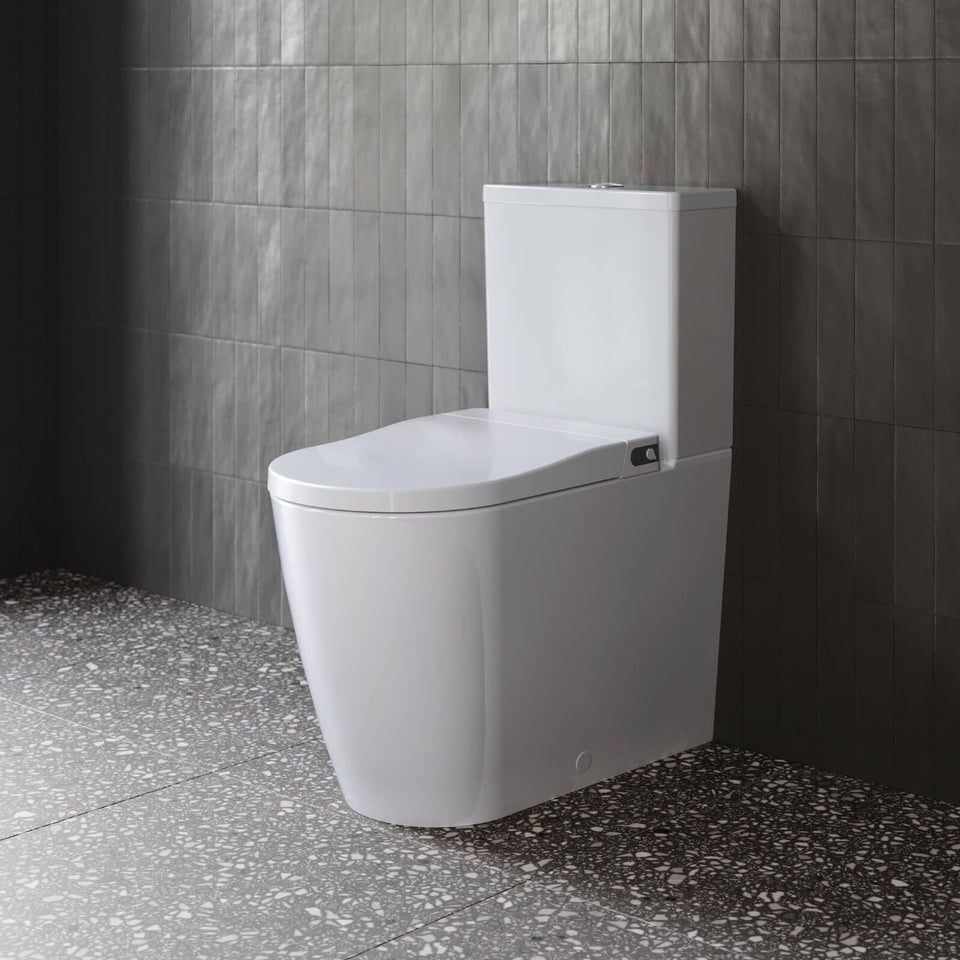

This page lists two Caroma Urbane II wall faced bidet suites. Both have an electronic bidet seat with an auto open and close lid and a remote control, and a pan with an LED glow for night use. They differ in the cistern. One is close coupled, with a ceramic cistern that sits on the pan. The other pairs the pan with an Invisi Series II cistern built into the wall. Both are rated 4 star under WELS at 4.5 and 3 litres per flush, which is a 3.5 litre average. For the wider Caroma range, see Caroma smart toilets and bidet seats, and for other makers see smart toilets and bidets.
The close coupled suite is 838mm high overall and 383mm wide, with a pan height of 440mm and a projection of 700mm. It uses a universal trap with a set out of 225mm and takes a back or a bottom inlet. The box lists the pan, a bottom inlet cistern with rectangular dual flush buttons in chrome, the electronic bidet seat and the remote. Batteries for the remote are not included. The close coupled toilets page explains the style.
The Invisi Series II suite has a pan height of 440mm, a projection of 570mm and a width of 370mm. It uses a universal S or P trap, with an S trap set out of 60 to 135mm and a P trap set out of 185mm. The box lists the pan, the Invisi Series II 4.5 and 3 litre cistern, the electronic bidet seat and the remote, again without batteries. The listing says the cistern suits in-wall, in-duct, under-counter or in-ceiling installations, so it needs an in-wall setup. Read in wall concealed toilets before you choose it.
The two suites suit different rooms. The close coupled suite has a cistern on the pan, so it needs no cavity for a cistern, has a wider S trap set out range of 60mm to 245mm, and is 700mm deep from the wall according to the listing. The in-wall suite has the cistern inside the wall, so the pan projects only 570mm, but it needs a cavity at least 90mm deep and between 400mm and 420mm wide, a plate and buttons bought separately, and an access plan. If the wall cannot take a cavity, or the existing waste is far from the wall, the close coupled suite is the practical choice. If floor space is tight and the wall can take a cavity, the in-wall suite saves 130mm of projection.
Both suites on this page carry the Urbane II electronic bidet seat, model 300071W, and its user manual, dated December 2024, gives the figures. The seat has rear wash, female wash and massage, with water temperature, flow rate and spray position each adjustable in five steps. The wash flow rate is 350 to 650 millilitres per minute, the water temperature is 31 to 39 degrees Celsius, and a wash cycle lasts three minutes from an 800 millilitre tank with a 1200 watt heater. The air dryer runs from 35 to 50 degrees at a speed of at least 4 metres per second, and the dryer cycle is three minutes. The heated seat has five steps from 29 to 37 degrees. The seat also has a deodoriser, a night light, a display screen, a descaling function and automatic cover opening, and it runs on 220 to 240 volts at a rated 1200 watts.
The manual lists a water supply pressure of 70 to 750 kilopascals, a supply temperature of 4 to 35 degrees, an ambient temperature of 4 to 40 degrees, and an IPX4 protection degree. It gives the backflow prevention as an air gap of AB type, lists residual current devices among the other safety devices, and says the remote takes two CR2032 batteries that are not supplied. It gives the power cord length as 1.8 metres, while the separate installation guide for the pan and seat describes a 1.5 metre plug-in cord with an IP65 rated connector, so ask Caroma which length is in the box before the outlet position is fixed.
The troubleshooting table in the 300071W user manual lists causes in the order to check them. If the seat does not wash, the power may be off, the water supply may be closed, or the filter may be blocked, with a service life of about six months. The seat will not operate if it cannot detect a user, so the user must be seated with the cover open. If the seat has not been used for more than 72 hours, a self-cleaning function runs for about three minutes when someone sits down, and the buttons are inactive until it finishes. If the nozzle goes back suddenly, the manual says the cycle is three minutes at constant temperature and one minute at gradual cooling, that this is normal, and that pressing wash restarts it. It also says not to put the cover down while the seat is washing.
For a low flow rate the manual lists the flow setting, a supply pressure below the dynamic pressure it needs, a blocked filter and a blocked nozzle. For low water temperature it lists the temperature setting, a cold supply and the thermostat, which can be reset. The nozzle cleans itself before it extends, so a slow nozzle is normal, and the manual says to replace the remote batteries, two CR2032 cells that are not provided, when the lights flash continuously. These are the checks to run before you call a plumber or the maker, and they help you describe the fault accurately when you do.
The Invisi Series II suite sits on an Invisi II concealed cistern, and Caroma's instructional booklet for the 4.5 and 3 litre cistern sets out the requirements. An in-wall cavity must be at least 90mm deep for a front mount button panel and at least 100mm deep for a top mount panel, between 400mm and 420mm wide, for example between studs, with a half inch BSP water connection. For an under counter installation the booklet adds an 850mm minimum height to the underside of the counter. The pack includes the cistern, mounting brackets, an adjustable flush pipe, 0.5 metres of pneumatic tube and a fixing pack. Buttons and the access plate are not part of the cistern pack.
The booklet describes six ways to reach the cistern. In-wall access allows the cistern internals to be reached through the button panel window, with no change to the standard configuration. Induct access allows access to the whole cistern and needs the optional remote mounting box kit if a remote button panel is used. In-ceiling access allows access to the whole cistern or the internals through the panel window depending on the installation. Under counter access reaches the internals through the button panel window and needs an optional under counter flush pipe. There is also a custom panel access option, and in masonry and stud walls the in-wall access differs. The seat in this suite is electric, so the power and water are part of the same wall as the cistern, and you should plan the access with both in mind.
The booklet describes a blue flush pipe tiling box installed on the horizontal flush pipe at the factory. The tiler tiles right up to the box, and after the tiles are set the screw inside the box is removed and the box discarded. At the time of pan installation, the plumber measures the pan inlet hole and checks it lines up with the flush pipe. If it does not, the horizontal section can be raised by up to 15mm or lowered by up to 10mm with a flat screwdriver, taking care not to damage the pipe. The suite spec sheet describes the adjustable flush pipe as raising by up to 25mm, so the documents differ, and the installation booklet in the box is the one to follow.
The booklet's servicing section says servicing is only required where outlet valve operation is faulty. If the outlet valve leaks, inspect the seal for damage and replace it if necessary. If the cistern short flushes, check that the pneumatic tubes are pushed into the bridge and the buttons. For anything else, consult a plumber or Caroma After Sales Service. The booklet also covers servicing the inlet valve, removing internal components through the access window, and converting the cistern from the 4.5 and 3 litre setting to 6 and 3 litres. These are plumber's tasks, and they depend on the plate being removable, which is why the plate you choose matters.
The spec sheet for the Invisi II bidet suite is a revision 0 document dated May 2023 that carries a draft mark. It describes an Easy Height wall faced back inlet rimless pan with a fully glazed 50mm back inlet and a universal S or P trap. The set out is 60 to 135mm with a recommended 90mm and up to 50mm of sideways adjustment with the Uni-Orbital connector. It says the Invisi Series II round dual flush plate and buttons are supplied separately in five finishes, chrome, black, brushed brass, brushed nickel and gunmetal grey. It shows a 30mm hole for the power cord at a stated height of 275mm and a half inch BSP nipple, and says the pan is fixed with the supplied D82 concealed fixing bracket. Because the sheet is marked as a draft, confirm the figures against the current installation instructions.
The Caroma instructions for the close coupled bidet pan give different waste figures from the in-wall suite. The Urbane II bidet Cleanflush pan is universal for S and P traps. The recommended S trap set out is 140mm from the finished wall, with flexibility for existing soil pipes from 60mm to 245mm. There is 50mm of sideways adjustment with the supplied Uni-Orbital connector, which is a fixed length of 295mm. The pan height is 440mm, the pan is fixed with D82 concealed fixing brackets, and a flexible hose of three eighths of an inch runs to the bidet seat. For a back entry cistern the instructions place the half inch BSP nipple so it projects 22mm from the finished wall. The power and water locations are measured from the pan centre line, with the 32mm conduit at 275mm high and a wall plate within 1 metre of the general purpose outlet.
Caroma's installation instructions for the bidet pan and cistern carry a boxed warning: to achieve a satisfactory 4.5 and 3 litre flush performance and a 4 star water efficiency rating, the cistern must be matched with a compatible Caroma Smartflush pan. A 2018 Plumbing Connection article on Cleanflush makes the same point for plumbers, quoting that you must use matched pan and cistern sets to ensure flows are balanced and meet the Standards requirements. That is why the suites on this page are sold as sets, and why a pan from one range should not be swapped onto a cistern from another without the listing saying it suits.
The Invisi Series II suite is sold without buttons. The Caroma Invisi II datasheet, revision 2 of July 2018, lists plates and buttons that are suitable for cistern access and custom buttons that need separate access, and says the buttons are pneumatic and can be activated up to 4 metres from the cistern. The standard button plate suits a wall lining of 6mm to 45mm, and for top push buttons on a counter the counter thickness is 45mm at most. The suite also has an electric seat that needs access, so the plate you choose is the way in for the plumber, and you should decide it with the plumber and electrician together. The buttons are on Caroma concealed toilet buttons.
The NSW Government advisory note on switches and sockets in wet areas, note 2/2021 updated August 2025 and citing AS/NZS 3000:2018, says that in Zone 2 a socket may be only a shaver outlet or an RCD-protected outlet in a cupboard. In Zone 3 a socket under 0.3 metres is not permitted, and one at 0.3 metres or more needs RCD protection, a separated supply or a SELV or PELV supply. The installation guide for the Urbane II seat places a wall plate for the power cable close to the general purpose outlet. It must be within 1 metre of the pan centre line, so the outlet and the zones have to be settled before the wall is lined. A licensed electrician decides where the outlet can go.
A Western Australian technical note on bidet douche seats and toilets, version 3 of May 2026, says most seats fall under the high hazard backflow rules of the Plumbing Code of Australia 2025. A product whose WaterMark entry names an integral air gap or an atmospheric vacuum breaker has acceptable integral protection, it says. Caroma's seat documents describe an integral air gap and dual check valves. The Blue Leaf Bath bidet guide says a connection to the household water supply requires a licensed plumber and that WaterMark certification does not mean a product can simply be connected to an existing outlet. So ask the plumber to check the model on the WaterMark database, and keep a copy of the result with the manuals.
The seat is mains powered. The maker's product page says its surge protector must be reset after a power outage, which you do by lifting the seat assembly, and that the toilet still flushes without power. The remote takes two CR2032 batteries. The suite lists dual check valves with an integrated air gap, designed for AS2845.2 backflow prevention. The listings give no electrical supply figure, so ask the supplier for the installation guide and have the power point and the water connection planned before the wall is closed.
Both suites use the Urbane II Easy Height pan, with a pan height of 440mm for the close coupled suite and the in-wall suite, plus the thickness of the seat. The Design for Dignity accessible toilets guide, published with the Australian Network on Disability, gives a top of seat to floor height of 460mm to 480mm for an accessible toilet. Caroma's own product page for the electronic seat marks it as not compliant with AS 1428.1 accessible or ambulant, so the combination is a comfort-height choice and should not be assumed to meet an accessible fit-out. An access consultant or certifier can confirm the room if that is the aim.
For a seat that fits a toilet you already own, see bidet toilet seats. The main toilets guide covers set out, inlet and projection.


