
*View accurate shipping rates and availability






47 Items


Up to 70% off across the store, plus free towels and mirrors up for grabs on orders over $800*






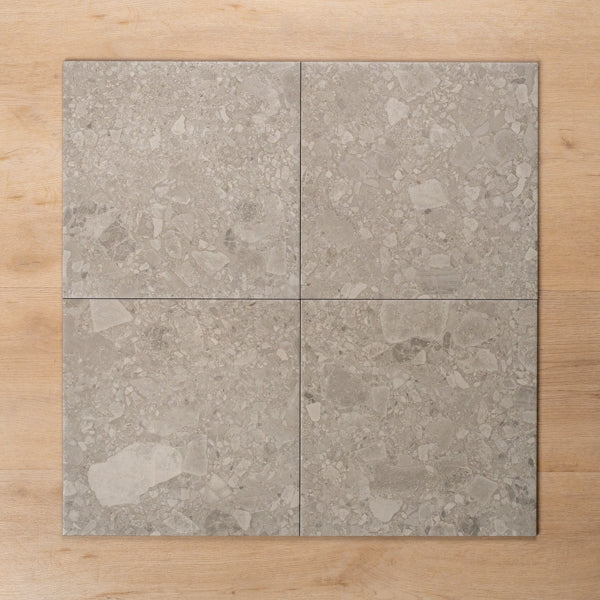



This collection holds the tiles in the store that carry the Australian Made tag. There are five ranges: Tamarama, an encaustic pattern in 300 x 300mm, Southside, a terrazzo look, Avalon, a stone look with a soft vein, Kings Marble, a Carrara marble look, and Perisher, a white marble look in 600 x 1200mm. All are porcelain apart from Kings Marble, which is ceramic.
The sections below explain what Made in Australia means as a claim, how a porcelain tile is made, what each range prints on its listing, and how slip, wear and edge lines decide where a tile can go. For tiles by size, see the 450mm x 450mm tiles collection and the 300mm x 300mm tiles collection. For the whole range, see the tiles collection.
The legal test for a country of origin claim changed in February 2017. Before that, a product labelled Made in Australia had to meet two tests: at least 50 percent of the cost of production incurred in Australia, and substantial transformation in Australia. The 50 percent test was removed, and substantial transformation is now the sole criterion.
The revised definition reads: goods are substantially transformed in a country if one or more processes undertaken there leave the goods fundamentally different in identity, nature or essential character from all of their imported ingredients or components. In plain terms, the tile has to be changed in Australia into something fundamentally different from the imported parts it was made from. Whether a given tile meets that test is a question for its maker.
Australian made describes where the tile was made, and it does not mean every input was dug up locally. Raw materials are often sourced both locally and internationally, while the design, production and packing happen in Australia.
The collection is built from a store tag, Australian Made. The Tamarama tiles are Australian made with a matte finish. The Southside tiles are made right here in Australia. The Avalon, Kings Marble and Perisher tiles carry the tag, and the store can confirm their origin.
That difference is worth knowing if you are quoting origin for a project or a tender. Ask the store to confirm origin for each range before you quote it.
Porcelain is made in a set order. Water and raw materials, typically feldspar, clay, silica sand and other additives, are mixed to a sand-like consistency, then run through a spray dryer to remove excess moisture. The mixture is pressed into tile bodies, called greenware, and dried again before glazing.
The dried tile is printed with an inkjet printer, which applies the pattern and colour, then glazed with a protective layer that sets a gloss or matte finish. The tiles are fired in kilns at temperatures from 1260 to 1345 degrees Celsius for extended periods, which removes any remaining moisture and adds strength. Porcelain is denser and more refined than ceramic.
Recipes vary slightly, which results in variations in colour, texture or other characteristics of the tiles. That is one reason batches differ, and why we advise ordering the full quantity at once. The steps are the same wherever the factory is. What changes with an Australian made tile is the place where the pressing, printing and firing happen. For more on the material, see the porcelain tiles collection and the ceramic tiles collection.
Local makers often make tiles for the order in hand, so check current waiting times before you order, and order samples first.
Stock can change. If a project has a fixed date, ask the store about availability before ordering, and place one order for the full quantity, because a later order may come from a different batch.
Each range prints its own details. These show the spread.
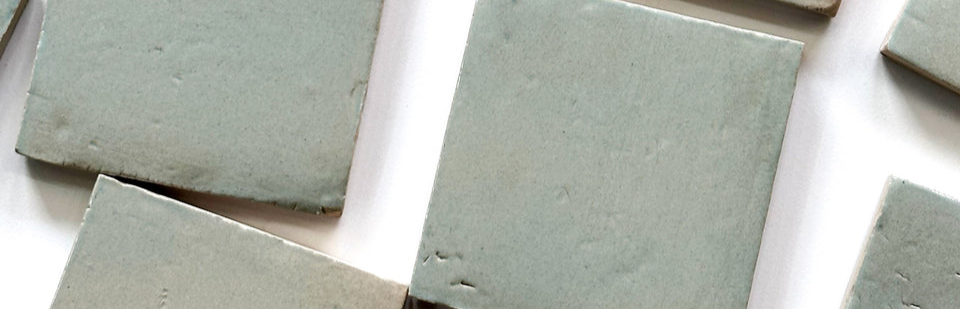
Tamarama is a modern take on a classic encaustic pattern. It comes in five colours, and the colours in the collection include soft sage, blue, black and soft clay. The tiles are 300 x 300 x 6.3mm glazed porcelain with a matte finish, a cushioned edge, a Wear Rating of 4 and an Appearance of V1, a uniform appearance with minimal to no texture or colour variation. For other patterns, see the patterned tiles collection.
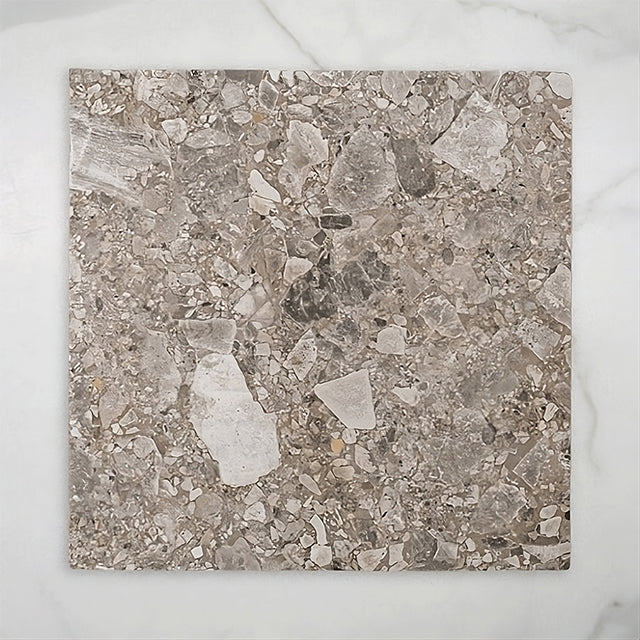
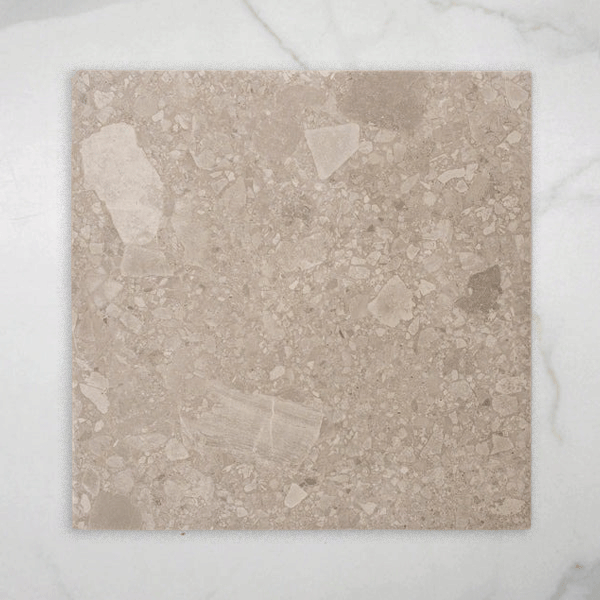
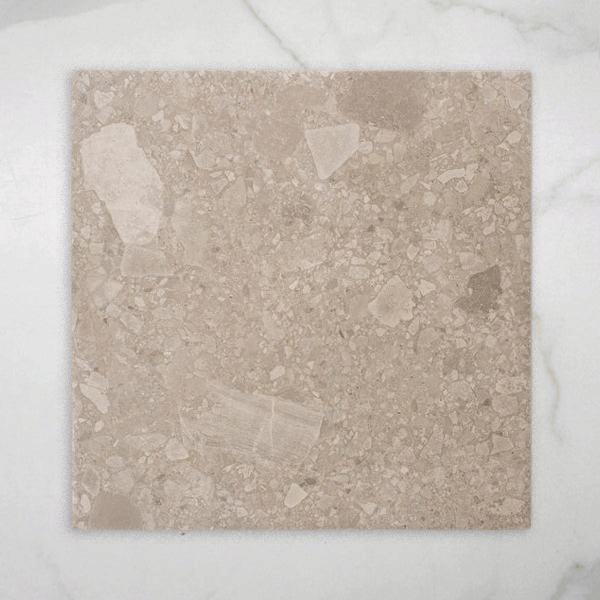
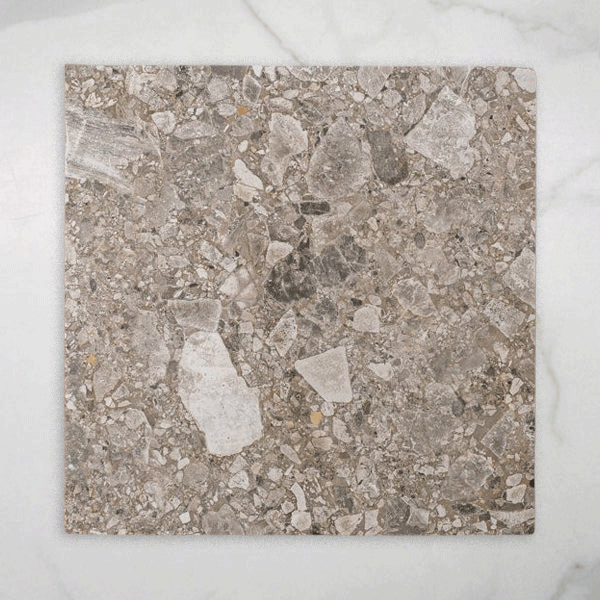
Southside is a terrazzo look porcelain, inspired by Venetian terrazzo and listed as made in Australia. It comes in white, natural and grey, in a matt version and an external version. For the wider terrazzo look, see the terrazzo look tiles collection.
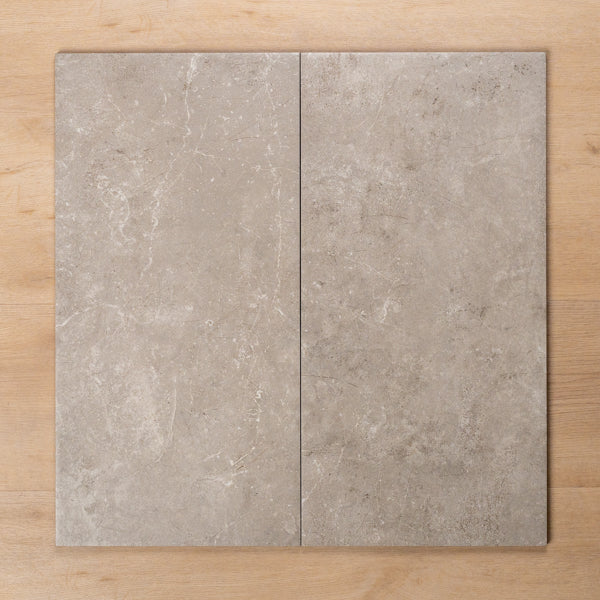
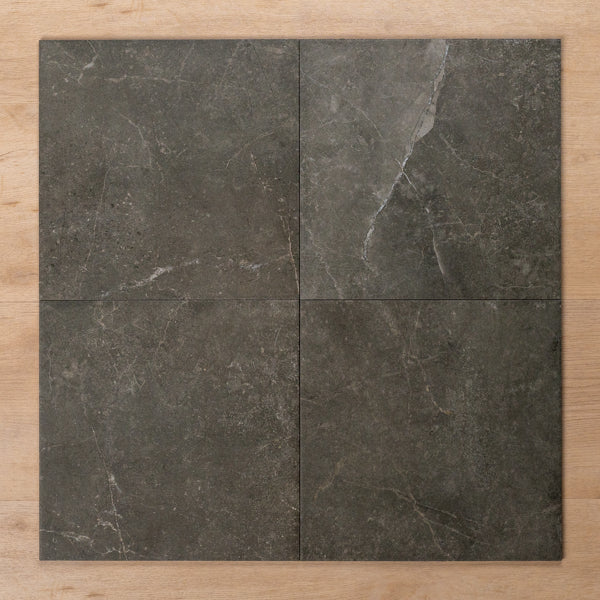
Avalon is a stone look porcelain described as having subtle vein movement through the tile, in white, greige, grey and charcoal, in matt, lappato and external versions. Kings Marble is a Carrara marble look in ceramic, and Perisher is a white marble look in 600 x 1200mm. For more marble looks, see the marble look tiles collection.
Tamarama is the only pattern range in the collection. It is a modern take on a classic encaustic pattern, in a matte finish on a 300 x 300mm tile. The Texture is Low, flat, the Edge is Non-Rectified, and the cushioned edge means the edges are naturally irregular.
The V1 appearance means each tile is uniform, so the pattern is the same from box to box. That suits a feature wall or a small floor where the pattern should repeat cleanly. A plain tile in a matching tone from the Avalon range makes a quiet partner for it, with the pattern doing the talking and the plain tile resting the eye. The Area line reads Indoors and covered outdoor areas, and the Wear Rating reads 4. Because the tile is 6.3mm thick, check the finished height against the floor beside it.
Southside comes in three sizes and is tough enough for busy living, working indoors and outside. The matt version is rated Walls and Floors, P2 with a Texture of Low, flat. The external version is P5 with a Texture of slight variation in texture. Both are non-rectified, with a recommended gap of over 3mm on the matt tile.
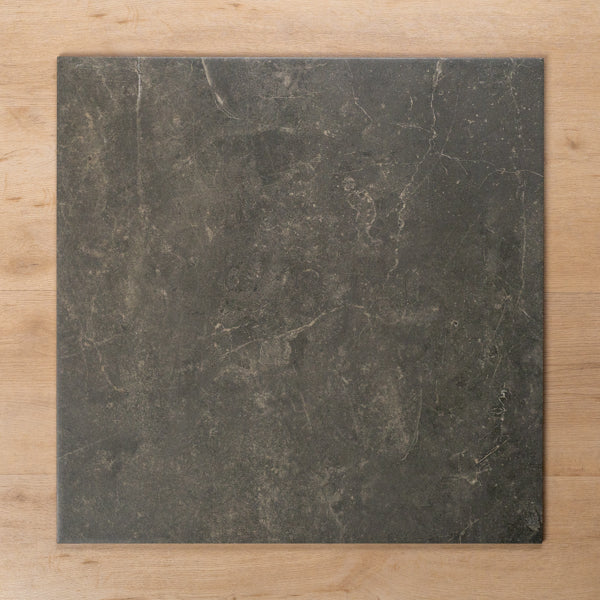
Avalon is the soft stone look, with subtle vein movement through the tile that makes an understated feature wherever it is used. It comes in matt, lappato and external versions, so one colour can run from a dry living floor to a covered outdoor area with the finish changing and the look staying the same.
Kings Marble is a Carrara marble look in ceramic with grey veining, in two finishes, matt and lappato. Both are non-rectified with a cushioned edge and a V3 appearance, and the Wear Rating is Wall Category 0. They are wall tiles, so match them with a floor tile from another range if the room needs one.
Perisher is a white marble look at 600 x 1200mm. It is an alternative to Statuario marble, one of Italy's most sought-after and high maintenance marbles. It is rectified, with a V3 appearance and moderate variation in colour and texture. It is the one range in the collection where a fine joint of 3mm or less is possible.
AS 4586 classifies the slip resistance of new pedestrian surface materials, and its wet pendulum test uses ratings from P0 to P5. The rating applies to floors people walk on, not to feature walls. The tiles here are tagged P2, P3 or P5, depending on the range and the version.
Tamarama is P3, moderate slip risk, and P3 or greater is recommended for wet areas such as bathrooms, kitchens and laundries. The Southside matt tile is P2, high slip risk, and is not recommended for wet areas. The external versions are P5. No single rating suits every room, so confirm what a wet area needs with your builder or tiler, and read the Slip Rating, Application and Area lines together.
The floor tiles collection and the outdoor tiles collection explain these ratings in more detail.
The porcelain tiles have a Wear Rating of 4, suitable for floors in normal use areas with a low risk of scratching. The Kings Marble tiles are Wall Category 0, intended for wall applications only and not suitable for flooring.
Perisher and Avalon suit wall and floor surfaces exposed to heavy duty wear by regular traffic in normal footwear, including entrances, laundries and patios. The Area line says where each can go: Tamarama is for indoors and covered outdoor areas, and the Southside matt tile is for indoor dry areas and covered outdoor areas.
For wall formats by size, see the wall tiles collection.
Most of the tiles in this collection are non-rectified, which gives a softer look and a wider joint. Leave a gap of over 3mm on the Southside matt tile, and use grout lines of 3mm or more on the cushioned edge tiles for a classic tiled appearance, since the edges are naturally irregular.
Perisher is the exception. The sharp edge tiles are accurately produced, allowing fine grout lines of 3mm or less, and Perisher is Rectified tile. It is also a 600 x 1200mm format, so it is the large tile in the collection. For more in that size, see the 600mm x 1200mm tiles collection and the large tiles collection.
The Appearance line shows how uniform each tile is. Tamarama reads V1, a uniform appearance. The Southside and Avalon tiles read V2, slight variation in pattern, and Kings Marble and Perisher read V3, moderate variation in colour and texture. A uniform tile gives a clean pattern repeat. A V3 tile has more movement from tile to tile, which suits a marble look.
Cushioned edge tiles install with similar colour and slight variation in texture and pattern. Open several boxes and mix the tiles as you lay, so the variation spreads across the surface.
The collection runs from 300 x 300mm to 600 x 1200mm. Most of the tiles are 450 x 450mm squares, which the 450mm x 450mm tiles collection covers in detail, with 600 x 600mm and 300 x 600mm tiles in Avalon and the 600 x 1200mm Perisher. The square tiles collection holds the squares by shape.
Thickness varies by range: Tamarama is 6.3mm, Southside is 7.5mm, and the Avalon external tiles are 9mm. Check the Thickness line when a tile will meet another floor surface, because a difference at the threshold is something to plan with your tiler.
Most of the tiles are tagged as floor tiles, a smaller group as wall tiles, and the external versions of Southside and Avalon carry an external application tag. A few listings add room tags for a bathroom wall, a bathroom floor, living areas and covered outdoor spaces. Tamarama's pattern tile is described as a feature wall or floor. The external versions are the ones to look at for an outdoor floor.
Choosing by room still comes back to the lines on the page: Application, Area, Slip Rating and Wear Rating. For room-led collections, see the bathroom tiles collection and the kitchen tiles collection.
Every product has a block of detail lines, and they are the quickest way to compare ranges. Dimensions gives the size and thickness. Finish gives the surface, which is matte on most of this collection. Slip Rating gives the P class where it is shown, and Application says whether the tile is for walls, floors or both.
Wear Rating says how much traffic the tile suits, Area says where it can go, and Edge says whether the tile is rectified. Texture and Appearance describe the surface and the variation from tile to tile. Not every product shows every line, and the older ones show fewer. Where a line is missing, ask the store before you plan around it.
A good habit is to read three lines first: Slip Rating, Area and Application. They decide whether a tile can go in the room at all, and the rest of the lines decide how it will look and how the joint is set.
Measure the length and width of the floor or wall in metres and multiply to get the area. Add 15 percent for breaks and offcuts, then divide by the coverage of one box and round up to the next whole box.
Here is a worked example for a bathroom floor of 3.2m by 2.4m, which is 7.68m2. With 15 percent added, the order is about 8.83m2. A box of Tamarama or Kings Marble 300 x 300mm holds 22 pieces and covers 1.98m2, so that floor needs 5 boxes. A box of Southside 450 x 450mm holds 7 pieces and covers 1.42m2, so the same floor needs 7 boxes. Walls follow the same steps, with the height taken to the top of the tiling and any window or door openings subtracted.
Round up rather than down. A tile from a later batch can differ slightly in colour and size, and a single missing box delays the job.
Porcelain suits a flexible cementitious adhesive, and a large tile such as Perisher at 600 x 1200mm is laid with the adhesive combed on the floor and also spread on the back of the tile so there are no hollows. A hollow under a tile cracks at the edge once the floor is in use. Wet areas need waterproofing by a licensed waterproofer before any tile goes down, and the tiler should confirm the substrate is flat and dry.
Tamarama, Southside and Avalon are all matte. A matte surface hides water marks, and it holds a little more grime in the texture than a gloss tile. Sweep or vacuum first, then mop with a pH-neutral cleaner and clean water. Avoid acid cleaners and abrasive pads on a glazed tile, and rinse any cleaner off so a film does not build up.
Pair these tiles with underfloor heating for a warmer, drier, mould-resistant bathroom. Porcelain carries heat well, and a warm floor dries faster after a shower. For a calm grey scheme, the Avalon greys sit alongside the grey tiles collection.
Order an extra 15 percent of tiles over the exact quantity required, to cover breaks and offcuts. Colour, size and texture may vary from batch to batch, so ordering enough at once lowers the chance of a mismatch if more is needed later. Keeping a few spare tiles for future repairs is also a good idea.
Installation must be carried out by a licensed tiler to the appropriate Australian standards. Share the product details with your tiler, including the joint recommendation, before the first tile is fixed.
Start with the look. For a pattern on a feature wall or a small floor, Tamarama is the encaustic style. For a terrazzo fleck, choose Southside. For a soft stone vein across a floor, choose Avalon. For a marble look on a wall, Kings Marble is the one listed for it, and for a large marble look floor tile, Perisher is the larger format.
Then check where it goes. Read the slip line first, then the Area line, then the Application line. Decide the joint last: wider for the non-rectified tiles, narrower for Perisher.
If the room mixes ranges, keep the finish and the joint consistent. Matte tiles from Tamarama, Southside and Avalon sit well together because they share a surface, and a tonal joint ties the pattern tile to the plain ones. Check the thickness lines before mixing, since Tamarama is 6.3mm and the Southside matt tile is 7.5mm, and the tiler will need to even the surfaces at each change.
If the origin label matters to your project, ask the store to confirm origin for each range. For other tiles by look and size, the tiles collection covers every shape and finish in the store.


