*View accurate shipping rates and availability






107 Items
A dummy handle gives a door something to push or pull and does nothing else. It has no latch, no spindle through the door and no lock. That makes it the right part for a wardrobe, a pantry or a linen press, and for the fixed leaf of a pair of French doors, where the door only needs a handle that matches the working ones around it. This guide covers what a dummy handle does, what holds the door shut in its place, how single and paired fitting differ, which numbers decide fit, and how the ranges in this collection differ in fixing, handing and material. The other two functions have their own pages: passage door handles and privacy door handles.
A dummy handle is a fixed, non-operational handle that does not operate a latch or lock. It gives you something to push or pull the door and lets the handle match the others in the house. A dummy is surface-mounted, with no latch, spindle or lock, so it does not turn and does not engage the frame. So the answer to the common question is no: a dummy handle does not turn. Its job is to be gripped and to look right.
One question sorts the three functions. Does turning this handle need to retract a latch or work a lock? If it does, the door needs a passage or privacy set. If it does not, a dummy is usually the right part. Dummy sets do not belong on bedrooms, bathrooms or the main locking point of an entry, because those doors need a working latch or lock.
The same few doors come up again and again. Wardrobes, linen presses, pantries and full-size cupboards that close on a catch are the usual ones. The Lane dummies suit cupboards, closets and pantries, and the Lockwood dummies suit wardrobes and linen cupboards.
The other common place is a pair of French doors. One leaf is active and carries the working latch. The other, the inactive or secondary leaf, is secured with bolts and needs no latch of its own, but a bare door beside a handled one looks unfinished. A dummy handle on the inactive leaf keeps the pair balanced. Two dummies can be used on the stationary leaf, one on each side. The working handles you would match them to are on door handles and interior door handles.
A dummy is fitted on one side of the door or on both. These are called a single or half dummy and a double or full dummy. The single type goes on the side where the user pulls the door open, and on the wrong side it is useless. The double type puts a matching handle on each face. The two are mounted independently and are not linked through the door.
Every product in this collection is one handle. The Lane Bala, Oxford, Westminster, Victoria, Buckingham, only one handle is included and ask for two in the cart if you want one on each side. The same. The Zanda Duke, Epic, Vienna and Zurich dummies come with one lever and a dummy fixing spindle in the box. Read the box line on each product page before you count how many you need.
A lever curves one way, so handing matters. If the lever on the active door curves left, a dummy on the next leaf looks wrong curving right. For double doors, order by handing, and pair a left-hand active set with a right-hand dummy of the same style.
The product pages differ, so read each one. The Lane Bala, Oxford, Westminster, Buckingham, non-handed, built to rotate into position for left and right hand doors. The Lane Victoria product page is titled left hand. The Zanda Duke Return, Oxford, non-handed, while the Zanda Duke, handing must be specified. The Nidus Collins dummy product page is titled right hand.
Four numbers decide fit: the cross bore, the door thickness, the backset and the rose size. The cross bore is the large hole through the door face. The Lane dummy levers and the Lane Bala dummy knob suit 50 to 54mm cross bore holes. The Lockwood Velocity rose suits 50 or 54mm holes.
Door thickness runs from 32 to 45mm on the Lane Bala and the Lockwood Velocity and Vivid products. Several Lane levers are 33 to 45mm, Lane Victoria and Avalon at 35 to 45mm, and Nidus Spring and Collins at 34 to 45mm. Zanda lists 35 to 45mm for Vertex and 35 to 53mm for Oxford and Baxter.
Backset is 60mm on the Zanda Vertex, Duke Return and Epic, and on Nidus Spring and Collins. Rose size is 54mm on Zanda Oxford and Epic and on the Lockwood Vivid, 63mm on the Lockwood Velocity, and 70mm on Nidus Spring and Collins. The Zanda Baxter has a 65mm rose that can be retrofitted over existing 55mm holes.
Some handles come fixed and some can be converted. A Taylors spindle, a short stub that screws to the door face, can turn a compatible handle into a fixed one by locating it and stopping it from operating. It works with compatible handles only. Converting a working knob means removing the mechanism and modifying the door, and a purpose-made dummy set is easier to fit.
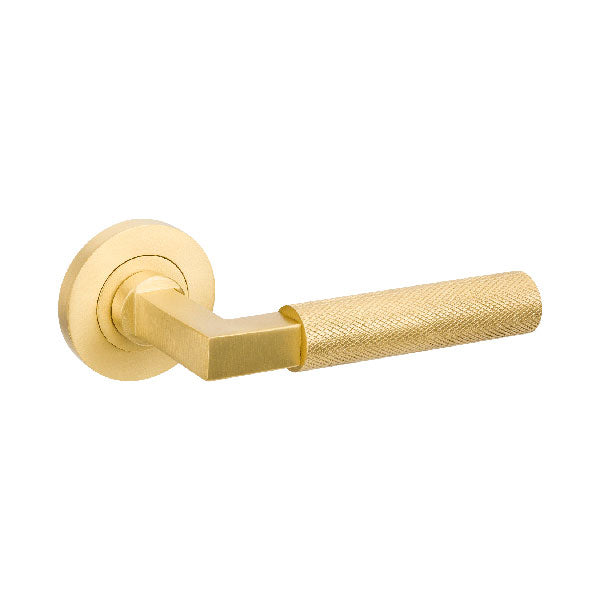
The Zanda dummies come with the fixing in the box. The Duke set is a half leverset with a dummy fixing spindle, a 54mm screw-on rose and through-door bolts. A knurled lever with concealed fixings. On a hollow-core door, drill pilot holes so the screws do not split the skin or miss the internal support.
A dummy gives itself away by sitting at the wrong height. The fix is to take the mounting height, backset and finish from the working handle on the paired door, and on a double door mirror the working side so both handles align. Small differences in height are easy to spot across repeated doors. Measure from the working handle, mark the dummy at the same height, and use a template if the maker supplies one.
Choose the dummy from the same series as the working handle where you can. One finish name can differ slightly between product lines, so the same range is the safer match. The Lockwood Vivid and Velocity series both include passage, privacy and dummy sets, which makes a matched set easy to build from one range.
This collection is mostly levers. Choose a lever over a round knob where grip matters, since a lever is easier to use without a firm grasp. A knob suits a traditional interior and matches knobs on the doors beside it. The Lane Bala dummy knob in this collection sits on a round rosette in several finishes. Knob questions, backplates included, are covered on dummy knobs, and the lever side on dummy levers. The wider ranges are on door levers and door knobs.
Each range has its own fixing, material and handing. Choose by those facts.
Match the dummy to the finish of the working handles on the neighbouring doors. The collection has matte black, brushed nickel, chrome, brushed brass, satin brass, bronze and gunmetal. Coordinate the dummy finish with nearby hinges and locks. A matching collection finish, so keep the working and dummy handles in one range.
The rest of the door is on door hardware, cabinet handles, door stops and door accessories. The working partners to your dummies are passage door handles and privacy door levers.
No. A dummy handle is fixed, with no spindle and no latch, so nothing moves when you push it. It is a pull or a trim piece, and the door is held shut by something else, such as a ball, roller or magnetic catch, or a bolt. Several product pages here describe the same thing: a lever with a fixing spindle that holds it in place without operating a latch.
A passage handle turns and retracts a latch, so the door opens when you press the lever. A dummy handle does not turn, so it only pulls the door once something else has released it. Passage sets are on passage door handles, and a dummy is the right choice where no latch is wanted.
The common uses are wardrobes, linen presses, pantries and cupboard doors held by a catch, and the inactive leaf of a pair of French doors. On a double door, one leaf carries a working handle and the other a matching dummy, with the inactive leaf secured by bolts. Advice on this does not recommend dummies on both leaves of a main entry, and they are not used on bedroom or bathroom doors.